UN’s top court opens Myanmar Rohingya genocide case

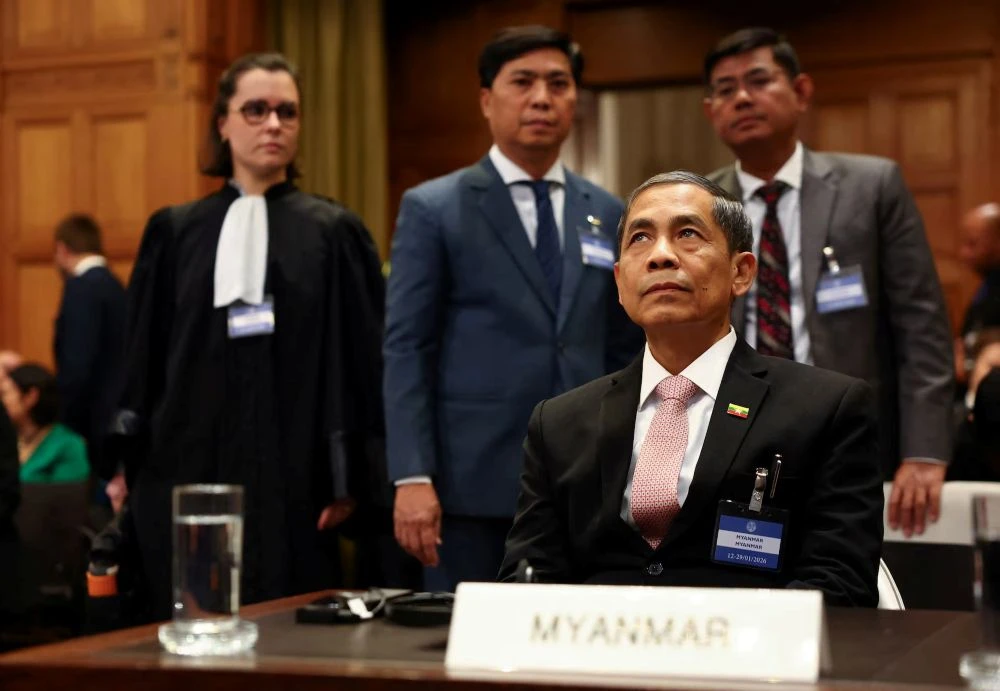
Myanmar Minister of International Cooperation Ko Ko Hlaing sits in the courtroom as the International Court of Justice starts hearings in a landmark case brought by Gambia, which accuses Myanmar of committing genocide against the Rohingya, The Hague, Netherlands, Jan. 12, 2026. (Reuters)
Short Url
Updated 12 January 2026
Follow

UN’s top court opens Myanmar Rohingya genocide case

  • The Gambia filed a case against Myanmar at the UN’s top court in 2019
  • Verdict expected to impact Israel’s genocide case over war on Gaza

DHAKA: The International Court of Justice on Monday opened a landmark case accusing Myanmar of genocide against its mostly Muslim Rohingya minority.

The Gambia filed a case against Myanmar at the UN’s top court in 2019, two years after a military offensive forced hundreds of thousands of Rohingya from their homes into neighboring Bangladesh.

The hearings will last three weeks and conclude on Jan. 29.

“The ICJ must secure justice for the persecuted Rohingya. This process should not take much longer, as we all know that justice delayed is justice denied,” said Asma Begum, who has been living in the Kutupalong refugee camp in Bangladesh’s Cox’s Bazar district since 2017.

A mostly Muslim ethnic minority, the Rohingya have lived for centuries in Myanmar’s western Rakhine state but were stripped of their citizenship in the 1980s and have faced systemic persecution ever since.

In 2017 alone, some 750,000 of them fled military atrocities and crossed to Bangladesh, in what the UN has called a textbook case of ethnic cleansing by Myanmar.

Today, about 1.3 million Rohingya shelter in 33 camps in Cox’s Bazar, turning the coastal district into the world’s largest refugee settlement.

“We experienced horrific acts such as arson, killings and rape in 2017, and fled to Bangladesh,” Begum told Arab News.

“I believe the ICJ verdict will pave the way for our repatriation to our homeland. The world should not forget us.”

A UN fact-finding mission has concluded that the Myanmar 2017 offensive included “genocidal acts” — an accusation rejected by Myanmar, which said it was a “clearance operation” against militants.

Now, there is hope for justice and a new future for those who have been displaced for years.

“We also have the right to live with dignity. I want to return to my homeland and live the rest of my life in my ancestral land. My children will reconnect with their roots and be able to build their own future,” said Syed Ahmed, who fled Myanmar in 2017 and has since been raising his four children in the Kutupalong camp.

“Despite the delay, I am optimistic that the perpetrators will be held accountable through the ICJ verdict. It will set a strong precedent for the world.”

The Myanmar trial is the first genocide case in more than a decade to be taken up by the ICJ. The outcome will also impact the genocide case that Israel is facing over its war on Gaza.

“The momentum of this case at the ICJ will send a strong message to all those (places) around the world where crimes against humanity have been committed,” Nur Khan, a Bangladeshi lawyer and human rights activist, told Arab News.

“The ICJ will play a significant role in ensuring justice regarding accusations of genocide in other parts of the world, such as the genocide and crimes against humanity committed by Israel against the people of Gaza.”
Rubio says technical talks with Denmark, Greenland officials over Arctic security have begun

Updated 29 January 2026
Follow

Rubio says technical talks with Denmark, Greenland officials over Arctic security have begun

  • US Secretary of State on Wednesday appeared eager to downplay Trump’s rift with Europe over Greenland

WASHINGTON: Technical talks between the US, Denmark and Greenland over hatching an Arctic security deal are now underway, Secretary of State Marco Rubio said on Wednesday.
The foreign ministers of Denmark and Greenland agreed to create a working group aimed at addressing differences with the US during a Washington meeting earlier this month with Vice President JD Vance and Rubio.
The group was created after President Donald Trump’s repeated calls for the US to take over Greenland, a Danish territory, in the name of countering threats from Russia and China — calls that Greenland, Denmark and European allies forcefully rejected.
“It begins today and it will be a regular process,” Rubio said of the working group, as he testified before the Senate Foreign Relations Committee. “We’re going to try to do it in a way that isn’t like a media circus every time these conversations happen, because we think that creates more flexibility on both sides to arrive at a positive outcome.”
The Danish Foreign Ministry said Wednesday’s talks focused on “how we can address US concerns about security in the Arctic while respecting the red lines of the Kingdom.” Red lines refers to the sovereignty of Greenland.
Trump’s renewed threats in recent weeks to annex Greenland, which is a semiautonomous territory of a NATO ally, has roiled US-European relations.
Trump this month announced he would slap new tariffs on Denmark and seven other European countries that opposed his takeover calls, only to abruptly drop his threats after a “framework” for a deal over access to the mineral-rich island was reached, with NATO Secretary-General Mark Rutte’s help. Few details of the agreement have emerged.
After stiff pushback from European allies to his Greenland rhetoric, Trump also announced at the World Economic Forum in Davos, Switzerland, last week that he would take off the table the possibility of using American military force to acquire Greenland.
The president backed off his tariff threats and softened his language after Wall Street suffered its biggest losses in months over concerns that Trump’s Greenland ambitions could spur a trade war and fundamentally rupture NATO, a 32-member transatlantic military alliance that’s been a linchpin of post-World War II security.
Rubio on Wednesday appeared eager to downplay Trump’s rift with Europe over Greenland.
“We’ve got a little bit of work to do, but I think we’re going to wind up in a good place, and I think you’ll hear the same from our colleagues in Europe very shortly,” Rubio said.
Rubio during Wednesday’s hearing also had a pointed exchange with Sen. Tim Kaine, D-Virginia, about Trump repeatedly referring to Greenland as Iceland while at Davos.
“Yeah, he meant to say Greenland, but I think we’re all familiar with presidents that have verbal stumbles,” Rubio said in responding to Kaine’s questions about Trump’s flub — taking a veiled dig at former President Joe Biden. “We’ve had presidents like that before. Some made a lot more than this one.”