

Le Pen: French far-right leader battling for political survival

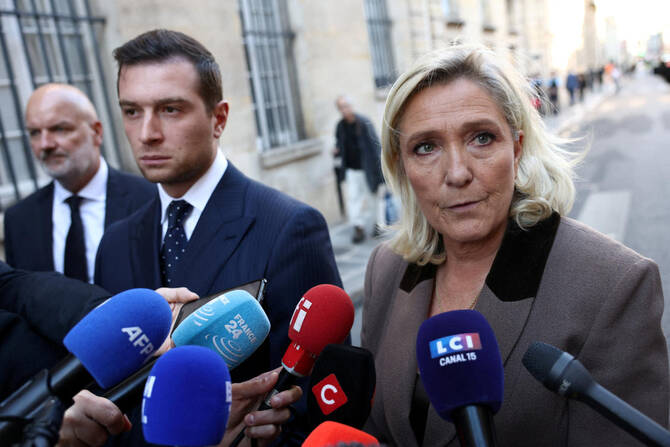
French far-right leader and member of parliament Marine Le Pen, President of the French far-right National Rally party parliamentary group talk to journalists in Paris, Sept. 17, 2025. (Reuters/File)
Short Url
Updated 09 January 2026
Follow

Le Pen: French far-right leader battling for political survival

  • Le Pen has said prosecutors wanted her “political death,” adding that she was being put on trial as a “political target“
  • Her life has been marked by the legacy of her outwardly racist father

PARIS: Far-right leader Marine Le Pen, who needs to have a graft conviction overturned to seize her best chance at the French presidency, risks seeing her life’s work upended if she loses her appeal.
Le Pen took over leadership of the National Front (FN) in 2011 from her father Jean-Marie, who co-founded France’s main postwar far-right movement.
In a move to distance it from the legacy of her father, who openly made antisemitic and racist statements, she renamed the party the National Rally (RN) and embarked on a policy she dubbed “de-demonization.”
The work bore fruit. In snap legislative polls in summer 2023, the RN emerged as the largest single party in the National Assembly — although without the outright majority it had targeted.
That gave Le Pen’s party power over French politics it had never before enjoyed, which she used by backing a no-confidence vote that toppled the government of prime minister Michel Barnier later in the year.
Critics accuse the party of still being inherently racist, taking too long to distance itself from Russia after its invasion of Ukraine and resorting to corrupt tactics to ease its strained finances, allegations Le Pen denies.
But by playing on people’s day-to-day concerns about immigration and the cost of living, Le Pen was seen as having her best chance to become France’s president in 2027 after three unsuccessful attempts.

- ‘Political target’ -
But her conviction last year, involving the use of fake jobs at the European Union parliament to channel funds to her party to employ people in France, has posed a potentially insurmountable hurdle to her long-sought end goal.
She was banned with immediate effect from standing for office for five years, which effectively disqualified her from running in next year’s presidential election.
Le Pen, 57, has said prosecutors wanted her “political death,” adding that she was being put on trial as a “political target.”
With her own ambitions hanging in the balance, she has backed her young lieutenant and protege, 30-year-old Jordan Bardella, to run in her place if needed.
“Bardella can win instead of me,” she told La Tribune Dimanche in December.
A poll in November predicted that Bardella — who is the RN party chief and not among those accused in the trial against Le Pen — would win the second round of the 2027 elections, no matter who stands against him.

- ‘Immense pain’ -
After coming third in the 2012 presidential polls, Marine Le Pen made the run-off in 2017 and 2022 but was beaten by Emmanuel Macron on both occasions.
Yet 2027 could be different, with Macron not allowed to stand again under France’s constitution.
Le Pen’s life has been marked by the legacy of her outwardly racist father, a veteran of the long war in Algeria that ultimately led to the former French colony’s independence.
She expelled her father, who once called the gas chambers of the Holocaust a “detail of history,” from the party in 2011, helping to temper its toxic image.
But his death last year aged 96 plunged his daughter into grief.
“I will never forgive myself” for expelling him, she said, describing him as a “warrior” in a tribute.
“I know it caused him immense pain,” she said of the man opponents nicknamed “the devil of the republic.”
“This decision was one of the most difficult of my life. And until the end of my life, I will always ask myself the question: ‘Could I have done this differently?’,” she said.


India, Arab League target $500bn in trade by 2030

Updated 6 sec ago
Follow

India, Arab League target $500bn in trade by 2030

  • It was the first such gathering of India–Arab FMs since the forum’s inauguration in 2016
  • India and Arab states agree to link their startup ecosystems, cooperate in the space sector

NEW DELHI: India and the Arab League have committed to doubling bilateral trade to $500 billion by 2030, as their top diplomats met in New Delhi for the India–Arab Foreign Ministers’ Meeting. 

The foreign ministers’ forum is the highest mechanism guiding India’s partnership with the Arab world. It was established in March 2002, with an agreement to institutionalize dialogue between India and the League of Arab States, a regional bloc of 22 Arab countries from the Middle East and North Africa.

The New Delhi meeting on Saturday was the first gathering in a decade, following the inaugural forum in Bahrain in 2016.

India’s Foreign Minister S. Jaishankar said in his opening remarks that the forum was taking place amid a transformation in the global order.

“Nowhere is this more apparent than in West Asia or the Middle East, where the landscape itself has undergone a dramatic change in the last year,” he said. “This obviously impacts all of us, and India as a proximate region. To a considerable degree, its implications are relevant for India’s relationship with Arab nations as well.”

Jaishankar and his UAE counterpart co-chaired the talks, which aimed at producing a cooperation agenda for 2026-28.

“It currently covers energy, environment, agriculture, tourism, human resource development, culture and education, amongst others,” Jaishankar said.

“India looks forward to more contemporary dimensions of cooperation being included, such as digital, space, start-ups, innovation, etc.”

According to the “executive program” released by India’s Ministry of External Affairs, the roadmap agreed by India and the League outlined their planned collaboration, which included the target “to double trade between India and LAS to US$500 billion by 2030, from the current trade of US$240 billion.”

Under the roadmap, they also agreed to link their startup ecosystems by facilitating market access, joint projects, and investment opportunities — especially health tech, fintech, agritech, and green technologies — and strengthen cooperation in space with the establishment of an India–Arab Space Cooperation Working Group, of which the first meeting is scheduled for next year.

Over the past few years, there has been a growing momentum in Indo-Arab relations focused on economic, business, trade and investment ties between the regions that have some of the world’s youngest demographics, resulting in a “commonality of circumstances, visions and goals,” according to Muddassir Quamar, associate professor at the School of International Studies, Jawaharlal Nehru University.

“The focus of the summit meeting was on capitalizing on the economic opportunities … including in the field of energy security, sustainability, renewables, food and water security, environmental security, trade, investments, entrepreneurship, start-ups, technological innovations, educational cooperation, cultural cooperation, youth engagement, etc.,” Quamar told Arab News.

“A number of critical decisions have been taken for furthering future cooperation in this regard. In terms of opportunities, there is immense potential.”