

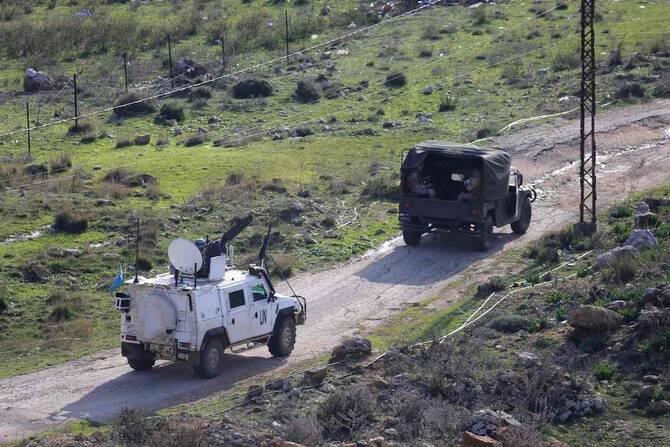


BEIRUT/JERUSALEM: The Lebanese army said on Thursday it had taken operational control in the south of the country, but Israel said efforts to disarm Hezbollah fighters were insufficient, raising pressure on Lebanese leaders who fear Israel could escalate strikes.
Lebanon has been seeking to place all arms under state control, in line with a November 2024 US-brokered ceasefire that ended war between Israel and the Iran-backed Shiite Muslim group Hezbollah. Israel says the truce requires the complete disarmament of Hezbollah, which was badly weakened by its strikes.
The army had set a deadline to clear non-state weaponry from the southern area near the Israeli border by the end of 2025, before moving on to other areas of the country.
It said on Thursday it had achieved that initial goal, securing areas south of the Litani River, excluding positions still held by Israeli forces, though there was more work to be done clearing unexploded ordnance and tunnels.
Hezbollah trying to rearm
Israeli Prime Minister Benjamin Netanyahu’s office said the efforts by Lebanon’s government and army were “an encouraging beginning.”
But it added: “They are far from sufficient, as evidenced by Hezbollah’s efforts to rearm and rebuild its terror infrastructure with Iranian support.”
Hezbollah’s disarmament was “imperative for Israel’s security and Lebanon’s future,” it said.
Israel has been conducting near-daily strikes in the south and sometimes more widely in Lebanon, accusing Hezbollah of trying to reestablish infrastructure, and Beirut of failing to uphold the ceasefire.
In a written statement on Thursday, Hezbollah’s parliamentary bloc said Lebanon had fulfilled its obligations under the ceasefire deal. It said Lebanon’s government should avoid making concessions to Israel and “exert all possible pressure” to compel Israel to halt attacks and withdraw troops.
So far, Hezbollah has not obstructed the Lebanese army’s clearing operations in southern Lebanon. But the group refuses to disarm in full and says the agreement does not apply to the rest of Lebanon.
'Decisions of war and peace'
Lebanon’s cabinet said the army must continue working on a state monopoly on arms in the rest of the country “as quickly as possible.” The army had previously proposed a phased plan in which it would clear unauthorized weapons caches region by region, moving north and east through the country.
The cabinet said the army commander would brief the cabinet in February on his plan for clearing the next region — a swathe of territory that lies between the Litani River and Beirut.
President Joseph Aoun said that the army deployment in the south aimed to affirm the principle that “decisions of war and peace” belonged to the state alone, and “to prevent the use of Lebanese territory as a starting point for any hostile acts.”
He said lasting stability would depend on addressing issues including the presence of Israeli troops.
Hezbollah has fought numerous conflicts with Israel since it was founded by Iran’s Revolutionary Guards in 1982. It kept its arms after the end of Lebanon’s 1975-1990 civil war, using them against Israeli troops who occupied the south until 2000.
The Lebanese military, which receives US support, has stayed out of conflicts between Hezbollah and Israel.
UN welcomes army control
UN Special Coordinator for Lebanon Jeanine Hennis-Plasschaert said it was “great to see” the army had “assumed operational control south of the Litani.”
“This is undeniable progress. Hard work lies ahead,” she wrote on X.
A Lebanese security source told Reuters that the army’s statement signalled that no group would be able to launch attacks from southern Lebanon.
Hezbollah opened fire in support of its Palestinian ally Hamas at the start of the Gaza war in 2023, and traded fire across the border until Israel went on the offensive in 2024, killing the group’s leaders and destroying much of its arsenal.
In a statement, Parliament Speaker Nabih Berri, a Hezbollah ally, affirmed support for the army and “its achievements which would have been nearly complete were it not for Israel’s occupation of numerous locations and its daily violations.”


