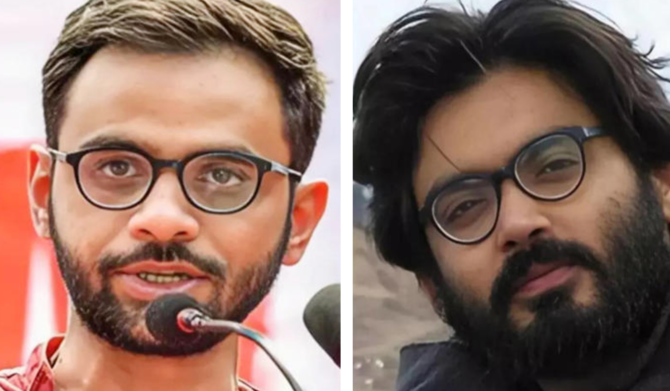
India’s top court denies bail to 2 Muslim activists after 5 years in jail without trial

Umar Khalid (L) and Sharjeel Imam. (Supplied)
Short Url
Updated 06 January 2026
Follow

India’s top court denies bail to 2 Muslim activists after 5 years in jail without trial

  • The two student activists were a leading voice in nationwide protests against the citizenship law, which marked one of the most significant challenges to Prime Minister Narendra Modi’s Hindu nationalist government
  • Amnesty International in a statement last year said Khalid’s “imprisonment without trial exemplifies derailment of justice” and is “emblematic of a broader pattern of repression faced by those who dare to exercise their rights to freedom of expression”

NEW DELHI: India’s Supreme Court on Monday denied bail to two Muslim student activists who have spent years in detention without trial over a conspiracy case linked to one of the country’s deadliest outbreaks of religious violence.
Umar Khalid and Sharjeel Imam were arrested five years ago under India’s harsh state security law and accused of conspiring to incite the communal violence that swept parts of Delhi in February 2020. The riots left 53 people dead, most of them Muslims, and took place amid massive months-long protests against a controversial 2019 citizenship law that critics said discriminated against Muslims.
While bail was granted to the other five accused in the same case, the court noted that Khalid and Imam had a “central role in the conspiracy.” It also said that the delay in their trial was not a sufficient ground for granting them bail.
“Umar Khalid and Sharjeel Imam stand on a qualitatively different footing as compared to other accused,” the Supreme Court said in its verdict, according to Bar and Bench, a legal news website.
The two student activists were a leading voice in nationwide protests against the citizenship law, which marked one of the most significant challenges to Prime Minister Narendra Modi’s Hindu nationalist government. Their detention has been widely seen as emblematic of a broader crackdown on dissent under Modi, drawing criticism from rights groups over the use of anti-terror laws against activists and student leaders.
In the months following the riots, police charged several activists and organizers, including Khalid and Imam, under the Unlawful Activities (Prevention) Act, that in the past was used only to quell violent insurgencies but under Modi has been largely used to silence political opposition. Activists and other dissenters targeted under the law can be held in pretrial detention almost indefinitely, often resulting in years of detention until the completion of trial.
Prosecutors representing the Delhi police had strongly opposed Khalid and Imam’s bail request, arguing that the violence was not a spontaneous outbreak but a deliberate plot intended to tarnish India’s global image, and that they made provocative speeches and instigated violence. Khalid and Imam’s lawyers argue that there is no evidence linking them to the violence and deny the charges against them.
Dozens of other Muslims were also charged in similar cases related to the riots and held under prolonged detention. Some of those cases later unraveled because police were unable to provide evidence linking many detainees to the riots.
Last week, eight US lawmakers wrote to India’s ambassador in Washington expressing concern over Khalid’s prolonged pretrial detention. They urged Indian authorities to grant him a fair and timely trial.
International human rights groups have also repeatedly urged Khalid and Imam’s release, saying their detention suppresses dissent and breaches fundamental legal protections.
Amnesty International in a statement last year said Khalid’s “imprisonment without trial exemplifies derailment of justice” and is “emblematic of a broader pattern of repression faced by those who dare to exercise their rights to freedom of expression.”


Indonesia threatens to ban Musk’s Grok AI over degrading images of children and women

Updated 07 January 2026
Follow

Indonesia threatens to ban Musk’s Grok AI over degrading images of children and women

  • Grok has been complying with user requests to alter images of real people  
  • Other countries, including Malaysia and France, have also threatened action against X 

JAKARTA: Indonesia’s Communications Ministry threatened on Wednesday to ban Elon Musk’s X and its artificial intelligence chatbot Grok after degrading pictures of women and children generated without consent surged on the social media platform. 

Grok has been complying with requests from X users to modify images of real women and children stripped to their underwear, creating a viral trend that has sparked concerns across the globe. 

A preliminary investigation found that Grok “does not yet have explicit and adequate regulations to prevent the production and distribution of pornographic content based on real photos” of Indonesian citizens,” Indonesia’s Ministry of Communications and Digital Affairs said in a statement. 

Indonesia has strict laws against the production and distribution of pornography, with the government regularly instructing internet service providers to block access to websites containing such content. 

“The obligation to comply with Indonesian laws and regulations applies to all digital platforms operating in Indonesia,” the ministry said. 

“Should there be non-compliance or lack of cooperation, the Ministry of Communications and Digital Affairs may impose administrative sanctions, including termination of access to Grok’s AI services and the X platform.” 

Indonesia has joined a growing list of countries, which includes Malaysia, India and France, that are calling for investigations and threatening action against Grok.

Concerns grew after a December update to the chatbot made it easier for users to post photographs of people and ask for their clothing to be removed.

In a report published on Tuesday, European non-profit organization AI Forensics said Grok is “systematically ‘undressing’ women.”  

Its analysis of 20,000 images generated by Grok between Dec. 25 and Jan.1 found that 53 percent of them contained individuals in minimal attire, with 81 percent of them being women, while two percent of the images depicted persons appearing to be 18 years old or younger. 

Indonesia’s Communications Ministry said AI service providers and users are also subject to administrative or criminal sanctions under Indonesian law if they are proven to have produced or distributed pornographic content or modified personal images without permission. 

“Every digital platform must ensure that the technology they provide does not become a medium for privacy violation, sexual exploitation or the degradation of a person’s dignity,” said Alexander Sabar, director-general of digital space at the ministry.  

“We urge all parties to use artificial intelligence technology responsibly. The digital space is not a lawless space; every citizen’s privacy and right to their image must be respected and protected.”