

Pakistan stocks hit record high on UAE investment optimism

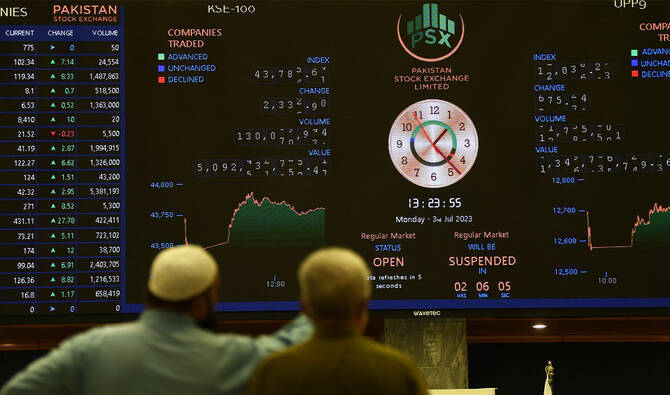
Stockbrokers monitor the latest share prices at the Pakistan Stock Exchange (PSE) in Karachi on July 3, 2023. (AFP/File)
Short Url
Updated 29 December 2025
Follow

Pakistan stocks hit record high on UAE investment optimism

  • Pakistan is in talks with the UAE to convert its $1 billion loan into equity investment
  • The KSE-100 index on Monday gained 1,495.61 points to close at 173,896.34 points

ISLAMABAD: The Pakistan Stock Exchange (PSX) on Monday closed at an all-time high of 173,896 points, traders and analysts said, attributing it to investor confidence in a prospective United Arab Emirates (UAE) investment in a Pakistani conglomerate, Fauji Foundation.

The benchmark KSE-100 index gained 1,495.61 points, or 0.87%, to close at 173,896.34, up from the previous close of 172,400.73. The index crossed 174,000 points during intra-day trading, with Pakistan's Finance Adviser Khurram Schehzad calling it a "strong start" to the week.

Ahsan Mehanti, Chief Executive Officer of Arif Habib Commodities, said the government’s deliberation on the privatization of ailing state-owned enterprises, rupee stability, and surging crude oil prices also played a catalytic role in the bullish trend.

"Stocks closed all-time high as investor eye UAE $1 billion rollover liability set to end [by] acquiring shareholding in Fauji Foundation," he told Arab News.

The development came days after Pakistan's Deputy Prime Minister Ishaq Dar said the country was seeking to convert part of its financial support from the UAE into long-term investment to reduce external debt.

Pakistan has been in talks with the UAE to convert its $1 billion loan in deposits into equity investment, potentially involving stakes in companies linked to the Fauji Fertilizer Group — a move that would eliminate Pakistan’s repayment obligation.

Since Jan 2025, the PSX has delivered more than 50% returns in US dollar terms, making it one of the best markets in Asia, with 2025 being another year of strong gains for investors, according to Schehzad.

"Investor participation is rising fast — the equity investor base has crossed 450,000, up 120,000+ investors (+37%) in 18 months," he said on X.

"These record levels reflect growing investor confidence, supported by continued macro stability, key reforms, and improving prospects for more sustainable, higher future growth."

In recent years, Pakistan has implemented stringent structural reforms under the International Monetary Fund (IMF) loan programs, aimed at reducing fiscal deficits and restoring investor confidence.

The South Asian country’s foreign exchange reserves have also risen past the $21 billion mark, according to the central bank’s latest data.


Pakistan reviews austerity measures amid Middle East crisis, urges strict nationwide implementation

Updated 11 March 2026
Follow

Pakistan reviews austerity measures amid Middle East crisis, urges strict nationwide implementation

  • Deputy Prime Minister Ishaq Dar chairs review meeting of austerity steps
  • Officials briefed on salary cuts, school closures, four‑day week, petrol conservation

ISLAMABAD: Pakistan’s government on Wednesday assessed progress on a sweeping set of austerity measures introduced to mitigate the country’s economic strain from sharply rising global oil prices and supply disruptions linked to the ongoing war in the Middle East.

Prime Minister Shehbaz Sharif this week announced a series of austerity steps, including a four‑day work week for government offices, requiring 50  percent of staff to work from home, cutting fuel allowances for official vehicles by half, grounding up to 60  percent of the government fleet and closing all schools for two weeks to conserve fuel amid the global oil crisis.

The measures were unveiled in response to global oil market volatility triggered by the conflict involving the United States, Israel and Iran, which has disrupted supply routes such as the Strait of Hormuz and pushed crude prices sharply higher, straining Pakistan’s heavily import‑dependent energy sector.

“The meeting stressed the importance of strict and transparent adherence to the austerity measures, promoting fiscal responsibility and prudent use of public resources,” Deputy Prime Minister and Foreign Minister Senator Mohammad Ishaq Dar said in a statement.

He was chairing a meeting of the Committee for Monitoring and Implementation of Conservation and Additional Austerity Measures, constituted under the directions of the PM, bringing together federal and provincial officials to review execution of the broad cost‑cutting plan. 

Dar emphasized the government’s commitment to enforcing the PM’s austerity steps nationwide. The committee’s review also covered reductions in departmental expenditure, deductions from salaries of senior officials earning over Rs. 300,000 ($1,120), and coordination with provincial administrations to ensure uniform implementation of the plan.

Participants at the meeting reiterated that all ministries and divisions must continue strict monitoring and reporting, with transparent oversight mechanisms, as Pakistan navigates the economic pressures from the prolonged Middle East crisis and its fallout on global energy and trade markets.