If India doesn’t want handshakes, Pakistan has no desire for it either— PCB
If India doesn’t want handshakes, Pakistan has no desire for it either— PCB /node/2627722/pakistan
If India doesn’t want handshakes, Pakistan has no desire for it either— PCB
India’s Abhishek Sharma and Pakistan’s Haris Rauf (right) exchange words during the Asia Cup cricket match between India and Pakistan at Dubai International Cricket Stadium in Dubai, United Arab Emirates, on September 21, 2025. (AP/File)
ISLAMABAD: Pakistan Cricket Board (PCB) Chairman Mohsin Naqvi recently criticized the Indian cricket team’s “no-handshake” policy, saying Pakistani cricketers will also refrain from the friendly gesture if it persists.
The Indian cricket team has refused to shake hands with their Pakistani counterparts in recent matches between the two sides. This policy made headlines worldwide in September when the two sides met for the Asia Cup 2025 in three cricket matches, with the Indian team refusing to shake hands with Pakistani team members each time.
India’s new policy to not shake hands with Pakistani cricketers took place months after the two nuclear-armed neighbors clashed in a four-day military conflict in May. Washington eventually intervened and brokered a ceasefire on May 10 after four days of conflict.
“If they do not want to do handshakes, then we also have no desire for it either,” Naqvi told reporters at a press conference on Sunday.
The PCB chairman, who is also Pakistan’s interior minister, said cricket matters related to India will be decided on an “equal footing.”
“It won’t happen that they do one thing and we beg them in return,” Naqvi said. “This won’t happen.”
Pakistan’s Under-19 squad this month defeated India in a one-sided final for the U-19 Asia Cup tournament in Dubai.
Pakistan’s senior men’s cricket team is set to face India in Sri Lanka on Feb. 15 in a group stage clash for the ICC T20 World Cup 2026.
QUETTA/ISLAMABAD: Dozens of militants and security personnel and policemen were killed as Pakistani security forces repulsed coordinated attacks by separatist militants in the southwestern Balochistan province, officials said on Saturday, in the latest incident of violence in the insurgency-hit region.
Separatist militants, affiliated with the Balochistan Liberation Army (BLA), launched “coordinated” attacks in several cities of Balochistan early Saturday, according to a senior police official, who requested anonymity.
The attacks in the provincial capital of Quetta began at around 6am with a powerful explosion, followed by intense gunfire that lasted for two hours along with multiple explosions. Residents of Dalbandin and Nuhski said they heard explosions and gunfire, while similar attacks were launched in Mastung, Gwadar, Pasni and Turbat.
A security official said Pakistani forces had repulsed the attacks and killed 37 “Indian-backed militants,” who were in continuous contact with “their handlers in Afghanistan.” Islamabad has frequently blamed such attacks on India and Afghanistan, an allegation consistently denied by Kabul and New Delhi.
“The terrorists of Fitna Al-Hindustan (Indian-backed Baloch separatist groups) launched coordinated attacks this morning at more than 12 locations, including Quetta, Noshki, Dalbandin, Pasni, and Gwadar,” the security official said.
“In these attacks, 37 terrorists have been eliminated. Throughout the operation, the terrorists were reportedly in continuous contact with their handlers in Afghanistan. Ten security personnel were martyred while few others were injured.”
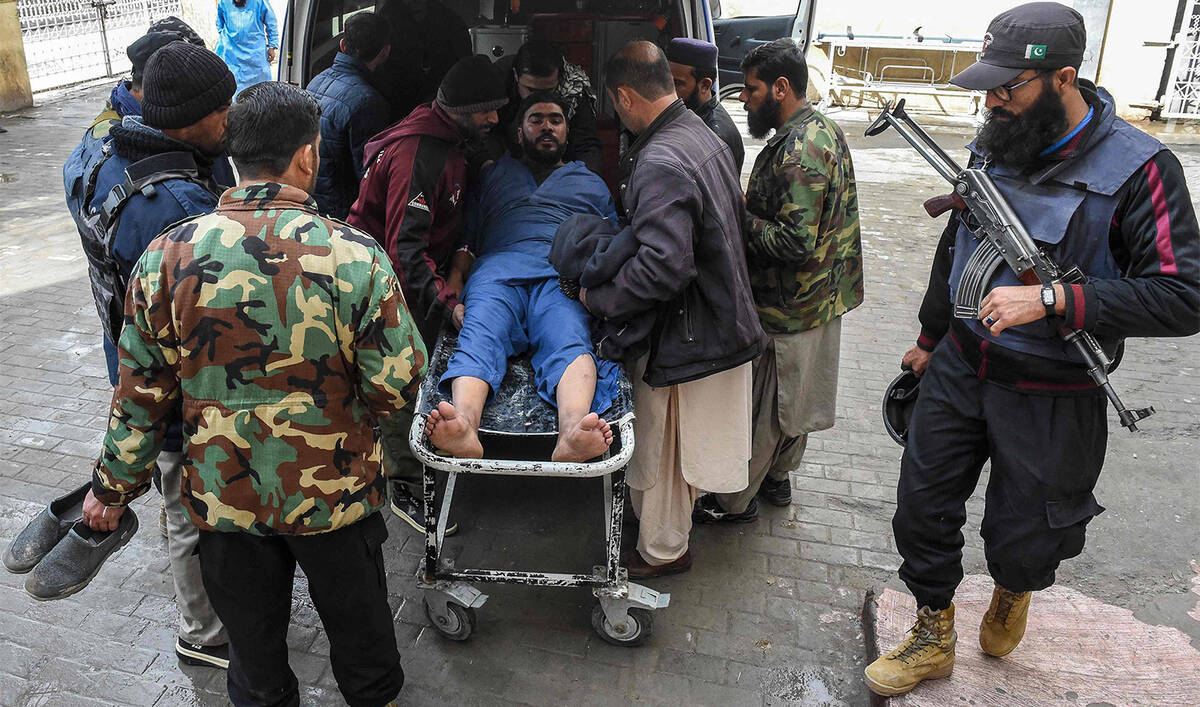
Security personnel shift an injured man at a hospital in Quetta on January 31, 2026, following an attack by Baloch separatists. Ethnic Baloch separatists launched "coordinated" attacks across Pakistan's Balochistan province on January 31, killing at least four policemen, officials said, the latest violence in insurgency-hit southwest region. (AFP)
A senior official at the Civil Hospital in Quetta told Arab News they had received 15 bodies, including nine policemen.
“Eight injured with bullet wounds were brought to the hospital,” said the official, who spoke on condition of anonymity. “Five of them were later shifted to the Combined Military Hospital (CMH) Quetta.”
Balochistan, which borders Iran and Afghanistan, is the site of a decades-long insurgency waged by Baloch separatist groups who often attack security forces and foreigners, and kidnap government officials.
Shahid Rind, the Balochistan chief minister’s aide for media and political affairs, said police and paramilitary Frontier Corps (FC) had foiled the attacks and were chasing the assailants.
“After the killing of more than 70 terrorists at different places in Balochistan in the last two days, terrorists have attempted to attack at a few places in Balochistan, which have been foiled by timely action by the police and FC,” he said on X.
“At present, the pursuit of the fleeing terrorists is underway. More details will be revealed very soon.”
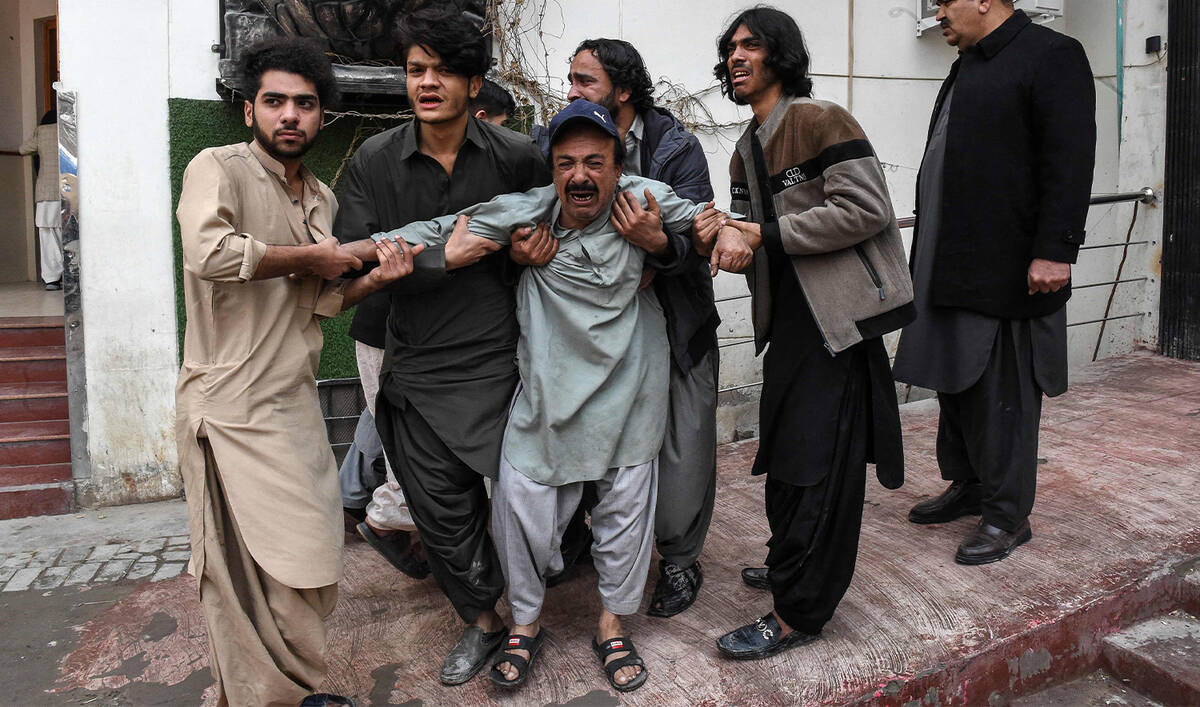
Family members mourn the death of a relative killed in an attack by Baloch separatists, at a hospital in Quetta on January 31, 2026. Ethnic Baloch separatists launched "coordinated" attacks across Pakistan's Balochistan province on January 31, killing at least four policemen, officials said, the latest violence in insurgency-hit southwest region. (AFP)
In a statement issued on Saturday, BLA said the group had launched ‘Operation Herof 2.0,’ which included a series of attacks in multiple cities of Balochistan.
Saturday’s attacks follow coordinated attacks carried out by the group in Aug. 2024 in various districts of Balochistan which killed dozens of people.
The separatists accuse the central government of stealing the region’s resources to fund development elsewhere in the country. The Pakistani government denies the allegations and says it is working for the uplift of local communities in Balochistan.
Pakistan Railways suspended train service from Balochistan to other parts of the country for a day, following Saturday’s attacks.
“Quetta-Peshawar bound Jaffar Express, and Quetta-Chaman passenger trains have been canceled due to the prevailing security situation in Balochistan,” Muhammad Kashif, the railways controller in Quetta division, told Arab News.