Myanmar’s sham election will entrench conflict — and ASEAN will share the blame

https://arab.news/56rqx
Myanmar’s military junta is once again promising elections as a pathway out of national crisis. After more than three years of civil war, economic collapse and state fragmentation, the regime led by Min Aung Hlaing claims that a vote can restore order and legitimacy. In reality, the proposed election risks deepening the conflict, entrenching military rule under a civilian disguise and exposing the failure of regional diplomacy — particularly by ASEAN and Myanmar’s immediate neighbors.
Since the February 2021 coup, Myanmar has ceased to function as a unified state. According to UN estimates, more than 3 million people are now internally displaced, a figure that has more than tripled since mid-2023 as fighting has intensified across central Myanmar, Rakhine State and the northern borderlands. The economy has contracted by an estimated 18 to 20 percent since the coup, while the kyat has lost more than 60 percent of its value, wiping out household savings and pushing millions into food insecurity.
Crucially, the military no longer controls much of the country. Resistance forces aligned with the National Unity Government operate across large areas of Sagaing, Magway and Chin State. Ethnic armed organizations have consolidated territorial control in border regions. In Rakhine State, the Arakan Army now exercises effective authority over most townships, running courts, taxation and local administration independently of Naypyidaw. Any “national” election conducted under these conditions would, by definition, exclude millions of people living outside junta control.
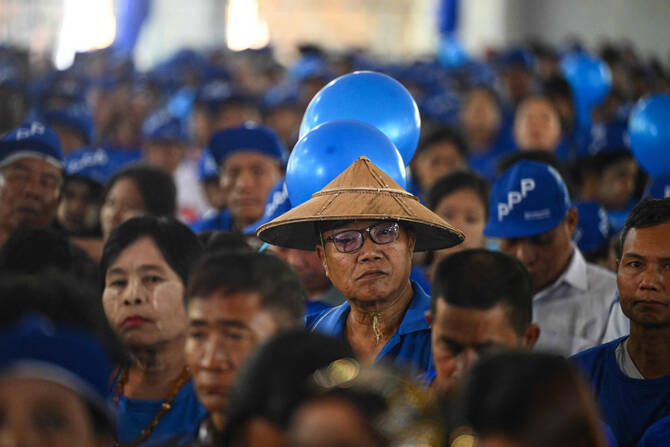
The junta’s plan is not to resolve this fragmentation, but to formalize it on its own terms. Elections would be held only in areas deemed secure, effectively disenfranchising populations in contested regions while rewarding loyalty to the military. Even in junta-held areas, basic conditions for a credible vote do not exist. Independent media has been dismantled, thousands of political prisoners remain behind bars, and opposition parties have been dissolved or intimidated into submission.
Elections would be held only in areas deemed secure, effectively disenfranchising populations in contested regions.
Dr. Azeem Ibrahim
History offers little reason for optimism. Under Myanmar’s previous military-designed political system, the armed forces retained decisive power regardless of electoral outcomes. When the National League for Democracy won decisively, the generals ultimately nullified the result through force. Today, the military is weaker, more isolated and more desperate — making an engineered election not a step toward compromise, but a survival tactic.
For minorities, the implications are especially stark. The Rohingya, almost 1 million of whom remain in refugee camps in Bangladesh, continue to be denied citizenship, political participation and physical security. Any junta-run election will almost certainly exclude Rohingya voters altogether, reinforcing a system that helped produce genocide in the first place. Meanwhile, renewed fighting in Rakhine has already displaced tens of thousands more civilians in 2024 alone, raising the risk of fresh refugee flows into Bangladesh and beyond.
This is where the responsibility of ASEAN and neighboring states becomes unavoidable. ASEAN’s Five-Point Consensus, adopted in 2021, called for an end to violence, inclusive dialogue and humanitarian access. Four years on, none of these commitments have been meaningfully enforced. Instead, ASEAN has allowed the junta to dictate timelines, delay negotiations and now rebrand repression as a “political road map.”
If ASEAN members accept or even passively tolerate a sham election, they will be complicit in legitimizing a process that entrenches conflict. Worse, it would signal to the junta that regional stability matters less than diplomatic convenience. This failure is already eroding ASEAN’s credibility as a security actor at a time when the region faces intensifying great-power competition.
Stability will not come from ballots cast under military supervision, but from a political process that reflects ground realities.
Dr. Azeem Ibrahim
Neighboring countries also face direct consequences. Bangladesh bears the humanitarian and economic burden of hosting the world’s largest refugee camp complex, while cross-border instability threatens trade and security along the frontier. Thailand confronts growing spillover risks, from arms trafficking to refugee movements, as fighting intensifies near its border. India, seeking stability in its northeast, cannot ignore the fragmentation unfolding just across its frontier.
Yet none of these challenges will be solved by endorsing a fraudulent vote. Stability will not come from ballots cast under military supervision, but from a political process that reflects new realities on the ground. That means regional actors must engage not only with Naypyidaw, but with the National Unity Government, ethnic administrations and local authorities that now exercise real power. It also means recognizing that elections are an endpoint of political settlement, not a substitute for it.
Myanmar’s crisis is no longer an internal affair that can be managed through ritual diplomacy. It is a regional emergency with cross-border humanitarian, economic and security consequences. Another staged election will not end the war, revive the economy or bring refugees home. It will merely lock in a failed status quo.
If ASEAN and Myanmar’s neighbors choose to look away, they will not be neutral bystanders. They will be enablers of a process that prolongs conflict and instability — and one whose costs will continue to spill far beyond Myanmar’s borders.
• Dr. Azeem Ibrahim is the director of special initiatives at the Newlines Institute for Strategy and Policy in Washington, D.C.
X: @AzeemIbrahim