

Jordanian FM and Palestinian VP discuss Trump’s Gaza plan

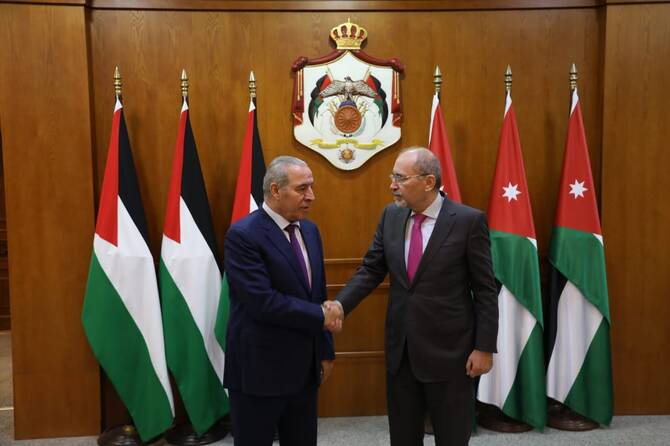
Jordanian Foreign Minister Ayman Safadi and Palestinian Authority Vice President Hussein Sheikh held a meeting in Amman on Tuesday. (Petra)
Short Url
Updated 23 December 2025
Follow

Jordanian FM and Palestinian VP discuss Trump’s Gaza plan

  • Ayman Safadi and Hussein Sheikh stressed the need to uphold the Gaza ceasefire and advance to the second phase

LONDON: Jordanian Foreign Minister Ayman Safadi and Palestinian Authority Vice President Hussein Sheikh have discussed efforts to solidify the ceasefire in Gaza and stop Israeli escalation in the occupied West Bank.

In a meeting in Amman on Tuesday, the two officials stressed the need to uphold the Gaza ceasefire and advance to the second phase of the agreement based on the plan by US President Donald Trump.

They agreed that achieving stability must be linked to a clear political path leading to a just and comprehensive peace based on a two-state solution, according to the Petra news agency.

They said Gaza was an integral part of the Occupied Palestinian Territories, where Palestinians seek to establish an independent Palestinian state.

Safadi and Sheikh addressed the worsening situation in the occupied West Bank, stressing the urgent need for coordinated regional and international efforts to stop illegal Israeli actions that could escalate violence and hinder peace.

They urged Israel to honor the historical and legal status quo of Islamic and Christian holy sites in occupied Jerusalem and to remove restrictions on freedom of worship.


Sudanese nomads trapped as war fuels banditry and ethnic splits

Updated 4 sec ago
Follow

Sudanese nomads trapped as war fuels banditry and ethnic splits

  • War disrupts nomads’ traditional routes and livelihoods
  • Nomads face threats from bandits as well as ethnic tensions
NEAR AL-OBEID: Gubara Al-Basheer and his family used ​to traverse Sudan’s desert with their camels and livestock, moving freely between markets, water sources, and green pastures. But since war erupted in 2023, he and other Arab nomads have been stuck in the desert outside the central Sudanese city of Al-Obeid, threatened by marauding bandits and ethnic tensions. The war between the Sudanese army and the paramilitary Rapid Support Forces (RSF) has left nearly 14 million people displaced, triggered rounds of ethnic bloodshed, and spread famine ‌and disease. It ‌has also upset the delicate balance of ‌land ⁠ownership ​and livestock routes ‌that had maintained the nomads’ livelihoods and wider relations in the area, local researcher Ibrahim Jumaa said. Al-Obeid is one of Sudan’s largest cities and capital of North Kordofan state, which has seen the war’s heaviest fighting in recent months. Those who spoke to Reuters from North Kordofan said they found themselves trapped as ethnic hatred, linked to the war and fueled largely online, spreads.
“We used to be ⁠able to move as we wanted. Now there is no choice and no side accepts you,” ‌al-Basheer said. “In the past there were a ‍lot of markets where we ‍could buy and sell. No one hated anyone or rejected anyone. Now ‍it’s dangerous,” he said.
RISK OF ROBBERY
As well as the encroaching war, the nomads — who Jumaa said number in the millions across Sudan — face a threat from bandits who steal livestock.
“There are so many problems now. We can’t go anywhere and if we ​try we get robbed,” said Hamid Mohamed, another shepherd confined to the outskirts of Al-Obeid. The RSF emerged from Arab militias known ⁠as the Janjaweed, which were accused of genocide in Darfur in the early 2000s. The US and rights groups have accused the RSF of committing genocide against non-Arabs in West Darfur during the current conflict, in an extension of long-running violence stemming from disputes over land. The RSF has denied responsibility for ethnically charged killings and has said those responsible for abuses will be held to account. Throughout the war the force has formed linkages with other Arab tribes, at times giving them free rein to loot and kidnap.
But some Arab tribes, and many tribesmen, have not joined the fight.
“We require a national program to counter ‌hate speech, to impose the rule of law, and to promote social reconciliation, as the war has torn the social fabric,” said Jumaa.