Somalia beefs up security ahead of first local elections in decades

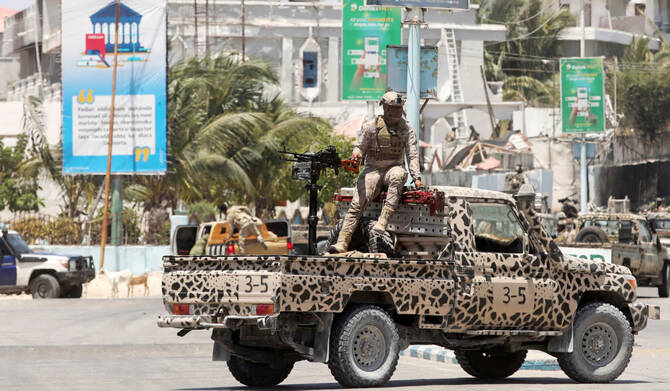
Somali security personnel in Mogadishu. The country is struggling to emerge from decades of conflict and chaos, battling a bloody insurgency and frequent natural disasters. (Reuters)
Short Url
Updated 22 December 2025
Follow

Somalia beefs up security ahead of first local elections in decades

  • Nearly 400,000 people are registered to vote in the elections, according to the country’s electoral body

MOGADISHU: Somalia will deploy more than 10,000 security personnel in the capital, Mogadishu, ahead of next week’s local elections — the first direct polls in nearly 60 years — the security minister said on Sunday.

The East African country is struggling to emerge from decades of conflict and chaos, battling a bloody insurgency and frequent natural disasters.

In April, the country launched voter registration for the first time in decades, a step toward universal suffrage and an end to the complex clan-based indirect voting system in place since 1969.

FASTFACT

In April, the country launched voter registration for the first time in decades, a step toward universal suffrage.

The Dec. 25 polls — which the opposition has boycotted, accusing the federal government of “unilateral election processes” — will see more than 1,600 candidates contest 390 local seats in the southeastern Banadir region.

Nearly 400,000 people are registered to vote in the elections, according to the country’s electoral body.

“We have managed to secure the city,” Security Minister Abdullahi Sheikh Ismail said in a statement.

Electoral Commission Chairman Abdikarin Ahmed Hassan said all movement would be restricted on election day, with voters transported to polling stations by bus.

“The whole country will be shut down,” Hassan said. “It is a great moment for the Somali people to see elections for the first nearly sixty years.”

Somalia’s system of direct voting was abolished after Siad Barre took power in 1969. Since the fall of his authoritarian government in 1991, the country’s political system has revolved around a clan-based structure.

Thursday’s elections, using the one-person, one-vote model, were postponed three times this year.

The country is expected to hold its presidential election in 2026, as President Hassan Sheikh Mohamud’s term comes to an end.


WHO says low taxes are making sugary drinks, alcohol more affordable

Updated 5 sec ago
Follow

WHO says low taxes are making sugary drinks, alcohol more affordable

  • The WHO has called for higher taxes on alcohol and sugar-sweetened drinks multiple times in recent years
  • “Health taxes are not ⁠a silver bullet, and they’re not simple,” said Ghebreyesus

NEW YORK: Sugary drinks and alcohol are not being sufficiently taxed and remain affordable, making it harder to tackle the chronic health problems caused by these beverages, according to two reports from the World Health Organization.
The WHO has called for higher taxes on alcohol and sugar-sweetened drinks multiple times in recent years, arguing it would help cut consumption of the products which contribute to diseases such as diabetes, as well as raise money at a time when development aid is shrinking and ⁠public debt is rising.
According to a report from WHO, sugary drinks have become more affordable in 62 countries in 2024 compared with 2022. In a separate report, the health agency said beer has become more affordable in 56 countries during the same period.
“Health taxes are not ⁠a silver bullet, and they’re not simple. They can be politically unpopular and they attract opposition from powerful industries with deep pockets and a lot to lose, but many countries have shown that when they’re done right, they’re a powerful tool for health,” said WHO Director-General Tedros Ghebreyesus.
Last year, the health agency launched the “3 by 35” initiative to push countries to raise the prices of sugary drinks, alcohol and tobacco by 50 percent over ⁠the next 10 years through taxation.
WHO expects the tax initiative to raise $1 trillion by 2035, based on evidence from health taxes in countries such as Colombia and South Africa.
Soda makers such as Coca-Cola and PepsiCo, and Mondelez, which manufactures Oreo cookies, have faced scrutiny from US Health Secretary Robert F. Kennedy Jr., who has pushed the “Make America Healthy Again” agenda, recommending that consumers avoid highly processed foods and eat more protein and less sugar to achieve a healthy diet.