

Sun, sea, sand... In Somalia? Tourism trickles in despite insecurity

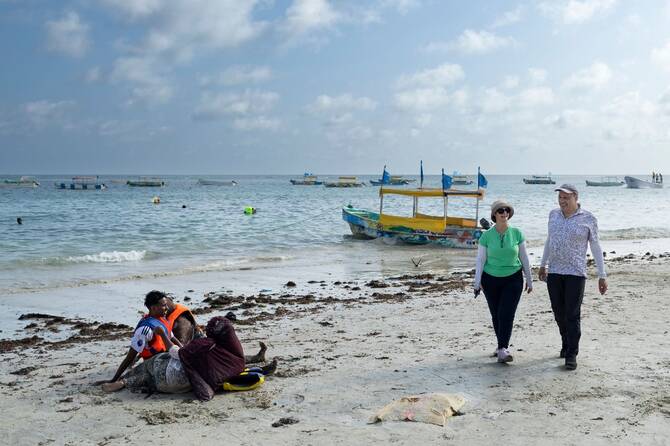
US tourists Richard and Sheryl walk on Lido beach during a guided tour of tourist attractions in Mogadishu, Somalia. (AFP)
Short Url
Updated 20 November 2025
Follow

Sun, sea, sand... In Somalia? Tourism trickles in despite insecurity

  • The government is keen to promote tourism, which it says employs some 30,000 people

MOGADISHU: Children run in turquoise water, hawkers tout wares on white sands, and families laugh as tourists disembark from small boats — but it’s not some tropical island, it’s Somalia’s capital Mogadishu.
“I didn’t really tell my family where I was going,” said Sheryl, from the United States, after walking along Lido Beach in the city.
“But... from the moment we got off the aeroplane, I’ve been feeling totally comfortable,” she told AFP.
“It’s nothing like what you hear.”
To say that Somalia does not have a good reputation would be an understatement.
It has endured decades of conflict — first a brutal civil war in the 1990s, and now against the Al-Qaeda-linked insurgent group Al-Shabab — and its capital, Mogadishu, is a byword for bombs and armored cars.
But the east African country is trying to change that narrative, trumpeting an 86 percent reduction of attacks in the city since 2023 thanks to more surveillance cameras, roadblocks and plainclothes police. However, incidents do still occur, including a major assault on a prison last month by the militants.
And while Mogadishu is comparatively secure, the rest of the country is not — Al-Shabab’s major territorial gains earlier this year provoked warnings the capital itself could be at risk.
Still, despite the perils, tourism minister Daud Aweis Jama told AFP that roughly 10,000 people visited last year and the number for 2025 could be twice that — mostly from China, the US, and Turkiye.
As AFP accompanied Sheryl and her husband Richard — both in their fifties — around the city, accompanied by one armed soldier, they provoked only a passing curiosity.
“We’re freely walking around, and people are lovely, as people tend to be, and it’s a really interesting place to visit,” she said.

- Security improved -

Sheryl and Richard, who declined to give their surnames, are perhaps not typical travelers. Between them, they have visited Afghanistan, Iran, and North Korea, among others.
They explored Somalia’s capital — including the beach, Peace Gardens memorial park, and Tomb of the Unknown Soldier — with Visit Mogadishu Tours, one of its oldest travel agencies having started business with a solitary Chinese tourist in 2012.
Most foreigners are put off by “warnings they see in Western and European media outlets, which claim that Somalia is not safe to visit,” said the agency’s co-founder, Ali Hassan.
Britain warns against travel, cautioning there is a “high risk of kidnapping” and that Britons are seen as “legitimate targets.” The US is blunter, stating: “Do not travel to Somalia.”
But Hassan said that was in the past.
“Security has improved in many parts of the country, and tourists can interact with locals without any problems,” he said.
His firm charges roughly $500 per tourist per day, which includes the visa, accommodation, food — plus an armed vehicle escort.
The government is keen to promote tourism, which it says employs some 30,000 people.
It has fixed roads and introduced a new e-visa system — though it has already been hacked, prompting fresh warnings from Britain and the US.
“We believe tourism will change the image of Somalia,” said Jama, the tourism minister.
“Everywhere you go in the world, if there is tourism, that means there is stability.”

- ‘Terrifies people’ -

But negative realities remain.
“The name Somalia terrifies most people,” said Briton Anthony Middleton, 42, who was on a two-night trip that cost him around $1,500 for food, accommodation, and security.
Four of his bank cards were blocked after his bank “freaked out” over his location.
The scars of recent conflicts remain in Mogadishu, with many buildings still in ruins.
But Middleton said his initial nerves were quickly assuaged.
“A lot of people think of Somalia as dangerous, and to be honest, Somalia is, even though it’s getting better,” he told AFP.
“But... there’s a difference between dangerous and unfriendly,” he added.
The government has control over Mogadishu but Al-Shabab still has a powerful presence, controlling many parts of the economy, and the outlying territory.
Shopkeeper Abdi Malik, 21, told AFP he served a foreign tourist — an avid YouTuber — the day before, and enjoyed the interaction.
“Security is good in some areas,” said Malik, but others remain no-go, “especially [for] tourists.”


Afghan barbers under pressure as morality police take on short beards

Updated 19 February 2026
Follow

Afghan barbers under pressure as morality police take on short beards

KABUL: Barbers in Afghanistan risk detention for trimming men’s beards too short, they told AFP, as the Taliban authorities enforce their strict interpretation of Islamic law with increasing zeal.
Last month, the Ministry for the Propagation of Virtue and Prevention of Vice said it was now “obligatory” to grow beards longer than a fist, doubling down on an earlier order.
Minister Khalid Hanafi said it was the government’s “responsibility to guide the nation to have an appearance according to sharia,” or Islamic law.
Officials tasked with promoting virtue “are obliged to implement the Islamic system,” he said.
With ministry officials patrolling city streets to ensure the rule is followed, the men interviewed by AFP all spoke on condition of anonymity due to security concerns.
In the southeastern province of Ghazni, a 30-year-old barber said he was detained for three nights after officials found out that one of his employees had given a client a Western-style haircut.
“First, I was held in a cold hall. Later, after I insisted on being released, they transferred me to a cold (shipping) container,” he said.
He was eventually released without charge and continues to work, but usually hides with his clients when the patrols pass by.
“The thing is that no one can argue or question” the ministry officials, the barber said.
“Everyone fears them.”

 This photograph taken on February 11, 2026 shows an Afghan barber trimming a customer's hair along a sidewalk in Kabul. (AFP)

He added that in some cases where both a barber and clients were detained, “the clients have been let out, but they kept the barber” in custody.
Last year, three barbers in Kunar province were jailed for three to five months for breaching the ministry’s rules, according to a UN report.

‘Personal space’

Alongside the uptick in enforcement, the religious affairs ministry has also issued stricter orders.
In an eight-page guide to imams issued in November, prayer leaders were told to describe shaving beards as a “major sin” in their sermons.
The religious affairs ministry’s arguments against trimming state that by shaving their beards, men were “trying to look like women.”
The orders have also reached universities — where only men study because women have been banned.
A 22-year-old Kabul University student said lecturers “have warned us... that if we don’t have a proper Islamic appearance, which includes beards and head covering, they will deduct our marks.”

 This photograph taken on February 11, 2026 shows an Afghan barber trimming a customer's hair along a sidewalk in Kabul. (AFP)

In the capital Kabul, a 25-year-old barber lamented that “there are a lot of restrictions” which go against his young clients’ preference for closer shaves.
“Barbers are private businesses, beards and heads are something personal, they should be able to cut the way they want,” he said.
Hanafi, the virtue propagation minister, has dismissed such arguments, saying last month that telling men “to grow a beard according to sharia” cannot be considered “invading the personal space.”

Business slump

In Afghanistan, the majority are practicing Muslims, but before the Taliban authorities returned to power in 2021, residents of major cities could choose their own appearance.
In areas where Taliban fighters were battling US-backed forces, men would grow beards either out of fear or by choice.
As fewer and fewer men opt for a close shave, the 25-year-old Kabul barber said he was already losing business.
Many civil servants, for example, “used to sort their hair a couple of times a week, but now, most of them have grown beards, they don’t show up even in a month,” he said.
A 50-year-old barber in Kabul said morality patrols “visit and check every day.”
In one incident this month, the barber said that an officer came into the shop and asked: “Why did you cut the hair like this?“
“After trying to explain that he is a child, he told us: ‘No, do Islamic hair, not English hair’.”