Geoeconomic confrontation tops global risks in 2026: WEF report

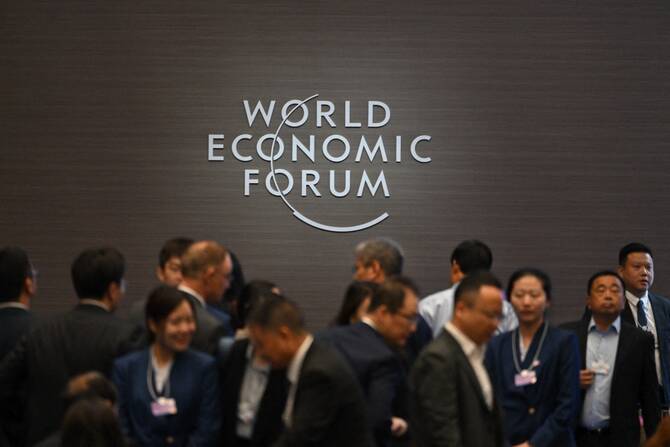
The Global Risk Report was released ahead of World Economic Forum’s annual meeting, which will be held in Davos from Jan. 19 to 23. (File/AFP)
Short Url
Updated 15 January 2026
Follow

Geoeconomic confrontation tops global risks in 2026: WEF report

  • Also armed conflict, extreme climate, public polarization, AI
  • None ‘a foregone conclusion,’ says WEF’s MD Saadia Zahidi

DUBAI: Geoeconomic confrontation has emerged as the top global risk this year, followed by state-based armed conflict, according to a new World Economic Forum report.

The Global Risks Report 2026, released on Wednesday, found that both risks climbed eight places year-on-year, underscoring a sharp deterioration in the global outlook amid increased international competition.

The top five risks are geoeconomic confrontation (18 percent of respondents), state-based armed conflict (14 percent), extreme weather events (8 percent), societal polarization (7 percent) and misinformation and disinformation (7 percent).

The WEF’s Managing Director Saadia Zahidi said the report “offers an early warning system as the age of competition compounds global risks — from geoeconomic confrontation to unchecked technology to rising debt — and changes our collective capacity to address them.

“But none of these risks are a foregone conclusion.”

The report assesses risks across three timeframes: immediate (2026); short-to-medium term (next two years); and long term (next 10 years).

Economic risks show the largest overall increase in the two-year outlook, with both economic downturn and inflation jumping eight positions.

Misinformation and disinformation rank fifth this year but rise to second place in the two-year outlook and fourth over the 10-year horizon.

The report suggests this reflects growing anxiety around the rapid adoption of artificial intelligence, with adverse outcomes linked to AI surging from 30th place in the two-year timeframe to fifth in the 10-year outlook.

Uncertainty dominates the global risk outlook, according to the report.

Surveyed leaders and experts view both the short- and long-term outlook negatively, with 50 percent expecting a turbulent or stormy global environment over the next two years, rising to 57 percent over the next decade.

A further 40 percent and 32 percent, respectively, describe the outlook as unsettled across the two- and 10-year timeframes, while just 1 percent anticipate a calm global outlook in either period.

Environmental risks ease slightly in the short-term rankings. Extreme weather fell from second to fourth place and pollution from sixth to ninth. Meanwhile, critical changes to Earth systems and biodiversity loss dropped seven and five positions, respectively.

However, over the next decade, environmental threats re-emerge as the most severe, with extreme weather, biodiversity loss, and critical changes to Earth systems topping the global risk rankings.

Looking ahead over the next decade, around 75 percent of respondents anticipate a turbulent or stormy environmental outlook, making it the most pessimistic assessment across all risk categories.

Zahidi said that “the challenges highlighted in the report underscore both the scale of the potential perils we face and our shared responsibility to shape what comes next.”

Despite the gloomy outlook, Zahidi signaled a positive shift in global cooperation.

 “It is also clear that new forms of global cooperation are already unfolding even amid competition, and the global economy is demonstrating resilience in the face of uncertainty.”

Now in its 21st year, the Global Risks Report highlights a core message: global risks cannot be managed without cooperation.

As competition intensifies, rebuilding trust and new forms of collaboration will be critical, with the report stressing that today’s decisions will shape future outcomes.

The report was released ahead of WEF’s annual meeting, which will be held in Davos from Jan. 19 to 23.


Trump is threatening to block a new bridge between Detroit and Canada from opening

Updated 10 February 2026
Follow

Trump is threatening to block a new bridge between Detroit and Canada from opening

  • Trump’s threat comes as the relationship between the US and Canada increasingly sours during the US president’s second term

WASHINGTON: President Donald Trump on Monday threatened to block the opening of a new Canadian-built bridge across the Detroit River, demanding that Canada turn over at least half of the ownership of the bridge and agree to other unspecified demands in his latest salvo over cross-border trade issues.
“We will start negotiations, IMMEDIATELY. With all that we have given them, we should own, perhaps, at least one half of this asset,” Trump said in a lengthy social media post, complaining that the United States would get nothing from the bridge and that Canada did not use US steel to built it.
The Gordie Howe International Bridge, named after a Canadian hockey star who played for the Detroit Red Wings for 25 seasons, had been expected to open in early 2026, according to information on the project’s website. The project was negotiated by former Michigan Gov. Rick Snyder — a Republican — and paid for by the Canadian government to help ease congestion over the existing Ambassador Bridge and Detroit-Windsor tunnel. Work has been underway since 2018.
It’s unclear how Trump would seek to block the bridge from being opened, and the White House did not immediately return a request for comment on more details. The Canadian Embassy in Washington also did not immediately return a request for comment.
Trump’s threat comes as the relationship between the US and Canada increasingly sours during the US president’s second term. The United States-Mexico-Canada trade agreement is up for review this year, and Trump has been taking a hard-line position ahead of those talks, including by issuing new tariff threats.
Canadian Prime Minister Mark Carney, meanwhile, has spoken out on the world stage against economic coercion by the United States.
Sen. Elissa Slotkin, D-Michigan, said the Canadian-funded project is a “huge boon” to her state and its economic future. “You’ll be able to move cargo from Montreal to Miami without ever stopping at a street light,” Slotkin told The Associated Press.
“So to shoot yourself in the foot and threaten the Gordie Howe Bridge means that this guy has completely lost the plot on what’s good for us versus just what’s spite against the Canadians,” Slotkin said.
Michigan, a swing state that Trump carried in both 2016 and 2024, has so far largely avoided the brunt of his second-term crackdown, which has targeted blue states with aggressive immigration raids and cuts to federal funding for major infrastructure projects.
Trump and Democratic Gov. Gretchen Whitmer have also maintained an unusually cordial relationship, with the president publicly praising her during an Oval Office appearance last April. The two also shared a hug last year ahead of Trump’s announcement of a new fighter jet mission for an Air National Guard base in Michigan.
While Canada paid for the project, the bridge will be operated under a joint ownership agreement between Michigan and Canada, said Stacey LaRouche, press secretary to Whitmer.
“This is the busiest trade crossing in North America,” LaRouche said, saying the bridge was “good for Michigan workers and it’s good for Michigan’s auto industry” as well as being a good example of bipartisan and international cooperation.
“It’s going to open one way or another, and the governor looks forward to attending the ribbon-cutting,” LaRouche said.
Rep. Shri Thanedar, the Democratic House representative of Detroit, said blocking the bridge would be “crazy” and said Trump’s attacks on Canada weren’t good for business or jobs. “The bridge is going to help Michigan’s economy. There’s so much commerce between Michigan and Canada. They’re one of our biggest partners,” Thanedar said.
Democratic Rep. Debbie Dingell of Ann Arbor brushed aside the president’s threat, saying she’s looking forward to the bridge’s opening later in the spring. “And I’ll be there,” Dingell said.
“That bridge is the biggest crossing in this country on the northern border. It’s jobs. It’s about protecting our economy. It was built with union jobs on both sides,” said Dingell. “It’s going to open. Canada is our ally.”