

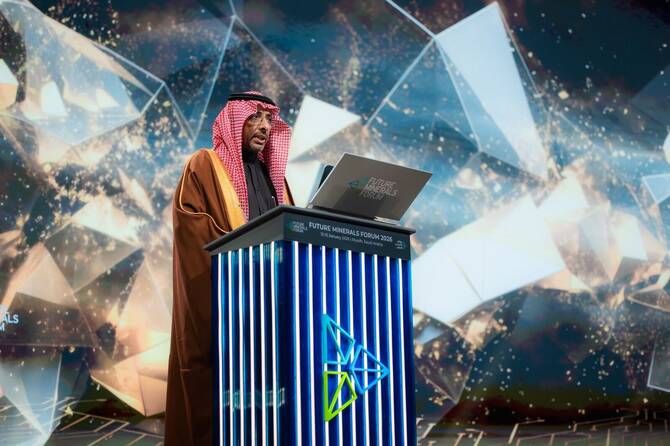
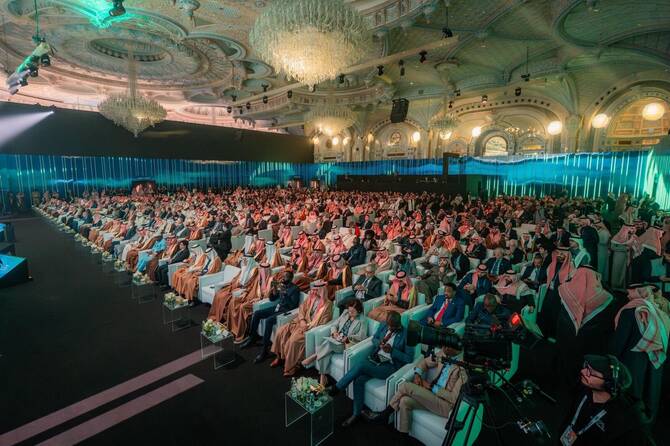

RIYADH: Saudi Arabia announced a new initiative to strengthen mining infrastructure as the Kingdom hosted global industry leaders in Riyadh for the Future Minerals Forum, underscoring its ambition to position mining as a core pillar of economic diversification.
Speaking at the opening of the fifth edition of the forum, Minister of Industry and Mineral Resources Bandar Alkhorayef said the new plan is designed to reduce investment risk and accelerate project development across the sector.
The minister reaffirmed Saudi Arabia’s commitment to international collaboration in building what he described as a resilient, responsible and future-ready global mining ecosystem.
The forum has attracted ministers and senior officials from more than 100 countries and representatives from over 70 organizations. The event runs until Jan. 15.
“I am pleased to announce the launch of the mining infrastructure enablement initiative, in partnership with MODON, the Saudi Authority for Industrial Cities and Technology Zones,” Alkhorayef said.
He explained that the first project under the initiative will involve a 75-km treated water pipeline to support mining development in the Jabal Sayid area, helping to accelerate mineral projects in the region.
In a further move to address capital constraints in the sector, Alkhorayef announced the launch of a financing portal in cooperation with the Bank of Montreal. “We are launching a gateway to funding, addressing one of the industry’s most critical challenge, which is funding and financing,” he said.
The minister also highlighted innovation-driven initiatives unveiled at the forum. “We have also launched our first global future mineral pioneer competition, designed to translate mining section innovation from concept to practical solutions. It attracted over 1,800 innovators from 57 countries and is proof that Riyadh is an emerging hub for talent and development in the sector,” he added.
Reflecting on the evolution of the forum, Alkhorayef described FMF “as the annual reunion of our FMF family.”
He said this year’s theme, “Dawn of a global cause: Minerals for a new era of development,” reflects the forum’s growing global relevance. “We are a cause in every sense, a global milestone of mineral community with the power to deliver real impact,” he said.
“While AI and energy transition may dominate the headlines, but without minerals neither is possible,” Alkhorayef added.
The minister described the previous day’s ministerial roundtable as “our most productive roundtable to date,” citing the adoption of the FMF framework, progress on centers of excellence and responsible mining standards, and alignment with the World Bank’s new mining strategy.
Alkhorayef said Saudi Arabia is strengthening global mineral supply resilience while advancing Vision 2030 objectives. “We are advancing our commitment to unlocking our value of $2.5 trillion of mineral potential by offering significant exploration opportunities through competition. We have so far been awarded over 33,000 sq. km across our tender licensing rounds. Our ninth exploration round alone awarded 172 mining sites to 24 companies and consortiums marking our biggest licensing round to date,” he said.
“We will continue offering significant exploration opportunities through competitive tender rounds throughout 2026 and 2027,” he added.
The minister noted that Saudi Arabia has completed geophysical and geochemical survey mapping of the Arabian Shield. “Exploration spending has risen more than five times in the last few years, from $54.6 million to more than $280 million in 2024.
“Our work is recognized globally. Saudi Arabia today is the first, world wide in political stability and is 23 in investment satisfaction, up from 104 in 2013,” he said.
Alkhorayef added: “We have introduced the Future Minerals Barometer to track progress on developments of mineral value chains across supplier countries, and have also launched our first global future mineral pioneer competition, designed to translate mining section innovation from concept to practical solutions.”


