

Pakistan, Iran resolve to strengthen trade cooperation, work for regional peace

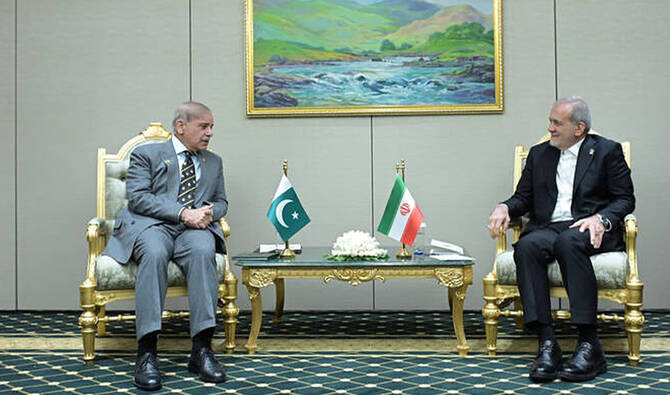
Prime Minister Shehbaz Sharif (left) meets Iranian President Masoud Pezeshkian in Tehran, Iran, on December 12, 2025. (Government of Pakistan)
Short Url
Updated 21 December 2025
Follow

Pakistan, Iran resolve to strengthen trade cooperation, work for regional peace

  • Pakistan Foreign Minister Ishaq Dar speaks to Iranian counterpart Seyyed Abbas Araghchi
  • Pakistan, Iran have attempted to enhance bilateral trade to $10 billion in recent years

ISLAMABAD: The foreign ministers of Iran and Pakistan vowed on Sunday to strengthen bilateral cooperation in trade, connectivity, various other sectors and work for regional peace, the Pakistani foreign ministry said in a statement.

Pakistan and Iran have attempted to enhance bilateral trade and commerce in recent years. The two neighbors have set up border markets and discussed barter trade to get around banking and currency restrictions.

Sanctions and foreign exchange shortages remain key hurdles for Iran, making barter systems and cross-border markets central to its trade strategy with Pakistan.

Deputy Prime Minister Ishaq Dar, who also serves as Pakistan’s foreign minister, spoke to Iran’s Foreign Minister Seyyed Abbas Araghchi over the phone on Sunday during which the two discussed regional developments. 

“Both leaders reaffirmed their commitment to further strengthening cooperation in trade, connectivity and people-to-people ties, and reiterated their resolve to work closely together for regional peace and development,” the Pakistani foreign office said in a statement. 

Pakistan and Iran have attempted to enhance bilateral trade to $10 billion. However, apart from sanctions and foreign exchange shortages, ties between the two countries remain complicated due to security issues. 

Pakistan and Iran have remained at odds over instability along their shared, porous border that even led to a missile exchange between them in 2024. Both countries, however, were quick to move to ease tensions.

Iranian President Dr. Masoud Pezeshkian visited Pakistan in August this year, during which the two countries signed agreements to enhance bilateral trade to $10 billion by 2028. 

Both countries have also consistently criticized Israel for its war on Gaza and repeated violations of a fragile ceasefire brokered by world powers, including the US. 


Pakistan regulator says over 21,600 new companies registered in first half of FY26

Updated 11 January 2026
Follow

Pakistan regulator says over 21,600 new companies registered in first half of FY26

  • This reflects a 29 percent increase compared to the 16,839 companies that were registered during same period last year, says regulator
  • These incorporations contributed $109.5 billion in paid-up capital, says Securities and Exchange Commission of Pakistan report

ISLAMABAD: The Securities and Exchange Commission of Pakistan (SECP) said this week it registered over 21,600 new companies in the first half of the current fiscal year, reflecting rising investor confidence and positive economic outlook in the country. 

In a report issued on Jan. 6, the SECP said it registered 21,668 companies in the first six months of the current fiscal year, adding that these incorporations contributed Rs30.7 billion [$109.5 million] in paid-up capital. 

The report said this represented a 29 percent increase compared to the 16,839 companies registered during the same period last year.

“Pakistan’s business landscape continues to demonstrate strong momentum, reflecting rising investor confidence and a positive economic outlook,” the SECP report said. 

The SECP said the latest increase has brought the total number of registered companies in Pakistan to 279,724. It said the top ten sectors by incorporations were led by the IT & e-commerce, with 4,277 companies, followed by trading (2,997 companies), services (2,686 companies) and real estate (2,031 companies). 

“This sectoral diversity highlights expanding entrepreneurial activity, particularly in technology-driven and service-oriented industries,” the report said. 

The SECP said foreign investment also remained “robust” during the period, adding that 524 newly incorporated companies received foreign investment amounting to Rs1.26 billion [$4.5 million] with the participation from 731 foreign investors. 

“China emerged as the leading source, accounting for 71 percent of total inflows,” the SECP said. “It was followed by Afghanistan (8 percent), the United States (2 percent), and the United Kingdom, Germany, South
Africa, South Korea, Norway, Vietnam, Nigeria, and Bangladesh, each contributing 1 percent,” it added. 

The SECP said an additional 11 percent of the investment originated from other countries.