

Private sector investment in Saudi transport, logistics exceeds $74.7bn
Private sector investment in Saudi transport, logistics exceeds $74.7bn/node/2626422/business-economy
Private sector investment in Saudi transport, logistics exceeds $74.7bn
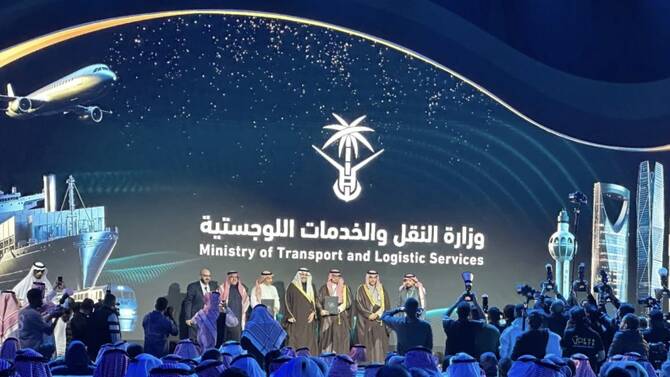
Speaking at the Supply Chain and Logistics Conference in Riyadh, Saleh Al-Jasser highlighted a 28 percent rise in employment in transport and storage activities by mid-2025. AL-EQTISADIAH.
Private sector investment in Saudi transport, logistics exceeds $74.7bn
Updated 16 December 2025
Al-Eqtisadiah ABDULLAH AL-ROUQI RANEEM AL-OSAIMI
RIYADH: Private sector investment, both domestic and international, in Saudi Arabia’s transport and logistics sector has exceeded SR280 billion ($74.7 billion), contributing 6.2 percent directly to the Kingdom’s gross domestic product, the minister of transport and logistics services said.
Speaking at the Supply Chain and Logistics Conference in Riyadh, Saleh Al-Jasser highlighted a 28 percent rise in employment in transport and storage activities by mid-2025 compared with the same period last year, adding 144,000 jobs to bring total sector employment to 651,000.
Air cargo sees 34% growth in a year
The minister noted that Saudi Arabia’s aviation and air transport sector is entering a phase of expansion, with air cargo volumes rising 34 percent this year to 1.2 million tonnes, with the number of logistics centers also growing to nearly 30.
In a related development, Senior Vice President of Aramco Procurement and Supply Chain Management, Sulaiman Al-Rubaian, announced the launch of the joint “ASMO” project with DHL to enhance supply chains and procurement.
The project aims to establish an integrated network of six logistics centers covering more than 8 million sq. meters and manage annual procurement activities exceeding SR30 billion.
Iktva program establishes 350 local manufacturing facilities
Al-Rubaian also unveiled the newly developed supplier registration and qualification system, which integrates electronically with several government systems, cutting registration time by more than 50 percent.
He noted that the Iktva program contributed SR900 billion to gross domestic product over the past decade, adding that the initiative has created over 200,000 direct and indirect jobs in local supply chains and established 350 local manufacturing facilities, including plants producing 47 products manufactured for the first time in the Kingdom.
On the international front, Al-Jasser said Saudi Arabia climbed 17 places in the World Bank’s Logistics Performance Index and ranked among the top four emerging markets in the 2025 Agility Emerging Markets Logistics Index, emphasizing the Kingdom’s ambition to enter the global top 10.
Supply chain conference sees signing of 93 deals worth SR19bn
Over two days, the conference will witness the signing of 93 agreements and memoranda of understanding totaling SR19 billion to support a range of logistics projects in Saudi Arabia.
Among Monday’s agreements was a MoU between ASMO and J.P. Morgan, alongside a partnership deal between Khaled Al-Dhafer & Brothers and UNITS Holding.
In the field of training and employment, key agreements included a framework training deal between King Khalid University and Meli, as well as a MoU between the Saudi Logistics Academy and Nupco. The academy also signed employment-linked training agreements with Lucid, in addition to two joint diploma programs with CEER and SMSA.
To further develop talent, other agreements and partnerships were also signed, including between Spark Logistics and DSV, and Spark and NAQEL.
Experts reveal how AI is reducing burnout and streamlining workflows
Updated 05 February 2026
Nada Hameed
JEDDAH: Artificial intelligence is increasingly moving from the margins of healthcare innovation into its operational core. Rather than replacing clinicians, AI is being deployed to address persistent challenges across health systems, from administrative overload and staff burnout to fragmented data and inefficient patient flow.
Speaking to Arab News, Abbes Seqqat, chief executive officer of Rain Stella Technologies, and Eric Turkington, chief product officer, discussed how AI is already transforming healthcare delivery — and why its impact is most meaningful when embedded directly into clinical workflows rather than treated as a standalone tool.
Seqqat describes AI’s role as accelerating a structural shift in healthcare delivery. “AI is accelerating the shift in healthcare from reactive to proactive care, because AI fundamentally helps detect, analyze and predict,” he said, noting that many health systems lack the resources to perform these tasks at scale.
While AI use cases in healthcare are broad, Seqqat emphasized that the most effective applications today focus on operational and clinical fundamentals, including reducing administrative burden, identifying patient risks earlier, and capturing clinical data more reliably and in real time.
RST’s portfolio reflects this approach, spanning surgical data capture and workflow automation, cloud-based electronic medical records, and health information exchange. Across these systems, the common goal is improving data quality and usability so clinicians can spend less time managing information and more time delivering care.
According to Turkington, RST’s systems rely on a mix of established and emerging AI technologies.
RST's Equinox offers a streamlined workflow, minimizing redundant data entry, and also allows for seamless integration with other systems. (RST images)
“Across the portfolio, we are using a wide range of AI and predictive technologies, from voice technology to reliably capture clinician inputs, to large language models that analyze and act on collected data,” he said.
A key focus has been adapting AI to regional and clinical realities. Voice models, for example, have been trained on UAE and GCC accents and grounded in medical terminology to improve accuracy in real-world settings. RST also uses retrieval-augmented generation and multi-agent AI architectures, allowing different AI components to perform specialized tasks such as classifying surgical notes, identifying unusual events, or assisting with billing and coding, Turkington explained.
DID YOU KNOW?
• AI can detect, analyze, and predict patient risks faster than traditional methods.
• Systems like Equinox use voice input and predictive analytics to actively support clinical decisions.
• AI assistants provide real-time updates, automate documentation, and improve coordination in operating theaters.
One of the central concerns around AI adoption is whether it adds complexity to already demanding clinical roles. Seqqat argues the opposite should be the goal.
“For nurses and frontline staff, AI’s greatest contribution is removing the invisible administrative friction that leads to burnout,” Seqqat said.
In operating theaters, AI systems can replace manual coordination methods such as phone calls and whiteboards by providing real-time situational awareness. By automating updates, anticipating delays, and serving as an on-demand clinical notepad, AI reduces cognitive load and allows staff to remain focused on patient care, he explained.
RST’s voice-enabled assistant, Orva, is designed specifically for perioperative environments.
Orva captures live updates through voice input, enabling it to surface delays, flag bottlenecks, and prompt coordination between departments. (RST photo)
Turkington said it enables hands-free documentation and coordination, helping surgical teams manage schedules and resources more effectively.
By capturing live updates through voice input, Orva can surface delays, flag bottlenecks, and prompt coordination between departments. It also assists with documentation and coding, reducing errors and supporting more accurate reimbursement— an area where incomplete records often create downstream challenges.
Electronic medical records remain central to healthcare delivery, but Turkington noted that AI can move them beyond passive data repositories.
Eric Turkington, chief product officer of Rain Stella Technologies. (RST photo)
“We designed Equinox as an EMR that enables you to spend less time with the software and more time with patients,” Turkington said.
Through voice input, automated documentation from visual annotations, and AI-generated pre-visit summaries, the system can actively support clinicians rather than slow them down. Predictive analytics, such as identifying no-show risks or highlighting care gaps, further shift EMRs toward decision-support tools rather than administrative obligations.
Both executives stressed that AI’s effectiveness depends heavily on data access and quality. Seqqat pointed to interoperability as a prerequisite rather than an afterthought.
“AI is only as powerful as the data it can access,” he said, adding that fragmented records limit both clinical insight and system-wide learning.
Health information exchanges, such as RST’s Constellation platform, enable patient data to be viewed longitudinally across providers. AI can then assist with patient identity matching and population-level analysis, allowing trends and risks to be identified across large datasets.
Turkington shared an example from an operating theatre where AI helped prevent cascading delays. When a surgical case ran late, a nurse verbally updated Orva that the patient was ready to exit. The system alerted the recovery unit, analyzed schedule conflicts, and prompted management to reassign staff before delays affected subsequent procedures.
Opinion
This section contains relevant reference points, placed in (Opinion field)
By tagging the cause of the delay and feeding that data into predictive models, the system helped prevent similar issues in the future — without additional manual coordination.
According to Seqqat, the primary returns from AI adoption come from combining efficiency with financial accuracy. Streamlined workflows allow providers to treat more patients without compromising care, while improved documentation reduces revenue leakage.
Looking ahead, Seqqat sees AI becoming central to Saudi Arabia’s healthcare transformation. He described its role as advancing smart hospitals, predictive patient flow, and precision medicine aligned with Vision 2030 goals.
“The role of AI in Saudi Arabia’s healthcare sector is evolving from a supporting technology to a foundational pillar of the Kingdom’s Vision 2030 transformation. Over the next few years, we expect to see AI move into the realm of smart hospitals, where predictive analytics optimize patient flow and AI-driven precision medicine leverages the Saudi Genome Program to provide hyper-personalized care. By unifying national health data and automating complex administrative workflows, AI will enable a more proactive, value-based healthcare model that improves patient outcomes and operational efficiency across the country.”