Children dying from cold as storm batters Gaza, killing 16

A Palestinian youth walks through a flooded area in a temporary tent camp after heavy rainfall in Deir Al-Balah, central Gaza Strip, Friday. (AP)
Short Url
Updated 12 December 2025
Follow

Children dying from cold as storm batters Gaza, killing 16

  • Three children die from exposure as winter rains flood displacement camps
  • Wet weather causes war-damaged buildings and walls to collapse, killing 13

GAZA CITY: Gaza’s civil defense agency on Friday said at least 16 people had died in the last 24 hours, including three children who died from exposure to the cold, as a winter storm batters the territory.
Heavy rain from Storm Byron has flooded tents and temporary shelters across the Gaza Strip since late Wednesday, compounding the suffering of the territory’s residents, nearly all of whom were displaced during more than two years of war.
Gaza’s civil defense agency, which operates as a rescue force under Hamas authority, told AFP three children had died from exposure to the cold — two in Gaza City and one in Khan Yunis in the south.
Al-Shifa Hospital in Gaza City confirmed the deaths of Hadeel Al-Masri, aged nine, and Taim Al-Khawaja, who it said was just several months old.
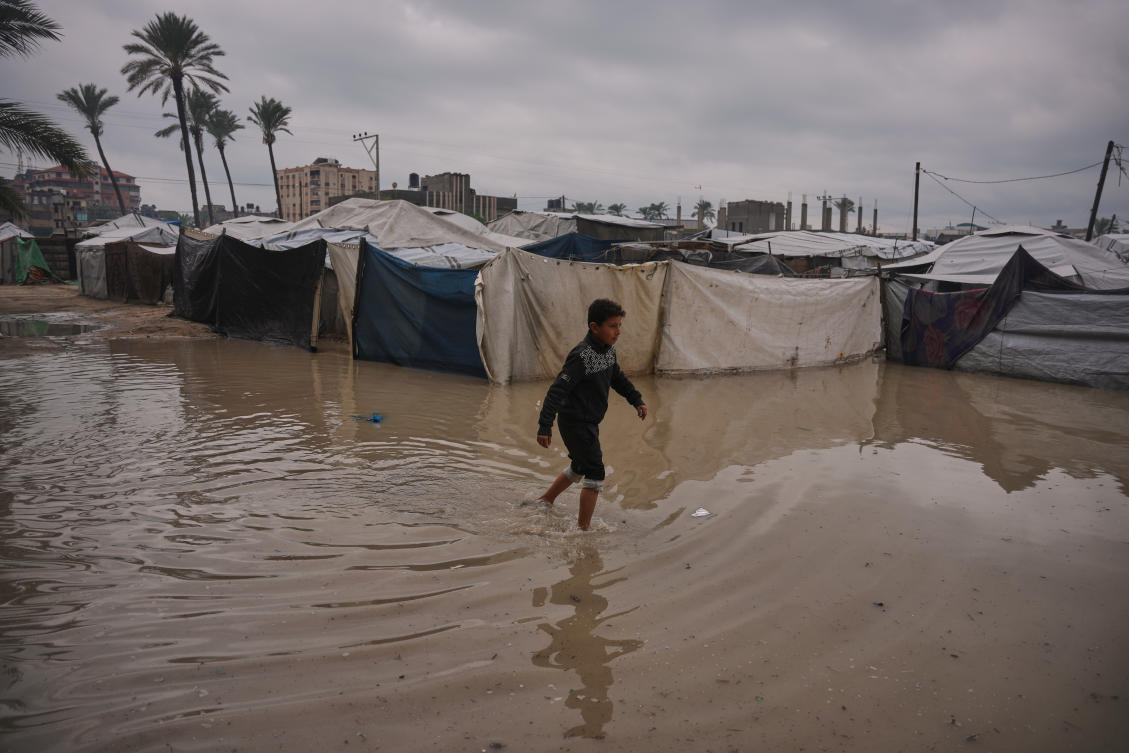


A Palestinian youth walks through a flooded area in a temporary tent camp after heavy rainfall in Deir Al-Balah, central Gaza Strip, Friday. (AP)

Nasser Hospital in Khan Yunis on Thursday said eight-month-old Rahaf Abu Jazar had died in the nearby tented encampment of Al-Mawasi due to the cold.
With most of Gaza’s buildings destroyed or damaged, thousands of tents and makeshift shelters now line areas cleared of rubble.
Civil defense spokesman Mahmud Bassal said six people died when a house collapsed in the Bir Al-Naja area of the northern Gaza Strip.
Two bodies were recovered from the rubble of a home in the Sheikh Radwan neighborhood of Gaza City, he added.
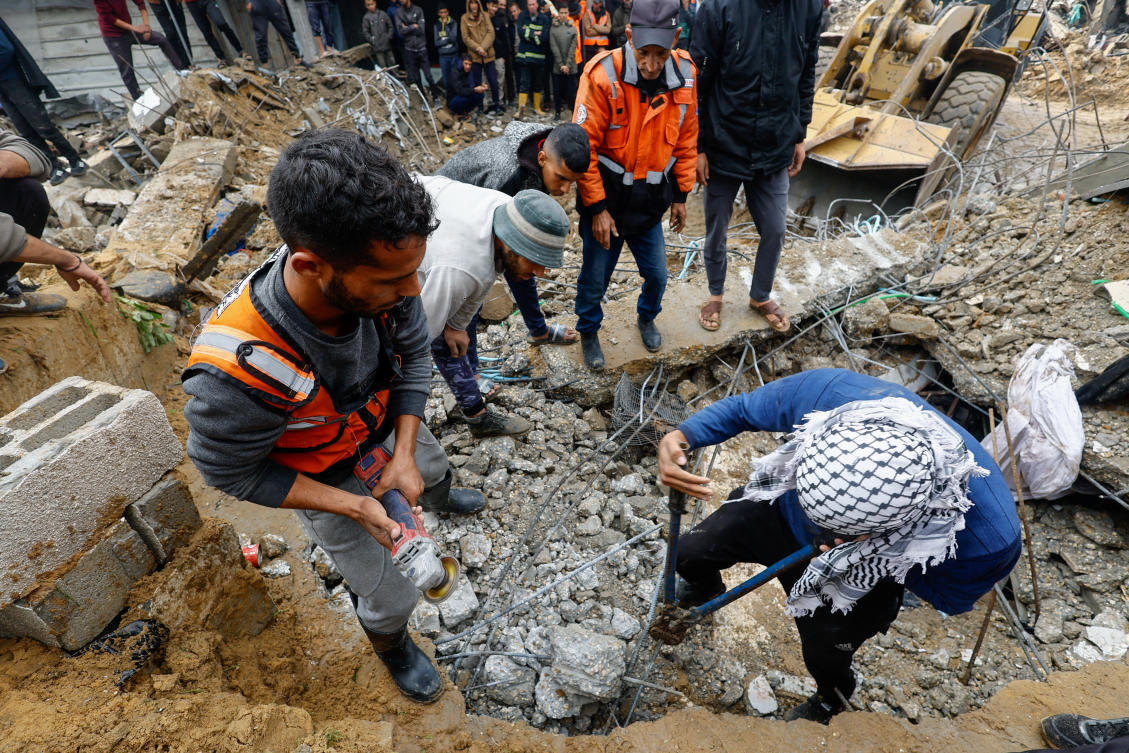


Palestinians search for victims in a destroyed house that collapsed amid heavy rains, in Beit Lahia, in the northern Gaza Strip, Friday. (Reuters)

Five others died when walls collapsed in multiple separate incidents, Bassal said.
In a statement, the civil defense said its teams had responded to calls from “13 houses that collapsed due to heavy rains and strong winds, mostly in Gaza City and the north.”
Under gloomy skies in Nuseirat in the central Gaza Strip, Palestinians used bowls, buckets and hoes to try and remove the water that had pooled around their tents made of plastic sheeting.
Young children, some barefoot and others wearing open sandals, trudged and hopped through ponds of muddy water as the rain continued to fall.
“The mattress has been soaked since this morning, and the children slept in wet bedding last night,” Umm Muhammad Joudah told AFP.
“We don’t have any dry clothes to change into.”
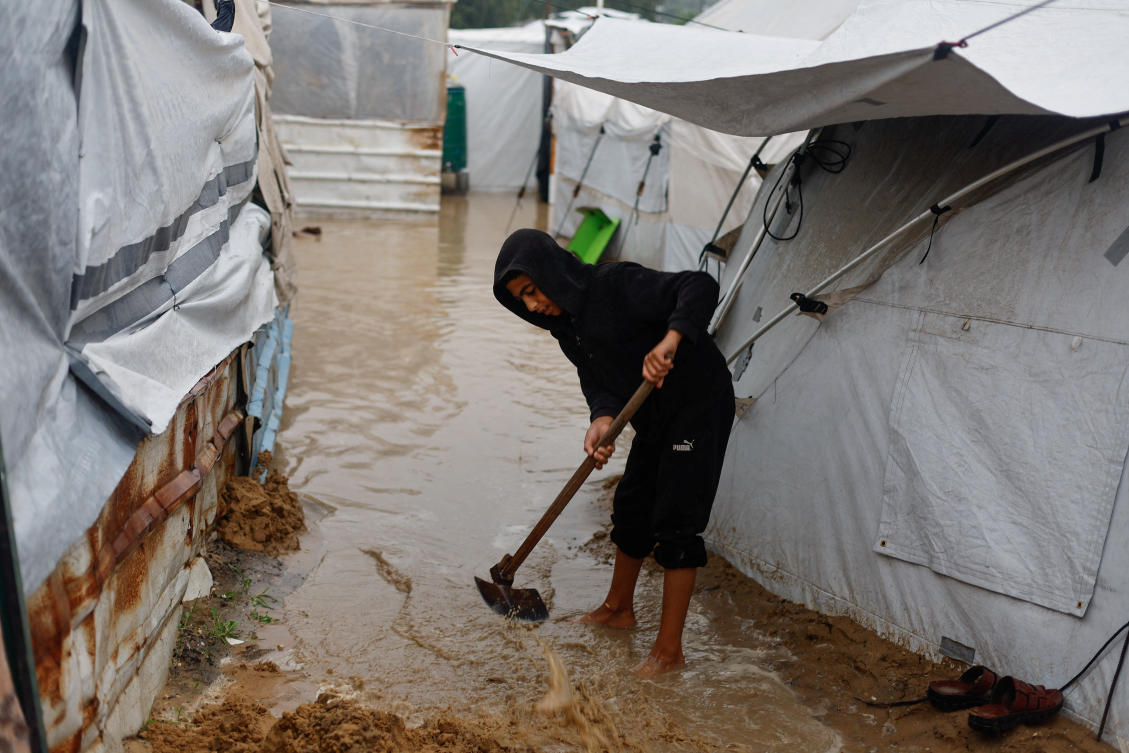


A displaced Palestinian boy uses a shovel as he stands in muddy water in a tent camp on a rainy day in Nuseirat, central Gaza Strip, Friday. (Reuters)

Saif Ayman, a 17-year-old who was on crutches due to a leg injury, said his tent had also been submerged.
“In this tent we have no blankets. There are six of us sleeping on one mattress, and we cover ourselves with our clothes,” he said.
Jonathan Crickx, spokesman for the UN children’s agency who is currently in Gaza, told AFP night-time temperatures could drop to around eight or nine degrees Celsius (46-48 degrees Fahrenheit).
“The rains are heavy, and these families are living in makeshift tents battered by the wind, where they’re barely protected by a plastic tarp,” he said.
Samer Mursi, a 22-year-old displaced Palestinian sheltering in the central area of Deir el-Balah, said he had “spent the night holding onto the tent pole so it wouldn’t fly away in the strong wind.”
“We don’t know how to cope with these harsh conditions,” he added.
“We are human beings with feelings, not made of stone.”
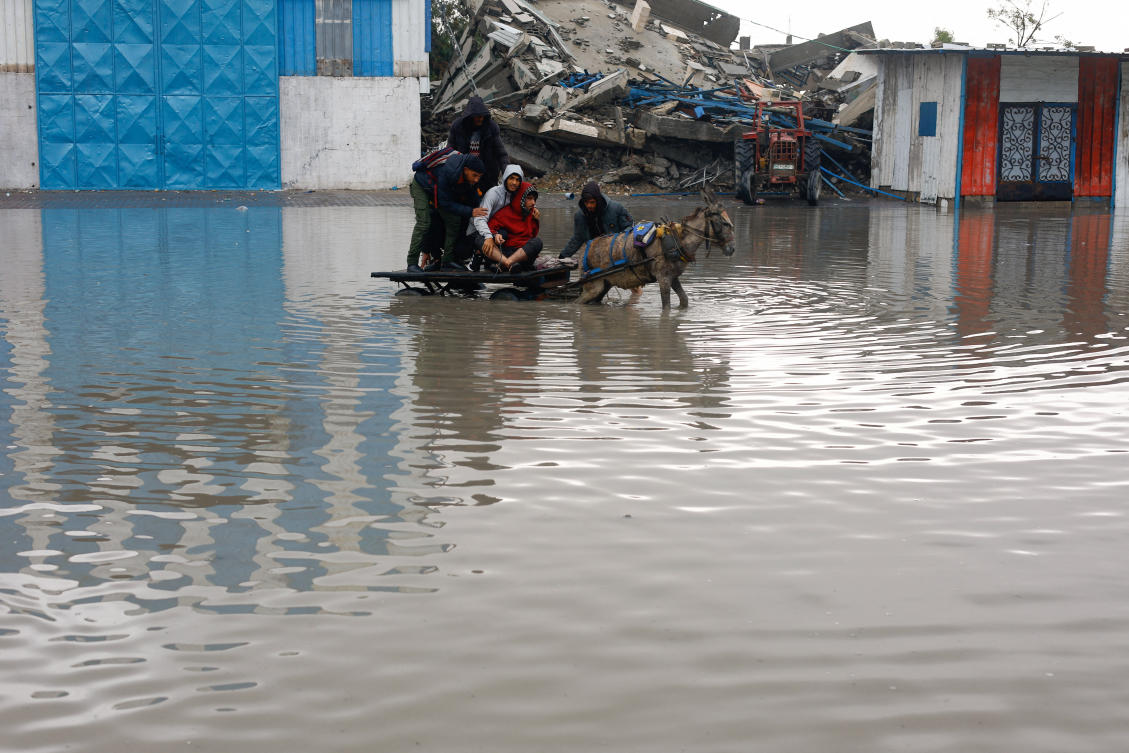


Displaced Palestinians ride a donkey-drawn cart on a rain-flooded street in Gaza City, on Friday. (Reuters)

Crickx also described “absolutely appalling hygiene and sanitary conditions,” saying there was a fear that preventable waterborne illnesses could spread.
“There aren’t enough toilets, there are places — I saw some in Gaza City — where large pools of water are essentially open sewers right next to the displacement camps. So we’re especially concerned for the immediate health of the children,” he said.
A ceasefire between Israel and militant group Hamas that took effect in October has partially eased restrictions on goods and aid entering into the Gaza Strip.
But supplies have entered in insufficient quantities, according to the United Nations, and the humanitarian needs are still immense.
The UN’s World Health Organization warned on Friday that thousands of families were “sheltering in low-lying or debris-filled coastal areas with no drainage or protective barriers.”
“Winter conditions, combined with poor water and sanitation, are expected to drive a surge in acute respiratory infections,” it added.
UN chief visits Iraq to mark end of assistance mission set up after 2003 invasion

Updated 5 sec ago
Follow

UN chief visits Iraq to mark end of assistance mission set up after 2003 invasion

  • Sudani said his country “highly values” the mission’s work in a region “that has suffered for decades from dictatorship, wars, and terrorism”
  • Guterres praised “the courage, fortitude and determination of the Iraqi people”

BAGHDAD: United National Secretary-General Antonio Guterres was in Baghdad on Saturday to mark the end of the political mission set up in 2003 following the US-led invasion of Iraq that toppled Saddam Hussein.
The UN Security Council, at Iraq’s request, voted last year to wind down the mandate of the United Nations Assistance Mission in Iraq (UNAMI), by the end of 2025. The mission was set up to coordinate post-conflict humanitarian and reconstruction efforts and help restore a representative government in the country.
Iraqi caretaker Prime Minister Mohammed Shia Al-Sudani said his country “highly values” the mission’s work in a region “that has suffered for decades from dictatorship, wars, and terrorism.” He said its conclusion showed Iraq had reached a stage of “full self-reliance.”
“Iraq emerged victorious thanks to the sacrifices and courage of its people,” he said in a joint statement with Guterres.
The ending of UNAMI’s mandate “does not signify the end of the partnership between Iraq and the UN,” Sudani said, adding that it represents the beginning of a new chapter of cooperation focused on development and inclusive economic growth.
The prime minister said a street in Baghdad would be named “United Nations Street” in honor of the UN’s work and in recognition of 22 UN staff who were killed in an Aug. 19, 2003, truck bomb attack on the Canal Hotel in Baghdad, which housed the UN headquarters.
Guterres praised “the courage, fortitude and determination of the Iraqi people” and the country’s efforts to restore security and order after years of sectarian violence and the rise of extremist groups, including the Daesh group, in the years after the 2003 invasion.
“Iraqis have worked to overcome decades of violence, oppression, war, terrorism, sectarianism and foreign interference,” the secretary-general said. “And today’s Iraq is unrecognizable from those times.”
Iraq “is now a normal country, and relations between the UN and Iraq will become normal relations with the end of UNAMI,” Guterres added. He also expressed appreciation for Iraq’s commitment to returning its citizens from the Al-Hol camp, a sprawling tent camp in northeastern Syria housing thousands of people — mostly women and children — with alleged ties to the IS.
Guterres recently recommended former Iraqi President Barham Salih to become the next head of the UN refugee agency, the first nomination from the Middle East in half a century.
Salih’s presidential term, from 2018 to 2022, came in the immediate aftermath of the Daesh group’s rampage across Iraq and the battle to take back the territory seized by the extremist group, including the key northern city of Mosul.
At least 2.2 million Iraqis were displaced as they fled the IS offensive. Many, particularly members of the Yazidi minority from the northern Sinjar district, remain in displacement camps today.