

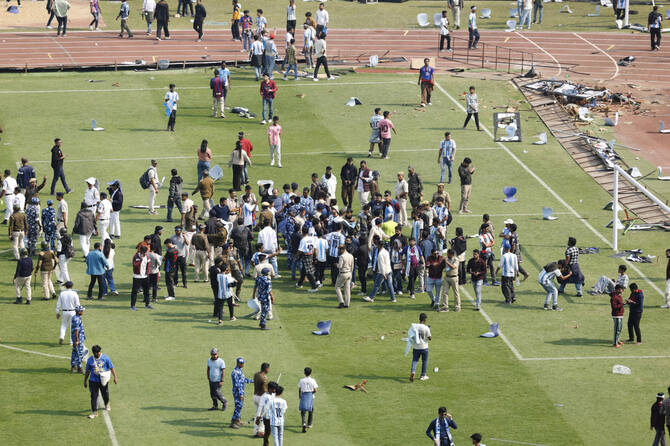
Lionel Messi’s India tour begins in chaos after angry fans storm pitch 

1 / 3
Fans react as Inter Miami's Argentine forward #10 Lionel Messi departs from the Salt Lake Stadium in Kolkata on December 13, 2025. (AFP)
2 / 3
Riot police and fans are seen on the pitch after Lionel Messi leaves the stadium (Reuters)
3 / 3
A fan takes a selfie with Inter Miami's Argentine forward #10 Lionel Messi (C) at the Salt Lake Stadium in Kolkata on December 13, 2025. (AFP)
Short Url
Updated 13 December 2025
Follow

Lionel Messi’s India tour begins in chaos after angry fans storm pitch 

  • Messi is in India as part of a tour during which he is scheduled to attend concerts, youth football clinics, a Padel tournament and launch charitable initiatives
  • The 2022 World Cup winner walked around the pitch at the stadium waving to the fans,

NEW DELHI: Lionel Messi’s highly anticipated visit to India turned into chaos for fans of the football icon in Kolkata on Saturday, after his brief appearance at a local stadium sparked anger among thousands in attendance. 

The Argentine football star, who is on a three-day visit to India billed as “GOAT (greatest of all time) Tour,” arrived in the eastern state of West Bengal early on Saturday. His main public event in Kolkata took place about noon at the Salt Lake Stadium, where thousands of spectators had reportedly paid up to 12,000 rupees, or $133, to see him.

Messi was seen walking around the pitch and waving to the crowd, but obscured by a large group of people, before leaving only about 20 minutes after arrival. 

Widely circulating clips online showed frustrated fans, some clad in the Argentinian team’s sky blue and white jersey, breaking down barricades and storming the pitch after he left, while others ripped up stadium seats and threw items onto the track. 

“People are very disappointed that this ended this way. I spent 4,500 rupees, but there are people who spent more,” Ayan Das, a Messi fan who attended the stadium event, told Arab News. 

“It was a disappointment that Messi, who was supposed to be in the stadium for at least one hour, left in 15 minutes.” 

West Bengal Chief Minister Mamata Banerjee said that she was “deeply disturbed and shocked” by how the Kolkata event unfolded. 

“I sincerely apologise to Lionel Messi, as well as to all sports lovers and his fans, for the unfortunate incident,” she wrote on X. 

Local authorities have since launched an investigation into the incident and arrested the event organizer, who has been identified as Satadru Dutta. 

Messi was returning to Kolkata — which has a large football fanbase in an otherwise cricket-crazed country — after first visiting in 2011 for an international friendly match with Venezuela. 

This time around, the city had built a 21-meter statue of the 2022 World Cup winner, which he inaugurated virtually as part of the visit. 

After weeks of build-up and excitement, the disappointment was palpable for the entire city, which has been looking forward to seeing Messi in real life, said Ranadeep Mukherjee, who owns coaching center German Football Academy in Kolkata.

“For so many people, this was their lifelong dream, right? I know people who have paid off their whole month’s salary to buy one ticket for this event. I mean, that has been the level of commitment. People have taken loans. People have, like, gone beyond their means to buy a ticket to see their god for one minute,” he told Arab News. 

“As a Kolkata native, it is very sad for me, and like, in a way, it is sort of a shame for the city that we could not show him how much of a football-loving city we are and how good of a fan base we are.”

But other Indian football fans were still brimming with excitement, as Messi’s tour of India also included stops in Hyderabad, Mumbai and New Delhi, where he is scheduled to attend concerts, youth football clinics, a padel tournament and launch charitable initiatives. 

“It will really inspire a lot of people, a lot of young kids and coaches and everywhere,” said Peter Alex Todd, a footballer from the northeastern state of Assam. 

“I believe we, all football lovers and the young generation, will be very much inspired to watch him.”

For Aarav Dadhwal, a 17-year-old student in Delhi, Messi’s visit was a “dream come true.” 

“This is like once in a lifetime that a player like him comes and visits India. So many people who might never get a chance to see him playing can get a glimpse of him,” he told Arab News. 

“Many people will definitely be inspired by him. And I also think that inspiration is necessary, and he also, like should take some initiative, like start some academies in India, because India’s progress in football is much-needed.” 


Journalists in Bangladesh demand protection amid rising attacks

Updated 5 sec ago
Follow

Journalists in Bangladesh demand protection amid rising attacks

  • Media industry in the South Asian country is being systematically targeted
  • Interim government blamed for failing to adequately respond to the incidents
DHAKA: Journalists, editors and owners of media outlets in Bangladesh on Saturday demanded that authorities protect them following recent attacks on two leading national dailies by mobs.
They said the media industry in the South Asian country is being systematically targeted in the interim government headed by Nobel Peace Prize laureate Muhammad Yunus. They said the administration failed to prevent attacks on the Daily Star, the country’s leading English-language daily, and the Prothom Alo, the largest Bengali-language newspaper, both based in Dhaka, the capital.
In December, angry mobs stormed the offices of the two newspapers and set fire to the buildings, trapping journalists and other staff inside, shortly after the death of a prominent Islamist activist.
The newspaper authorities blamed the authorities under the interim government for failing to adequately respond to the incidents despite repeated requests for help to disperse the mobs. Hours later, the trapped journalists who took shelter on the roof of the Daily Star newspaper were rescued. The buildings were looted. A leader of the Editors Council, an independent body of newspaper editors, was manhandled by the attackers when he arrived at the scene.
On the same day, liberal cultural centers were also attacked in Dhaka.
It was not clear why the protesters attacked the newspapers, whose editors are known to be closely connected with Yunus. Protests had been organized in recent months outside the offices of the dailies by Islamists who accused the newspapers of links with India.
On Saturday, the Editors Council and the Newspapers Owners Association of Bangladesh jointly organized a conference where editors, journalist union leaders and journalists from across the country demanded that the authorities uphold the free press amid rising tensions ahead of elections in February.
Nurul Kabir, President of the Editors Council, said attempts to silence media and democratic institutions reflect a dangerous pattern.
Kabir, also the editor of the English-language New Age daily, said unity among journalists should be upheld to fight such a trend.
“Those who want to suppress institutions that act as vehicles of democratic aspirations are doing so through laws, force and intimidation,” he said.
After the attacks on the two dailies in December, an expert of the United Nations said that mob attacks on leading media outlets and cultural centers in Bangladesh were deeply alarming and must be investigated promptly and effectively.
“The weaponization of public anger against journalists and artists is dangerous at any time, and especially now as the country prepares for elections. It could have a chilling effect on media freedom, minority voices and dissenting views with serious consequences for democracy,” Irene Khan said in a statement.
Yunus came to power after former Prime Minister Sheikh Hasina fled the country amid a mass uprising in August, 2024. Yunus had promised stability in the country, but global human rights groups including Human Rights Watch and Amnesty International have blamed the government for its failure to uphold human and other civil rights. The Yunus-led regime has also been blamed for the rise of the radicals and Islamists.
Dozens of journalists are facing murder charges linked to the uprising on the grounds that they encouraged the government of Hasina to use lethal weapons against the protesters. Several journalists who are known to have close links with Hasina have been arrested and jailed under Yunus.