

US, Japan hold joint air exercise after China-Russia patrols

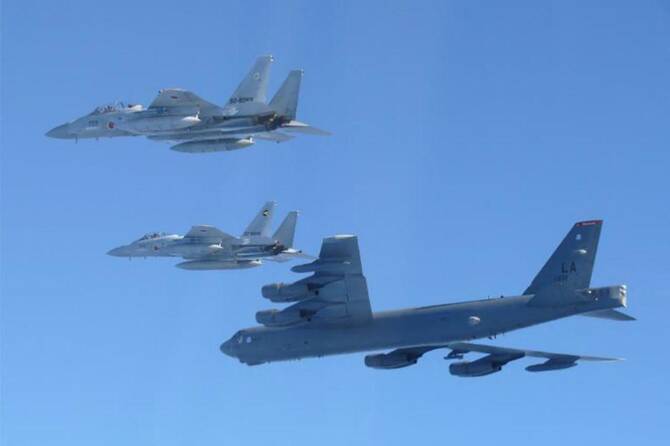
US Air Force B-52 strategic bomber (bottom) and two Japan Air Self-Defense Force F-15 fighter jets conducting a joint exercise over the Sea of Japan. (AFP)
Short Url
Updated 11 December 2025
Follow

US, Japan hold joint air exercise after China-Russia patrols

  • The joint exercise came as the United States criticized Beijing for the first time on Wednesday after Chinese military aircraft locked radar onto Japanese jets on Saturday

TOKYO: Japan said Thursday it held a joint air exercise with the United States in a show of force, days after Chinese-Russian patrols in the region and following weeks of diplomatic feuding between Tokyo and Beijing.
The Japanese joint chiefs of staff said Wednesday’s exercise with the US Air Force was conducted in “an increasingly severe security environment surrounding our country.”
Tokyo said Wednesday that two Russian Tu-95 nuclear-capable bombers flew a day earlier from the Sea of Japan to rendezvous with two Chinese H-6 bombers in the East China Sea, then conducted a joint flight around the country.
Japan said that it scrambled fighter jets in response.
Prime Minister Sanae Takaichi angered Beijing last month by suggesting that Japan would intervene with military force in any Chinese attack on Taiwan.
Thursday’s announcement by Japan’s chiefs of staff said: “We confirmed the strong resolve of Japan and the United States not to allow any unilateral change of the status quo by force, as well as the readiness of the Self-Defense Forces and the US military.”
In a separate statement it said that the “tactical exercises” over the Japan Sea involved two US B52 bombers, three Japanese F-35 fighter jets and three Japanese F-15s.
The joint exercise came as the United States criticized Beijing for the first time on Wednesday after Chinese military aircraft locked radar onto Japanese jets on Saturday.
The J-15 jets from China’s Liaoning aircraft carrier twice locked radar on Japanese aircraft in international waters near Okinawa, according to Japan, which scrambled jets in response.
“China’s actions are not conducive to regional peace and stability,” a US State Department spokesperson told AFP on Wednesday.
“The US-Japan Alliance is stronger and more united than ever. Our commitment to our ally Japan is unwavering, and we are in close contact on this and other issues.”
Fighter jets use their radar for fire control to identify targets as well as for search and rescue operations.
Tokyo also summoned Beijing’s ambassador following the radar incident, over which the two countries offer differing accounts of events.
Japan said it scrambled its F-15 jets because it was worried about possible “airspace violations.”
Guo Jiakun, spokesman for the ministry of foreign affairs, accused Japan Wednesday of sending the jets “to intrude into the Chinese training area without authorization, conduct close-range reconnaissance and harassment, create tense situations, and continue to maliciously hype up the situation.”
Takaichi’s comments about intervening in any Taiwan emergency enraged Beijing as China claims the self-ruled island as its own and has not ruled out seizing it by force.
Tokyo was forced to deny a Wall Street Journal report that said US President Donald Trump had advised Takaichi not to provoke China over Taiwan’s sovereignty.
But Tokyo is apparently frustrated at the lack of public support from top officials in Washington and has urged the US to be more vocal, the Financial Times reported on Sunday.

‘Regrettable’

NATO chief Mark Rutte said on Wednesday that the radar incident and the joint Chinese-Russian patrols were “regrettable,” Japan’s Defense Minister Shinjiro Koizumi said on X.
The statement followed a 15-minute video conference between Rutte and Koizumi, the defense ministry said in a statement.
Rutte “affirmed that security in the Indo-Pacific and Euro-Atlantic regions is completely inseparable,” Koizumi said.
South Korea said Tuesday that Russian and Chinese warplanes also entered its air defense zone, with Seoul also deploying fighter jets that same day.
Beijing confirmed later on Tuesday that it had organized drills with Russia’s military according to “annual cooperation plans.”
Moscow also described it as a routine exercise, saying it lasted eight hours and that some foreign fighter jets followed the Russian and Chinese aircraft.


Russia has thrust world into new ‘age of uncertainty’: UK spy chief

Updated 4 sec ago
Follow

Russia has thrust world into new ‘age of uncertainty’: UK spy chief

  • In her maiden speech, Blaise Metreweli highlighted the “threat” posed by an “aggressive, expansionist and revisionist” Russia
  • “We are now operating in a space between peace and war,” added the new head of Britain’s MI6 foreign intelligence service

LONDON: Russia has propelled the world into an “age of uncertainty” and the UK is now operating in “a space between peace and war,” Britain’s new MI6 spy chief said Monday.
“Let’s be in no doubt. Our world is more dangerous and contested now than it has been for decades,” Blaise Metreweli, the first woman to lead the MI6 Secret Intelligence Service (SIS), warned.
“Conflict is evolving and trust eroding, just as new technologies spur both competition and dependence,” she said.
In her maiden speech, the new head of Britain’s MI6 foreign intelligence service highlighted the “threat” posed by an “aggressive, expansionist and revisionist” Russia.
In its war against Ukraine, Russian President Vladimir Putin “is dragging out negotiations and shifting the cost of war onto his own population,” she said.
“Russia is testing us in the grey zone with tactics that are just below the threshold of war,” she added.
Metreweli highlighted tactics by Moscow to “bully, fearmonger and manipulate” through cyberattacks on critical infrastructure, drones buzzing around European airports, aggressive activity on the seas and state-sponsored arson.
“Across the globe, we are now confronting not one single danger, but an interlocking web of security challenges — military, technological, social, ethical even — each shaping the other in complex ways,” she said.
“We are now operating in a space between peace and war.”
And Metreweli warned that “our world is being actively remade, with profound implications for national and international security.
“Institutions which were designed in the ashes of the Second World War are being challenged.”
Metreweli was appointed in June as the 18th head of the service. The MI6 chief is the only publicly named member of the organization and reports directly to the foreign minister.
She warned of the increasingly complex nature of global threats, adding the “front line is everywhere” as a result of cyber disruption, hybrid warfare, “terrorism and information manipulation.”

- ‘National resilience’ -

The new head of Britain’s armed forces, Richard Knighton, meanwhile was Monday to call for “national resilience” in another speech at the Royal United Services Institute (RUSI), a think tank specializing in defense.
“The situation is more dangerous than I have known during my career and the response requires more than simply strengthening our armed forces,” the chief of defense staff will say, according to a Ministry of Defense (MoD) statement.
“A new era for defense doesn’t just mean our military and government stepping up — as we are — it means our whole nation stepping up.”
Knighton will announce £50 million ($67 million) in funding for new “Defense Technical Excellence Colleges” to help defense employers train up staff.
The speeches come as Prime Minister Keir Starmer was due in Berlin later Monday for talks with Ukrainian President Volodymyr Zelensky and European leaders on how to end Moscow’s nearly four-year invasion.
Britain has repeatedly warned of the threat from Russia, recently raising the alarm after the government said a Russian military ship was sighted near British waters.
The MoD has just launched a new organization — the Military Intelligence Services — to unify intelligence gathering and sharing efforts undertaken by the army, navy and air force.
“The announcement comes amid escalating threats to the UK, as adversaries intensify cyber-attacks, disrupt satellites, threaten global shipping lanes, and spread disinformation,” the MoD said on Friday.