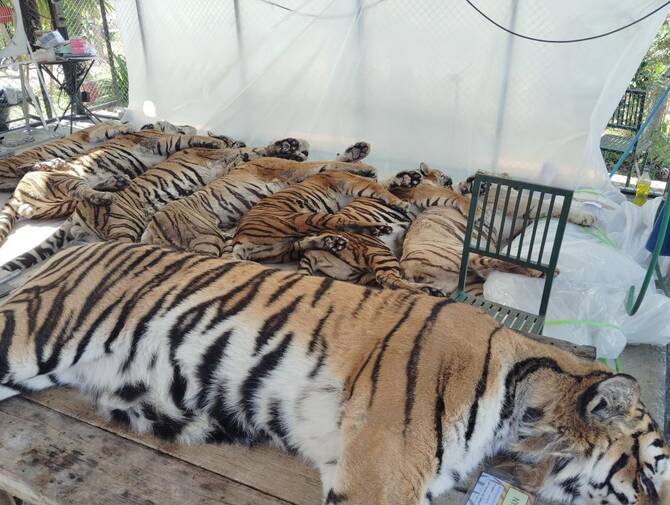
BANGKOK: The deaths of 72 tigers in two animal parks for tourists in northern Thailand shouldn’t be a major concern for the public, officials said Tuesday, because they were caused by a virus not known to affect humans, rather than bird flu.
No one has shown any symptoms so far, but authorities were nonetheless monitoring the health of people who had recently come into contact with the animals.
“There has not been an animal-to-human infection case,” Public Health Minister Pattana Promphat said at a news conference at Government House in Bangkok.
The tigers in the parks in Mae Taeng and Mae Rim districts in Chiang Mai province became sick and died during a roughly 10-day period between Feb. 8-18.
On Friday, the Chiang Mai regional livestock office announced in a statement that autopsies of the animals found genetic material of canine distemper virus, or CDV, and traces of bacterial infection, but no avian influenza type A virus, also known as bird flu.
“If we detect any sick persons, we will prepare for a nationwide monitoring measure,” said Monthien Khanasawat, director-general of the Public Health Ministry’s Disease Control Department. “This will include contact tracing and treatment as necessary.”
Monthien spoke at the news conference in an apparent effort to reassure the public that the tigers’ deaths didn’t come from bird flu, which has been resurgent in parts of Asia. Thailand saw 17 deaths among 25 infected patients from poultry-caused influenza from 2004 to 2007, according to the Public Health Ministry.
CDV, infectious for both dogs and felines, can cause stronger symptoms in cats and tigers and can be spread through bodily fluids and air. Thai authorities said that tigers in confined environments, and which are already affected by stress and inbreeding conditions, could be particularly vulnerable to the viral infection.
The remains of the tigers went through necropsies before being cremated and buried. The carcasses were properly disinfected, photographed and discarded to prevent any further use, Livestock Development Department Director-General Somchuan Rattanamangklanan said at the news conference.
But Visit Arsaithamkul, a veterinarian who took part in the tiger necropsies, expressed concern that the origins of the infections remained unclear without further investigation. In a Facebook post, he said that he suspected that as the two parks were located just 30 kilometers (18 miles) apart, the cause of infection could be food the tigers were fed that came from the same source.
He declined to elaborate when contacted by The Associated Press. Both parks, run under the name of Tiger Kingdom, remain closed. The operators didn’t immediately respond when asked for comment.
Thai authorities are still alert for the threat of a bird flu outbreak. Monthien, the Public Health Ministry director, urged Thais to be careful with their consumption of poultry after a man in a neighboring country that he didn’t name was found infected with bird flu.
The first animal-to-human transmission of bird flu was discovered in Hong Kong in 1997 before a pandemic started spreading in Asia in 2003. In Thailand, tens of millions of poultry were exterminated and consumption plunged in fear of getting infected.


Thai officials say 72 tigers at tourist parks died of canine distemper, allaying bird flu fears
https://arab.news/vsykp
Thai officials say 72 tigers at tourist parks died of canine distemper, allaying bird flu fears

- “There has not been an animal-to-human infection case,” Promphat said
- “If we detect any sick persons, we will prepare for a nationwide monitoring measure,” said Khanasawat


Viral phenomenon in Argentina has young people identifying themselves as animals
- As the movement gains traction, psychologists are stepping in to analyze the phenomenon and its place in public discourse
BUENOS AIRES: On a recent Sunday, a Buenos Aires plaza transformed into a makeshift wilderness for an unusual group of teenagers.
Sofía, wearing a lifelike beagle mask, ran across the grass on all fours. Nearby, 15-year-old Aguara leapt through the air, clearing an obstacle course while imitating the precise movements of a Belgian breed dog. Others dressed as cats and foxes perched in the branches of trees, keeping their distance from curious onlookers.
It was the latest gathering of “therians,” individuals who say they identify mentally, spiritually or psychologically with non-human animals. The trend has taken over Argentine social media over the past few months, gaining traction on platforms like TikTok, where the hashtag #therian has surpassed 2 million posts, with Argentina leading all other Latin American countries in engagement. The surge has drawn the attention of influencers and media outlets alike, sparking reactions that range from laughter and bewilderment to outright anger.
And as the movement gains traction, psychologists are stepping in to analyze the phenomenon and its place in public discourse.
Aguara, who claims to identify as a Belgian Malinois and counts her age as the equivalent of two years and two months in dog years, says she’s a lot like any other teenager.
“I wake up like a normal person and live my life like a normal person,” she said. “I simply have moments when I like being a dog.”
As the leader of what she calls her “pack,” Aguara — the name she identifies with — boasts more than 125,000 followers on TikTok and coordinates regular meetups around the Argentine capital.
Aru, a 16-year-old who wore a seal mask to the park meetup, said she considers herself part of the “otherpaw” branch of therians: individuals who wear masks and tails or move on all fours just for fun. “It’s not necessarily about identifying as an animal,” she said.
She reckons the therian trend took off in Argentina because of the country’s “fairly free” environment. For other young Argentines, the movement has provided a vital community where they can feel truly accepted.
Should parents be worried?
Débora Pedace, a psychologist and director of the Integral Therapeutic Center in Buenos Aires, acknowledged that the phenomenon generates a complex mix of confusion, laughter and even anger.
“From a psychological standpoint, this is a symbolic identification with an animal,” Pedace said. “It becomes pathological or alarming only when it turns into a deeply rooted belief and the person fully assumes the role of an animal, potentially leading to self-harm or hurting others.”


