

Pakistan approves upgrades to national ID cards in push to strengthen digital ecosystem

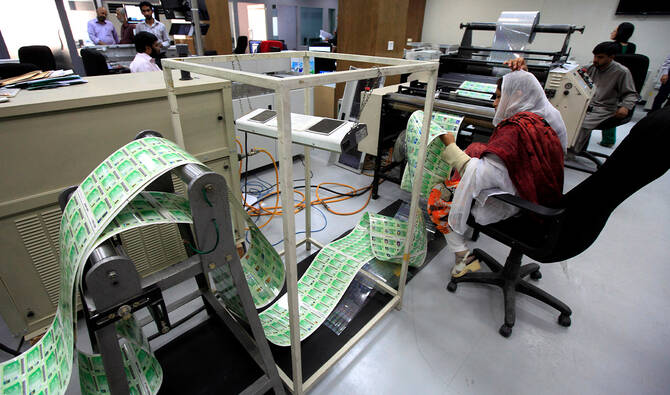
A worker of the National Database and Registration Authority (NADRA) checks newly printed identity cards of registered citizens at the NADRA head office in Islamabad, Pakistan, on November 14, 2012. (Reuters/File)
Short Url
Updated 24 February 2026
Follow

Pakistan approves upgrades to national ID cards in push to strengthen digital ecosystem

  • The amendments allow for QR-based verification, authentication controls, biometric expansion, and card format updates
  • The measures advance integrated digital governance through National Data Exchange Layer and broader digital ID ecosystem

ISLAMABAD: Pakistan has notified amendments to the National Identity Card and Pakistan Origin Card rules and introduced QR-based verification and stronger fraud controls, the National Database and Regulatory Authority (NADRA) said on Tuesday, amid efforts to strengthen the country’s digital ecosystem.

The amendments modernize Pakistan’s identity document framework by legally embedding QR-based verification, strengthening authentication controls across digital services, expanding biometric recognition and updating card formats for key citizen categories.

A core reform is the statutory introduction of the Quick Response (QR) code as a defined security and verification feature, authorizing the use of “QR code or any other technological feature” in lieu of current microchip enabling NADRA to adopt evolving verification technologies without repeated rule amendments.

This QR-enabled capability directly strengthens Pakistan’s Digital ID ecosystem and supports interoperability through the National Data Exchange Layer, according to the national database regulator.

“This establishes a robust legal basis for quick and secure verification of identity credentials in both offline and online environments,” NADRA said.

“This will also enable all citizens to carry similar card instead of currently prevalent two types of national identity cards one of which is with microchip and the other without.”

Pakistani state media reported in August that the country was developing digital identities of all its citizens to enable secure and efficient payments. The measures came as part of a broader effort to digitize the economy for greater transparency.

QR-based credentials allow rapid front-end validation of identity attributes in service delivery settings, while also enabling back-end systems to confirm authenticity and status through trusted exchanges. This is expected to improve speed, transparency and consistency of identity verification across government entities and regulated sectors, reduce manual handling, and lower the risk of fraud and impersonation, according to NADRA.

The amendments also strengthen the enforcement effect of card suspension. The Rules now clarify that where a card is suspended, all verification, authentication and related services linked to that card shall stand suspended forthwith. This closes a key risk area by ensuring that once a card is suspended, it cannot continue to be used through digital verification channels or institutional authentication processes.

“The amendments also introduce standardized identification for residents of Azad Jammu and Kashmir by requiring an inscription indicating ‘Resident of Azad Jammu and Kashmir’ in the manner specified by the Authority, thereby ensuring uniform geographic identification on the document,” NADRA said.

“Overall, these amendments strengthen the legal and technological foundations of Pakistan’s identity system by enabling secure QR-based verification, reinforcing the integrity of digital authentication services, improving biometric assurance,” it said. “They also advance readiness for integrated digital governance by supporting structured interoperability through the National Data Exchange Layer and a broader Digital ID ecosystem.”


China’s mediation eases fighting between Pakistan, Afghanistan — sources

Updated 4 sec ago
Follow

China’s mediation eases fighting between Pakistan, Afghanistan — sources

  • China’s envoy shuttles between Pakistan and Afghanistan to mediate in conflict
  • Gulf countries that mediated in the past embroiled in Middle East conflict

ISLAMABAD/BEIJING: Chinese mediation efforts, including a message from ​President Xi Jinping, have helped ease the worst fighting between Pakistan and Afghanistan since the Taliban returned to power in 2021, three Pakistani government officials said.

The officials said a meeting between the Chinese ambassador to Pakistan, Jiang Zaidong, and Prime Minister Shehbaz Sharif late last month included a message from Xi to cease hostilities.

Neither side has reported any Pakistani air strikes on Afghanistan in recent days and ground fighting along the 2,600-km (1,600-mile) border has tapered off, although daily clashes continue to be reported.

China has said it is ‌in contact ‌with both countries about ending hostilities but Mosharraf Zaidi, a ​spokesman ‌for ⁠Sharif who ​has previously ⁠said there would not be any talks with the Taliban, did not respond to questions about Beijing’s efforts.

Pakistani security officials have said the military campaign will continue until desired goals were achieved, which was to prevent militant attacks in Pakistan launched from Afghan soil.

Pakistan’s foreign ministry and military did not respond to Reuters requests for comment.

Islamabad launched air strikes on Afghanistan on February 26, saying the Taliban were providing a safe haven to ⁠militants carrying out attacks in Pakistan. Kabul denies the charge ‌and says militancy in Pakistan is an internal problem.

The ‌Chinese efforts came as Qatar, Saudi Arabia and ​Turkiye, who hosted talks between Pakistan and ‌Afghanistan during previous clashes in October, have been embroiled in the war in the Middle ‌East following the US and Israeli strikes on Iran.

“China’s Special Envoy for Afghanistan Affairs is currently shuttling between the two countries to mediate, while Chinese embassies in both nations maintain close communication with the respective parties,” the Chinese foreign ministry told Reuters in an email.

“The most urgent task ‌is to prevent the fighting from expanding and for the two countries to return to the negotiating table as soon as possible.”

The ⁠foreign ministry added ⁠that Foreign Minister Wang Yi held telephone talks with Pakistan’s Deputy Prime Minister and Foreign Minister Ishaq Dar on Tuesday to discuss the conflict.

China’s ambassador to Kabul, Zhao Xing, and the special envoy Yue Xiaoyong met Afghanistan’s acting Foreign Minister Amir Khan Muttaqi this week, the Afghan foreign ministry said in a statement.

Afghanistan and Pakistan have said they inflicted heavy damage on the other in the conflict and killed hundreds of opposition troops, without providing evidence. Reuters has not been able to verify the reports.

Beijing, a longtime Pakistani ally, has invested heavily in mines and minerals in both nations.

The investments include over $65 billion in road, rail and other development projects in Pakistan, part ​of Beijing’s Belt and Road Initiative to ​expand land and sea trade routes to Europe and Africa.