

Pakistan says Afghan forces opened ‘unprovoked’ border fire, warns of retaliation

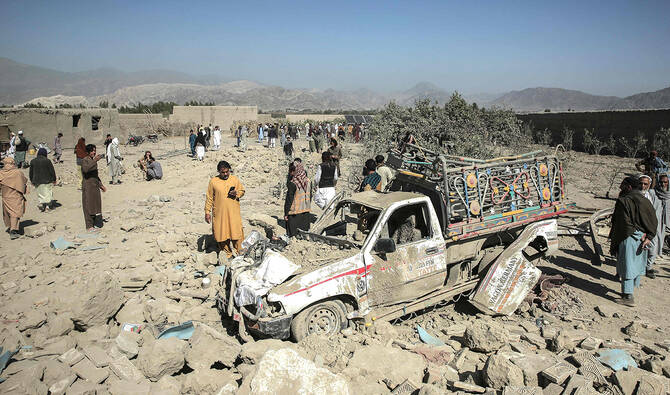
Afghan men gather near a damaged car after an overnight Pakistani airstrike at the Girdi Kas village in Bihsud district, Nangarhar province, Afghanistan, on February 22, 2026. (AFP)
Short Url
Updated 24 February 2026
Follow

Pakistan says Afghan forces opened ‘unprovoked’ border fire, warns of retaliation

  • Incident follows Pakistan’s weekend strikes on TTP and Daesh targets inside Afghanistan
  • Escalation threatens fragile ceasefire along 2,600-km frontier linking South and Central Asia

ISLAMABAD: Pakistan on Tuesday accused Afghan Taliban forces of opening “unprovoked” fire along their shared border and warned that any further aggression would draw a swift response.

The latest exchange comes amid sharply rising tensions between the two neighbors following Pakistan’s weekend strikes targeting what it described as Tehreek-e-Taliban Pakistan (TTP) and Daesh militant camps inside Afghanistan. Kabul said the strikes killed civilians and condemned them as violations of its sovereignty, vowing to respond.

Cross-border violence has intensified since Pakistan blamed recent suicide bombings in Islamabad, Bajaur and Bannu on militants it says are based in Afghanistan. Islamabad maintains that militant safe havens across the border are driving a surge in attacks inside Pakistan, a charge Kabul denies.

Mosharraf Zaidi, Prime Minister Shehbaz Sharif’s spokesperson for foreign media, said Afghan forces opened fire near the Torkham border crossing and Tirah Valley in Pakistan’s northwest.

“Pakistan’s security forces responded immediately and effectively silencing the Taliban aggression,” he told Arab News. “Any further provocation will be responded to immediately and severely, god willing. Pakistan will continue to protect its citizens and guard its territorial integrity.”

The incident marks the second major escalation in less than a year. Similar Pakistani strikes last year triggered weeklong clashes before Qatar, Turkiye and other regional actors mediated a tenuous ceasefire in October.

The 2,600-kilometer (1,600-mile) frontier, a key trade and transit corridor linking Pakistan to landlocked Afghanistan and onward to Central Asia, has faced repeated closures amid tensions, disrupting commerce and humanitarian movement. Trade between the two nations has remained closed since October.

Analysts warn that sustained military exchanges risk undermining diplomatic efforts to stabilize ties, including a Saudi-mediated initiative earlier this month that secured the release of three Pakistani soldiers.

Separately on Tuesday, Prime Minister Sharif discussed the situation in Afghanistan with Qatar’s Deputy Prime Minister Sheikh Saoud Al-Thani during talks in Doha, according to a statement from Sharif’s office. Both sides emphasized dialogue and de-escalation to promote regional stability.


Pakistan’s president defends ongoing strikes in Afghanistan, urges Kabul to dismantle militants

Updated 7 sec ago
Follow

Pakistan’s president defends ongoing strikes in Afghanistan, urges Kabul to dismantle militants

  • Afghanistan on Thursday launched attacks in retaliation for Pakistani airstrikes the previous Sunday
  • Pakistan’s military says it is only targeting Afghan military installations to avoid civilian casualties

ISLAMABAD: Pakistan’s president on Monday defended his country’s ongoing military strikes in neighboring Afghanistan, saying Islamabad tried all forms of diplomacy before targeting militants operating from Afghan territory, and called on the Taliban government in Kabul to disarm groups responsible for attacks in Pakistan.

Pakistan earlier said it is in “open war” with Afghanistan, alarming the international community. The border area remains a stronghold for militant organizations including Al-Qaeda and the Daesh (Islamic State) group.

“(The Afghan Taliban) must choose to dismantle the terror groups that survive on conflict and its war economy,” Asif Ali Zardari said during a speech to lawmakers, adding that “no state accepts serial attacks on its soil.”

Afghanistan on Thursday launched attacks in retaliation for Pakistani airstrikes the previous Sunday. Since then, Pakistan has carried out operations along the border, with Information Minister Attaullah Tarar claiming the killing of 435 Afghan forces and the capture of 31 Afghan positions.

Kabul has denied such claims.

In Afghanistan, the deputy government spokesman Hamdullah Fitrat said Pakistan’s military fired mortar shells at a refugee camp in eastern Kunar province, killing three children and injuring three others.

Afghanistan’s defense ministry said Afghan forces carried out strikes targeting a Pakistani military facility near Paktia province, causing “substantial losses and heavy casualties.”

Pakistan’s military did not respond to questions. It has said Pakistan is only targeting Afghan military installations to avoid civilian casualties.

Pakistan has witnessed a surge of violence in recent months and blames it on the outlawed Pakistani Taliban, known as Tehreek-e-Taliban Pakistan or TTP. It operates both inside Pakistan and from Afghan territory.
Islamabad accuses Afghanistan’s Taliban government of providing safe havens for the TTP, which Kabul denies.

The latest cross-border fighting ended a ceasefire brokered by Qatar and Turkiye in October. The two sides failed to reach a permanent agreement during talks in Istanbul.

Zardari reiterated Pakistan’s call for talks, saying, “We have never walked away from dialogue.”

The Pakistani leader again accused Afghanistan of acting as a proxy for India by sheltering militant groups.

“Stop being used by another country as a battlefield for their ambitions,” he said.

Zardari cited a recent report from the United Nations Security Council’s monitoring team that described the presence of militant groups in Afghanistan as an extra-regional threat.