US bombers join Japanese jets in show of force after China–Russia drills

1 / 2
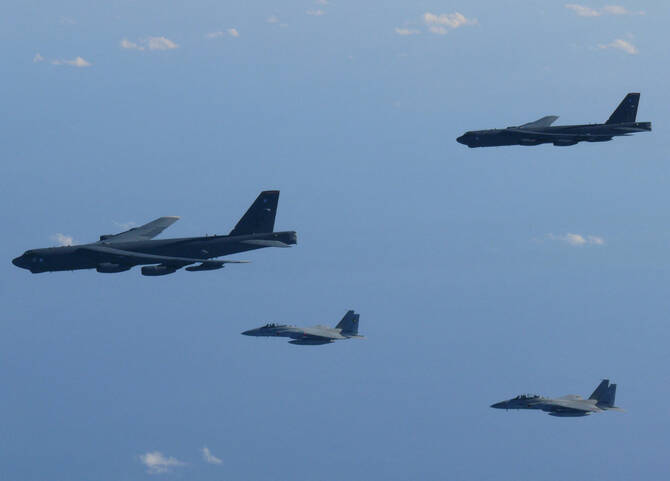
Japan Air Self-Defense Force's F-15 fighters hold a joint military drill with the US B-52 bombers over Sea of Japan on December 10, 2025. (Japan Defense Ministry/Handout via REUTERS)
2 / 2
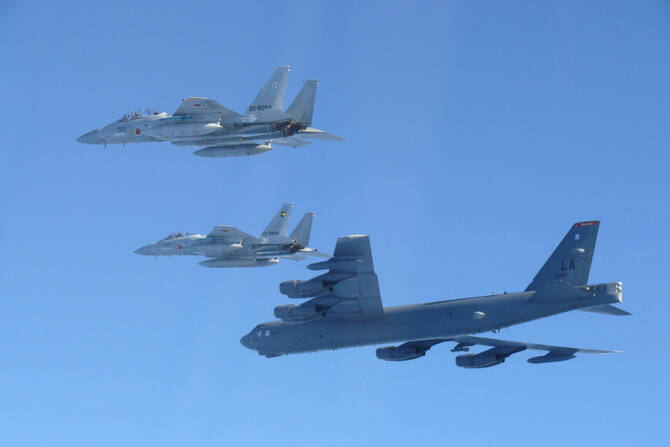
Japan Air Self-Defense Force's F-15 fighters hold a joint military drill with the US B-52 bombers over Sea of Japan on December 10, 2025. (Japan Defense Ministry/Handout via REUTERS)
Short Url
Updated 11 December 2025
Follow

US bombers join Japanese jets in show of force after China–Russia drills

  • Japan says US B-52 bombers flew with Japanese F-35s and F-15s
  • South Korea and Japan have scrambled jets during Chinese and Russian drills

TOKYO: US nuclear-capable bombers flew over the Sea of Japan alongside Japanese fighter jets on Wednesday, Tokyo said, in a show of force following Chinese and Russian drills in the skies and seas around Japan and South Korea.
Japan and the US “reaffirmed their strong resolve to prevent any unilateral attempt to change the status quo by force and confirmed the readiness posture of both the Self-Defense Forces (SDF) and US forces,” Japan’s defense ministry said in a press release on Thursday.
The flight of two US B-52 strategic bombers with three Japanese F-35 stealth fighters and three F-15 air-superiority jets was the first time the US had asserted its military presence since China began military exercises in the region last week.
The display follows a joint flight of Chinese and Russian strategic bombers in the East China Sea and western Pacific on Tuesday and separate Chinese aircraft carrier drills that prompted Japan to scramble jets that Tokyo said were targeted by radar beams.


A Russian Tu-95 nuclear-capable strategic bomber which flew from the Sea of Japan to the East China Sea to rendezvous with two Chinese H-6 bombers before heading into the Western Pacific on December 9, 2025. (Japan Self Defense Forces/Handout via REUTERS)

The encounter drew criticism from Washington, which said the incident was “not conducive to regional peace and stability” and reaffirmed that its alliance with Japan was “unwavering.”
Both Japan and South Korea host US forces, with Japan home to the biggest concentration of American military power overseas, including an aircraft carrier strike group and a US Marine expeditionary force.
China denied Tokyo’s accusation, saying Japanese jets flying near the carrier had endangered its air operations south of Japan.

South Korea’s military said it also scrambled fighter jets when the Chinese and Russian aircraft entered its air defense identification zone on Tuesday, an area that extends beyond its airspace and is used for early warning.


Chinese H6 nuclear-capable strategic bomber flies from the East China Sea over the Miyako Strait into the Western Pacific on December 9, 2025. (Japan Self Defense Forces/Handout via REUTERS)

Regional tensions have risen since Japanese Prime Minister Sanae Takaichi triggered a dispute with Beijing last month with her remarks on how Tokyo might react to a hypothetical Chinese attack on Taiwan.
China claims democratically governed Taiwan and has not ruled out using force to take control of the island, which sits just over 100 km (62 miles) from Japanese territory and is surrounded by sea lanes on which Tokyo relies. 


Trump insists he struck Iran on his own terms

Updated 04 March 2026
Follow

Trump insists he struck Iran on his own terms

  • “We are now a nation divided between those who want to fight wars for Israel and those who just want peace and to be able to afford their bills and health insurance,” Marjorie Taylor Greene posted on X.
  • Rubio himself doubled down on Tuesday after meeting with US House and Senate members, while insisting that “No, I told you this had to happen anyway”

WASHINGTON, United States: President Donald Trump and his team scrambled Tuesday to reclaim the narrative on why he decided to attack Iran, after his top diplomat suggested the US struck only after learning of an imminent Israeli strike.
Secretary of State Marco Rubio alarmed Democrats — who say only Congress can declare war — as well as many of Trump’s MAGA supporters on Monday when he said: “We knew that there was going to be an Israeli action.”
“We knew that that would precipitate an attack against American forces, and we knew that if we didn’t pre-emptively go after them before they launched those attacks, we would suffer higher casualties,” Rubio told reporters.
Administration officials quickly backpedalled, insisting Trump authorized the strikes because Tehran was not seriously negotiating an accord on limiting its nuclear ambitions, and the United States needed to destroy Iran’s missile capabilities.
“No, Marco Rubio Didn’t Claim That Israel Dragged Trump into War with Iran,” White House Press Secretary Karoline Leavitt posted Tuesday on X.
At an Oval Office meeting later with Germany’s chancellor, Trump went further, saying that “Based on the way the negotiation was going, I think they (Iran) were going to attack first. And I didn’t want that to happen.”
“So, if anything, I might have forced Israel’s hand.”

- Had to happen? -

Rubio himself doubled down on Tuesday after meeting with US House and Senate members, while insisting that “No, I told you this had to happen anyway.”
“The president made a decision. The decision he made was that Iran was not going to be allowed to hide... behind this ability to conduct an attack.”
Critics seized on the muddied messaging to accuse Trump of precipitating the country into a war without a clear rationale, without informing Congress — and without a clear idea of how it might end.
They noted that just two weeks ago, Israel Prime Minister Benjamin Netanyahu pressed Trump again in Washington to take a hard line, in their seventh meeting since Trump’s return to power last year.
Some Republican allies rallied behind the president, with Senator Tom Cotton, chairman of the Senate Intelligence Committee, insisting that “No one pushes or drags Donald Trump anywhere.”
“He acts in the vital national security interest of the United States,” Cotton told the “Fox & Friends” morning show.
But as crucial US midterm elections approach that could see Republicans lose their congressional majority, Trump risks shedding supporters who had welcomed his pledge to end foreign military interventions.
“We are now a nation divided between those who want to fight wars for Israel and those who just want peace and to be able to afford their bills and health insurance,” Marjorie Taylor Greene, a top former Trump ally and a major figure in the populist and isolationist hard right, posted on X.