

Sudanese paramilitary drone attack kills 50, including 33 children in Kordofan, doctor group says

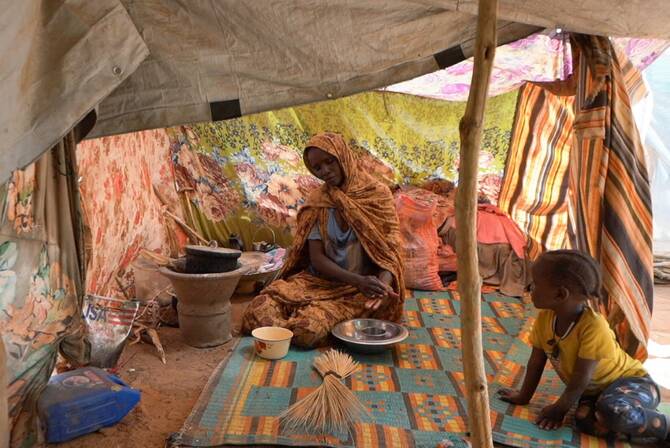
Awadeya, a Sudanese displaced woman who was held by the paramilitary Rapid Support Forces (RSF), at a camp, in Tawila. (Reuters)
Short Url
Updated 06 December 2025
Follow

Sudanese paramilitary drone attack kills 50, including 33 children in Kordofan, doctor group says

  • The group condemned the attack, blaming RSF for the strikes, calling them “a flagrant violation of international humanitarian law”
  • The death toll is expected to be higher, but communication blackouts in the area have made it difficult to report casualties

CAIRO: A drone attack by the Sudanese paramilitary forces hit a kindergarten in south-central Sudan, killing 50 people, including 33 children, a doctors’ group said.
Paramedics on the scene in the town of Kalogi in South Kordofan state were targeted in “a second unexpected attack,” Sudan Doctors’ Network said in a statement late Friday.
Emergency Lawyers, a rights group tracking violence against civilians in Sudan reported in a statement Saturday the second strike on paramedics treating survivors in Kalogi and said “a third civilian site near the previous two” was also attacked.
The group condemned the attack, blaming the paramilitary group, the Rapid Support Forces, or RSF, for the strikes, calling them “a flagrant violation of international humanitarian law, including the protection of civilians, especially children, and vital civilian infrastructure.”

The death toll is expected to be higher, but communication blackouts in the area have made it difficult to report casualties.
Thursday’s attack is the latest in the fighting between the RSF, and the Sudanese military, who have been at war for over two years. It is now concentrating in the oil-rich Kordofan states.
“Killing children in their school is a horrific violation of children’s rights,” said UNICEF Representative for Sudan Sheldon Yett in a statement Friday.
“Children should never pay the price of conflict,” said Yett.
He said UNICEF urges all parties “to stop these attacks immediately and allow safe, unhindered access for humanitarian assistance to reach those in desperate need.”
Hundreds of civilians were killed throughout the Kordofan states in the last few weeks as intensified fighting shifted from Darfur after the RSF took over the besieged city of el-Fasher.
Sudanese military aerial strikes on Sunday killed at least 48 people, mostly civilians, in Kauda, South Kordofan.
UN Human Rights Chief Volker Türk warned that Kordofan could face new atrocities like those in el-Fasher.
Separately, the RSF condemned in a statement Friday a drone strike on the Chad-Sudan border, accusing the Sudanese military of being behind it and posted a video showing billowing black smoke. This couldn’t be independently verified and it is unclear whether there were casualties in this strike. There was no immediate comment from the Sudanese military.
RSF’s violent takeover of el-Fasher was marked with executions of civilians, rapes and sexual assaults, and other atrocities. Thousands escaped and thousands more are feared killed or trapped in the city.
The RSF and the Sudanese military have been fighting for power over Sudan since 2023. More than 40,000 people were killed in the war, according to the World Health Organization, and 12 million displaced. However, aid groups say the true death toll could be way higher.


Trump warns Iran of ‘very traumatic’ outcome if no nuclear deal

Updated 12 February 2026
Follow

Trump warns Iran of ‘very traumatic’ outcome if no nuclear deal

  • Speaking a day after he hosted Netanyahu at the White House, Trump said he hoped for a result “over the next month”

WASHINGTON: US President Donald Trump threatened Iran Thursday with “very traumatic” consequences if it fails to make a nuclear deal — but Israeli Prime Minister Benjamin Netanyahu said he was skeptical about the quality of any such agreement.
Speaking a day after he hosted Netanyahu at the White House, Trump said he hoped for a result “over the next month” from Washington’s negotiations with Tehran over its nuclear program.
“We have to make a deal, otherwise it’s going to be very traumatic, very traumatic. I don’t want that to happen, but we have to make a deal,” Trump told reporters.
“This will be very traumatic for Iran if they don’t make a deal.”
Trump — who is considering sending a second aircraft carrier to the Middle East to pressure Iran — recalled the US military strikes he ordered on Tehran’s nuclear facilities during Israel’s 12-day war with Iran in July last year.
“We’ll see if we can get a deal with them, and if we can’t, we’ll have to go to phase two. Phase two will be very tough for them,” Trump said.
Netanyahu had traveled to Washington to push Trump to take a harder line in the Iran nuclear talks, particularly on including the Islamic Republic’s arsenal of ballistic missiles.
But the Israeli and US leaders apparently remained at odds, with Trump saying after their meeting at the White House on Wednesday that he had insisted the negotiations should continue.

- ‘General skepticism’ -

Netanyahu said in Washington on Thursday before departing for Israel that Trump believed he was laying the ground for a deal.
“He believes that the conditions he is creating, combined with the fact that they surely understand they made a mistake last time when they didn’t reach an agreement, may create the conditions for achieving a good deal,” Netanyahu said, according to a video statement from his office.
But the Israeli premier added: “I will not hide from you that I expressed general skepticism regarding the quality of any agreement with Iran.”
Any deal “must include the elements that are very important from our perspective,” Netanyahu continued, listing Iran’s ballistic missile program and its support for armed groups such as the Palestinian movement Hamas, Yemen’s Houthi rebels and Hezbollah in Lebanon.
“It’s not just the nuclear issue,” he said.
Despite their differences on Iran, Trump signaled his strong personal support for Netanyahu as he criticized Israeli President Isaac Herzog for rejecting his request to pardon the prime minister on corruption charges.
“You have a president that refuses to give him a pardon. I think that man should be ashamed of himself,” Trump said on Thursday.
Trump has repeatedly hinted at potential US military action against Iran following its deadly crackdown on protests last month, even as Washington and Tehran restarted talks last week with a meeting in Oman.
The last round of talks between the two foes was cut short by Israel’s war with Iran and the US strikes.
So far, Iran has rejected expanding the new talks beyond the issue of its nuclear program. Tehran denies seeking a nuclear weapon, and has said it will not give in to “excessive demands” on the subject.