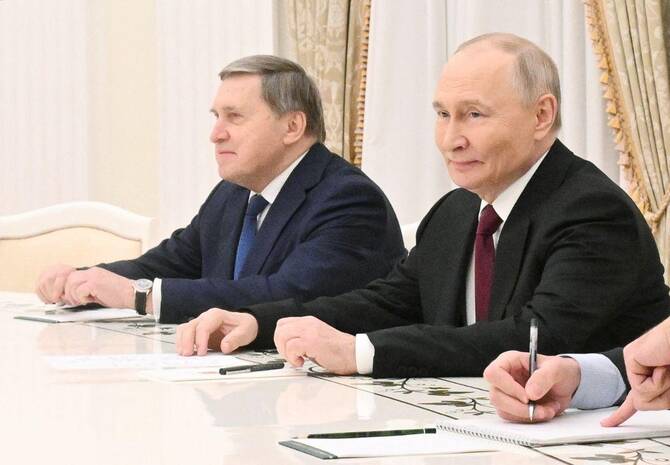
MOSCOW: Russian President Vladimir Putin accused Kyiv’s European allies Tuesday of sabotaging US-led efforts to end the nearly 4-year-old war in Ukraine, shortly before he met with a delegation sent by President Donald Trump.
“They don’t have a peace agenda, they’re on the side of the war,” Putin said of the Europeans prior to talks in the Kremlin with US special envoy Steve Witkoff and Trump’s son-in-law Jared Kushner.
Putin ‘s accusations appeared to be his latest attempt to sow dissension between Trump and European countries and set the stage for exempting Moscow from blame for any lack of progress.
He accused Europe of amending peace proposals with “demands that are absolutely unacceptable to Russia,” thus “blocking the entire peace process” and blaming Moscow for it.
“That’s their goal,” Putin said.
He reiterated his long-held position that Russia has no plans to attack Europe — a concern regularly voiced by some European countries.
“But if Europe suddenly wants to wage a war with us and starts it, we are ready right away. There can be no doubt about that,” Putin said.
Russia started the war in 2022 with its full-scale invasion of a sovereign European country, and European governments have since spent billions of dollars to support Ukraine financially and militarily, to wean themselves from energy dependence on Russia, and to strengthen their own militaries to deter Moscow from seizing more territory by force.
They worry that if Russia gets what it wants in Ukraine, it will have free rein to threaten or disrupt other European countries, which already have faced incursions from Russian drones and fighter jets, and an alleged widespread Russian sabotage campaign.
Trump’s peace plan relies on Europe to provide the bulk of the financing and security guarantees for a postwar Ukraine, even though no Europeans appear to have been consulted on the original plan. That’s why European governments have pushed to ensure that peace efforts address their concerns, too.
Speaking with Putin via a translator before the talks, Witkoff said he and Kushner had taken “a beautiful walk” around Moscow and described it as a “magnificent city.” After four hours, negotiations were still ongoing behind closed doors.
Coinciding with Witkoff’s trip, Ukrainian President Volodymyr Zelensky went to Ireland, continuing his visits to European countries that have helped sustain his country’s fight against Russia’s invasion.
High-stakes negotiations
In what could be a high-stakes day of negotiations, Zelensky said he was expecting swift reports from the US envoys in Moscow on whether talks could move forward, after Trump’s initial 28-point plan was whittled down to 20 items in Sunday’s talks between US and Ukrainian officials in Florida.
“They want to report right after that meeting to us, specifically. The future and the next steps depend on these signals. Such steps will change throughout today, even hour by hour, I believe,” Zelensky said at a news conference in Dublin with Irish Prime Minister Micheál Martin.
“If the signals show fair play with our partners, we then might meet very soon, meet with the American delegation,” he said.
“There is a lot of dialogue, but we need results. Our people are dying every day,” Zelensky said. “I am ready ... to meet with President Trump. It all depends on today’s talks.”
Building on progress in Florida
After months of frustration in trying to stop the fighting, Trump deployed officials to get traction for his peace proposals. Kremlin spokesman Dmitry Peskov said Putin’s talks with Witkoff and Kushner would take “as long as needed.”
The talks have followed parallel lines so far, with US Secretary of State Marco Rubio sitting down with Ukrainian officials.
Zelensky said he met Tuesday with the Ukrainian delegation that returned from the negotiations with US representatives in Florida. Rubio said those talks made progress, but added that “there’s more work to be done.”
Zelensky said the Florida talks took as their cue a document that both sides drafted at an earlier meeting in Geneva. The Ukrainian leader said that document was now “finalized,” although he didn’t explain what that meant.
Ukrainian diplomats are working to ensure that European partners are “substantially involved” in decision-making, Zelensky said on the Telegram messaging app, and warned about what he said were Russian disinformation campaigns aimed at steering the negotiations.
“Ukrainian intelligence will provide partners with the information we have about Russia’s true intentions and its attempts to use diplomatic efforts as cover to ease sanctions and block important collective European decisions,” Zelensky said.
European leaders want a say
Zelensky met with political leaders and lawmakers in Dublin on his first official visit. Ireland is officially neutral and isn’t a member of NATO but has sent nonlethal military support to Ukraine. More than 100,000 Ukrainians have moved to Ireland since Russia launched its war on Feb. 24, 2022.
Although this week’s consultations could move the process forward, few details have become public. It remains unclear how envoys are going to bridge the gap between the two sides on such basic differences as who keeps what territory. European officials say the road to peace will be long.
European leaders want to make their voices heard after being largely sidelined by Washington. They are also working on future security guarantees for Ukraine.
Zelensky was in Paris on Monday, and French President Emmanuel Macron said they spoke by phone with Witkoff. They also spoke to leaders of eight other European countries as well as top European Union officials and NATO Secretary-General Mark Rutte.
Macron said the coming days will see “crucial discussions” between US officials and Western partners. Zelensky’s Paris visit followed Sunday’s meeting between Ukrainian and US officials, which Rubio described as productive.
Diplomats face a hard time trying to bridge Russian and Ukrainian differences and persuading them to strike compromises. The key obstacles — over whether Kyiv should cede land to Moscow and how to ensure Ukraine’s future security — appear unresolved.
Zelensky under pressure
Zelensky is under severe pressure in one of the darkest periods of the war for his country. As well as managing diplomatic pressure, he must find money to keep Ukraine afloat, address a corruption scandal that has reached the top echelons of his government, and keep Russia at bay on the battlefield.
The Kremlin late Monday claimed that Russian forces have captured the key city of Pokrovsk in the Donetsk region of eastern Ukraine. Zelensky, however, said in Paris that fighting was still ongoing in Pokrovsk on Monday.
Ukraine’s general staff on Tuesday also denied Russia’s claims to have captured Pokrovsk, saying it was a propaganda stunt. The Ukrainian army is readying additional logistic routes to deliver supplies to troops in the area, the Facebook post said.


![]()

Putin accuses Europeans of sabotaging peace efforts on Ukraine and meets US delegation
Short Url
https://arab.news/wh9hx
Putin accuses Europeans of sabotaging peace efforts on Ukraine and meets US delegation
- “They don’t have a peace agenda, they’re on the side of the war,” Putin said of the Europeans prior to talks in the Kremlin with Witkoff and Kushner
- He accused Europe of amending peace proposals with “demands that are absolutely unacceptable to Russia,”


Latest updates


© 2026 SAUDI RESEARCH & PUBLISHING COMPANY, All Rights Reserved And subject to Terms of Use Agreement.