Putin cannot leave Ukraine war successfully, German chancellor says

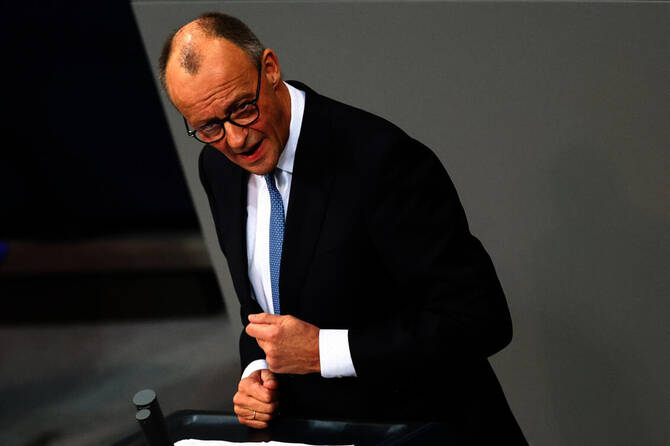
German Chancellor Friedrich Merz speaks during a budget debate at the lower house of parliament Bundestag in Berlin, Germany, November 26, 2025. (REUTERS)
Short Url
Updated 27 November 2025
Follow

Putin cannot leave Ukraine war successfully, German chancellor says

  • Germany will increase financial aid to Ukraine to $13.31 billion in the 2026 budget

BERLIN: Russian President Vladimir Putin must accept he has no option to leave the war in Ukraine successfully, German Chancellor Friedrich Merz said on Wednesday.
“We want this war to end as quickly as possible,” Merz said in the Bundestag lower house of parliament.
“But an agreement negotiated between great powers without the consent of Ukraine and without the consent of the Europeans will not be the basis for a genuine, sustainable peace in Ukraine,” he added.
Ukrainian President Volodymyr Zelensky said on Tuesday he was ready to advance a US-backed framework for ending the war with Russia and discuss disputed points with US President Donald Trump in talks he said should include European allies.
“Decisions about European matters can only be made by mutual consent,” Merz said. “Ukraine is not a pawn, but a sovereign actor for its own interests and values.”
The chancellor added that Germany would continue to support the Ukrainian people and would use frozen Russian assets for that purpose.
Germany will increase financial aid to Ukraine to 11.5 billion euros ($13.31 billion) in the 2026 budget, up from 8.5 billion euros previously planned.


‘Unofficial’ talks on plastic pollution treaty to begin in Japan

Updated 6 sec ago
Follow

‘Unofficial’ talks on plastic pollution treaty to begin in Japan

  • “Plastic pollution is a planetary problem that affects everyone: every country, every community and every individual,” Cordano warned after being elected

TOKYO: Delegates from around 20 countries will hold three days of “informal” talks in Japan from Sunday aimed at salvaging efforts toward a landmark global treaty on plastic pollution.
Supposedly final talks in South Korea in 2024 toward an agreement failed, and a renewed effort in Geneva last August likewise collapsed in overtime.
A Japanese Environment Ministry official said that the “informal” closed-door meeting among “working-level officials” through Tuesday was not expected to result in any official announcement.

If we don’t take concerted action, it will get much worse in the coming decades. A treaty is urgently needed.

Julio Cordano, Chile’s chief climate negotiator

“Japan is in a position of pushing for progress on the issue, and so is hosting the meeting,” the official told AFP without wishing to be named.
She added that “little progress” has been made since August, other than the election in early February of Chile’s chief climate negotiator Julio Cordano as chairman.
“Plastic pollution is a planetary problem that affects everyone: every country, every community and every individual,” Cordano warned after being elected.
“If we don’t take concerted action, it will get much worse in the coming decades. A treaty is urgently needed,” he said.
More than 400 million tonnes of plastic are produced globally each year, with half for single-use items.
A large bloc of states wants bold action such as curbing plastic production, while a smaller clutch of oil-producing states wants to focus more narrowly on waste  management.
Countries expected to be present in Tokyo include big oil producers like Saudi Arabia, Russia and the United States as well as islands states Antigua and Barbuda and Palau, plus China, India and the European Union.
The UN’s environment chief told AFP in an interview in October that a global treaty remains “totally doable.”
“No one has walked away and said, ‘this is just too hopeless, we’re giving up’,” United Nations Environment Programme executive director Inger Andersen said.