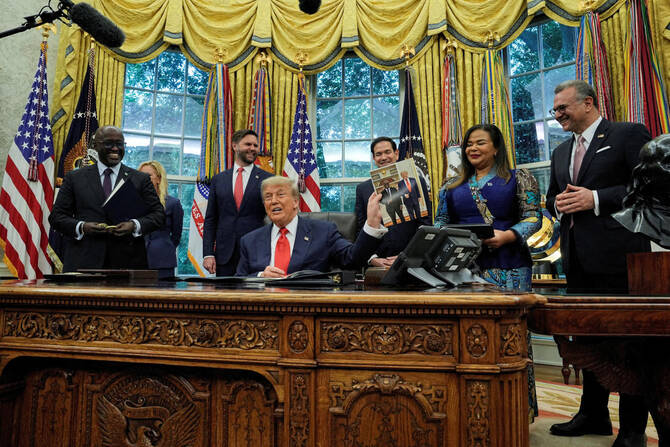
WASHINGTON: US President Donald Trump will bring together the leaders of Rwanda and the Democratic Republic of Congo in Washington on Thursday to sign a peace agreement, months after an earlier US-brokered deal failed to stop violence.
“President Trump will host the presidents of the Republic of Rwanda and the Democratic Republic of Congo to sign the historic peace and economic agreement that he brokered,” White House Press Secretary Karoline Leavitt told reporters on Monday.
Trump had met in June at the White House with the two countries’ foreign ministers as they signed an earlier deal, and has since boasted that DR Congo is one of a number of countries where he has ended war.
But violence has continued, with both sides blaming each other. It was not immediately clear how different the presidential-level agreement will be from the June deal.
Rwandan President Paul Kagame last week publicly accused the Congolese government of delaying the signing of a peace deal.
The region — rich in minerals vital to new technologies — has endured three decades of armed conflict, costing hundreds of thousands of lives.
Violence intensified in January when the Rwandan-backed M23 armed group captured swathes of territory, including the cities of Goma and Bukavu.
Rwanda has made the end of its “defensive measures” contingent on Kinshasa neutralizing the Democratic Forces for the Liberation of Rwanda (FDLR), an ethnic Hutu group with links to the 1994 genocide in Rwanda.
Trump has voiced hope for securing minerals from the eastern DRC, giving a boost to the United States over China.
In talks last month in Washington, Rwanda and the DRC “recognized lagging progress” in implementation of the June agreement but agreed to work on easing tensions.

White House says DR Congo, Rwanda to sign deal Thursday
Short Url
https://arab.news/jej2c
White House says DR Congo, Rwanda to sign deal Thursday
- The region has endured three decades of armed conflict, costing hundreds of thousands of lives
- The peace agreement comes months after an earlier US-brokered deal failed to stop violence
Putin and Modi to discuss Russia-India trade and defense ties amid US pressure
NEW DELHI: Russian President Vladimir Putin is set to hold talks with Indian Prime Minister Narendra Modi on Friday at an annual summit aimed at strengthening bilateral ties on the second day of his state visit.
The 23rd Russia-India Summit comes at a pivotal moment as the United States pushes for a Ukraine peace deal while seeking global cooperation. They will test New Delhi’s efforts to balance relations with Moscow and Washington as the nearly four-year war in Ukraine grinds on.
Putin was received by Modi at an airport in New Delhi on Thursday, who gave the visting leader a bear hug and a tight handshake with the gusto of an old friend.
According to Indian officials involved in the preparation for the summit, the agenda includes talks on defense, energy and labor mobility.
While India has historically maintained deep ties with Russia, critics say Putin’s visit could strain relations with the European Union and the United States and might jeopardize negotiations for major trade agreements with both that are seen as critical for India’s exports.
US President Donald Trump raised tariffs on Indian goods to 50 percent in August, citing New Delhi’s discounted Russian oil. India has been the second biggest importer of Russian crude after China.
The US says purchases of Russian oil help finance Moscow’s war machine. In October, US sanctioned two of Moscow’s biggest oil producers to force countries like India to cut down on imports. Indian officials have said New Delhi has always abided by international sanctions and would do so in the case of Russia oil purchases as well.
India and the US set a target for the first tranche of a trade deal by the fall, but the deal hasn’t come through yet amid strains in relations.
India is also in the final stages of talks on a trade agreement with the EU, which sees Russia’s war in Ukraine as a major threat.
In his meeting with Putin, Modi is likely to push for faster delivery of two further more Russian S-400 surface-to-air missile systems. It has already received three under a 2018 deal worth about $5.4 billion. The delay has been tied to supply chain disruptions linked to the war in Ukraine.
The two sides signed a pact in February to improve military cooperation, exercises, port calls, disaster relief assistance and logistics support. Moscow’s State Duma ratified the same ahead of Putin’s India visit.
Talks are also expected on upgrading India’s Russian-made Su-30MKI fighter jets and accelerating deliveries of critical military hardware.
Trade is also expected to be a major point in talks.
Bilateral trade between the two countries stood at $68.7 billion in the last fiscal year ended March, while the aim is to boost it to $100 billion by 2030. The trade is heavily skewed in favor of Russia with deep deficits for India, which it is looking to bridge by pushing exports.
India is keen to increase exports of pharmaceuticals, agriculture and textiles to Russia and is seeking the removal of non-tariff barriers. New Delhi is also seeking long-term supplies of fertilizers from Moscow.
Another key area where the two countries are expected to finalize an agreement is the safety and regulation of migration of Indian skilled workers to Russia.
Putin last visited India in 2021. Modi was in Moscow last year, and the two leaders briefly met in September in China during a Shanghai Cooperation Organization summit.
The 23rd Russia-India Summit comes at a pivotal moment as the United States pushes for a Ukraine peace deal while seeking global cooperation. They will test New Delhi’s efforts to balance relations with Moscow and Washington as the nearly four-year war in Ukraine grinds on.
Putin was received by Modi at an airport in New Delhi on Thursday, who gave the visting leader a bear hug and a tight handshake with the gusto of an old friend.
According to Indian officials involved in the preparation for the summit, the agenda includes talks on defense, energy and labor mobility.
While India has historically maintained deep ties with Russia, critics say Putin’s visit could strain relations with the European Union and the United States and might jeopardize negotiations for major trade agreements with both that are seen as critical for India’s exports.
US President Donald Trump raised tariffs on Indian goods to 50 percent in August, citing New Delhi’s discounted Russian oil. India has been the second biggest importer of Russian crude after China.
The US says purchases of Russian oil help finance Moscow’s war machine. In October, US sanctioned two of Moscow’s biggest oil producers to force countries like India to cut down on imports. Indian officials have said New Delhi has always abided by international sanctions and would do so in the case of Russia oil purchases as well.
India and the US set a target for the first tranche of a trade deal by the fall, but the deal hasn’t come through yet amid strains in relations.
India is also in the final stages of talks on a trade agreement with the EU, which sees Russia’s war in Ukraine as a major threat.
In his meeting with Putin, Modi is likely to push for faster delivery of two further more Russian S-400 surface-to-air missile systems. It has already received three under a 2018 deal worth about $5.4 billion. The delay has been tied to supply chain disruptions linked to the war in Ukraine.
The two sides signed a pact in February to improve military cooperation, exercises, port calls, disaster relief assistance and logistics support. Moscow’s State Duma ratified the same ahead of Putin’s India visit.
Talks are also expected on upgrading India’s Russian-made Su-30MKI fighter jets and accelerating deliveries of critical military hardware.
Trade is also expected to be a major point in talks.
Bilateral trade between the two countries stood at $68.7 billion in the last fiscal year ended March, while the aim is to boost it to $100 billion by 2030. The trade is heavily skewed in favor of Russia with deep deficits for India, which it is looking to bridge by pushing exports.
India is keen to increase exports of pharmaceuticals, agriculture and textiles to Russia and is seeking the removal of non-tariff barriers. New Delhi is also seeking long-term supplies of fertilizers from Moscow.
Another key area where the two countries are expected to finalize an agreement is the safety and regulation of migration of Indian skilled workers to Russia.
Putin last visited India in 2021. Modi was in Moscow last year, and the two leaders briefly met in September in China during a Shanghai Cooperation Organization summit.
© 2025 SAUDI RESEARCH & PUBLISHING COMPANY, All Rights Reserved And subject to Terms of Use Agreement.


