

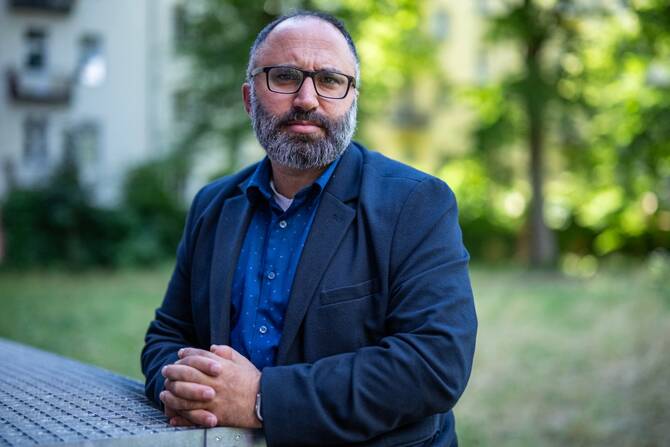
Palestinian activist faces months of harassment from settlers, Israeli soldiers following documentary appearance

Activists argue these actions form part of a wider campaign of intimidation designed to silence Amro’s vocal nonviolent advocacy. (AFP/File)
Short Url
Updated 01 December 2025
Follow

Palestinian activist faces months of harassment from settlers, Israeli soldiers following documentary appearance

  • Issa Amro says he has ‘nightmares that settlers will come into my house and shoot me’ after revealing he was attacked three times in less than 12 hours
  • A Nobel Peace Prize nominee, Amro appeared in Louis Theroux’s BBC documentary ‘The Settlers’

LONDON: Palestinian activist and community leader Issa Amro has reported months of harassment and threats from Israeli settlers and soldiers following his appearance in a documentary highlighting the harsh realities faced by Palestinians in the occupied West Bank.

Amro, who was recently nominated for the Nobel Peace Prize and named among Time magazine’s Time100 Next list for 2025, featured prominently in Louis Theroux’s BBC documentary “The Settlers,” which aired in May to spotlight conditions under occupation.

Since the documentary’s release, Amro — who has lived in the Tel Rumeida neighborhood of Hebron for almost 20 years — says he has become a frequent target of settler retaliation, with Israeli soldiers allegedly aiding or turning a blind eye to attacks against him.

“It’s a zoo now,” he said. “They’re acting as wild as possible. I don’t feel safe in my own house.”

He added that his harassment has intensified to a point where he experiences “nightmares that they (settlers) will come into my house and shoot me.

“They started hating me more after I appeared in the BBC documentary with Louis Theroux. They hated me much more since then.”

Amro recounted experiencing multiple attacks over recent months, including three over the preceding 12 hours. One episode in October involved Israeli soldiers forcibly entering his home and arresting a friend who was caring for the property in his absence. The friend was subsequently barred from returning.

He described this as part of a broader strategy by Israeli authorities to isolate him from his community and undermine his activism.

Other incidents include settlers surrounding his home, taunting him about the death of his brother, and an occasion where a settler climbed the wall of Amro’s house to remove a security camera in the presence of a soldier.

Following this, after rocks were thrown at his home, soldiers entered the house and arrested him, accusing him of the rock-throwing.

In another incident in late October, friends and neighbors of Amro were ordered to leave his home after it was declared a “closed military zone.” Maps shown to Amro reveal his residence is effectively an island surrounded by a military area.

The Israeli Defense Forces, when approached for comment, denied Amro’s allegations, saying he “is permitted to host people within the framework of the law.”

Activists argue these actions form part of a wider campaign of intimidation designed to silence Amro’s vocal nonviolent advocacy.

The occupied West Bank’s security situation is deteriorating rapidly, with settler attacks — many reportedly aided by Israeli soldiers — increasing in frequency and severity.

According to the UN High Commissioner for Human Rights, more settler attacks were recorded in October than in any month since 2006 — more than 260.

Since Oct. 7, 2023, until November 13, 2025, Israeli security forces and settlers have killed at least 1,017 Palestinians in the occupied West Bank, including East Jerusalem. Among the victims were 221 children.


BBC backs Israel’s participation in Eurovision Song Contest amid expanding boycott

Updated 06 December 2025
Follow

BBC backs Israel’s participation in Eurovision Song Contest amid expanding boycott

  • Ireland, Spain, the Netherlands and Slovenia withdraw, citing concerns about the war in Gaza, after organizers clear Israel to compete
  • Critics accuse organizers of double standards, given that Russia was banned from Eurovision in 2022 after invasion of Ukraine

LONDON: The BBC has backed the European Broadcasting Union’s decision to allow Israel to participate in the 2026 Eurovision Song Contest, despite mounting opposition and an expanding boycott by European countries and public broadcasters.

National broadcasters in Ireland, Spain, the Netherlands and Slovenia have formally withdrawn from next year’s event, citing what they described as Israel’s violations of international law during its ongoing war on Gaza, which has killed more than 70,000 people, left much of the territory in ruins and prompted accusations of war crimes.

The BBC, however, said it backed the decision to allow Israel to take part in the contest.

“We support the collective decision made by members of the EBU,” a BBC spokesperson said. “This is about enforcing the rules of the EBU and being inclusive.”

Israel’s participation in the 2026 event, set to take place in the Austrian capital Vienna in May, was confirmed during the EBU’s general assembly in Geneva on Thursday. 

However, pressure continued to build in opposition to the decision, with broadcasters from four countries pulling out and critics accusing organizers of double standards, given that Russia was banned from Eurovision in 2022 after the invasion of Ukraine.

Following the EBU decision, Irish public broadcaster RTE said it would neither participate in nor screen the contest. It said Ireland’s participation “remains unconscionable given the appalling loss of lives in Gaza and the humanitarian crisis there.” It also condemned the killing of journalists in Gaza and the denial of access to the international media. More than 200 Palestinian journalists have reportedly been killed since the start of the war.

Slovenian broadcaster RTV said it was withdrawing from the competition “on behalf of the 20,000 children who died in Gaza.” Chairperson Natalija Gorscak said the decision reflected growing public demand to uphold European values of peace and press freedoms, noting that the international media are still banned from Gaza.

She added that Israel’s 2025 Eurovision performance had been overtly political, and contrasted the decision about Israel with the ban on Russia’s participation following the invasion of Ukraine.

Dutch broadcaster AVROTROS also withdrew from the contest, describing the decision of the EBU as “incompatible with the public values that are essential to us.”

CEO Taco Zimmerman said: “Culture unites, but not at all costs. What happened last year touches our boundaries … Universal values like humanity and a free press have been seriously violated.”

The EBU did not hold a vote on Israel’s participation in the contest. Instead, member broadcasters voted in favor of new rules for contest voting to prevent governments or other groups from unfairly promoting songs to manipulate the result.

Austria, which is set to host the competition after Viennese singer JJ won this year with “Wasted Love,” supports Israel’s participation. Germany, too, was said to back Israel.