Eurovision plans changes to voting, security after allegations of Israeli government ‘interference’

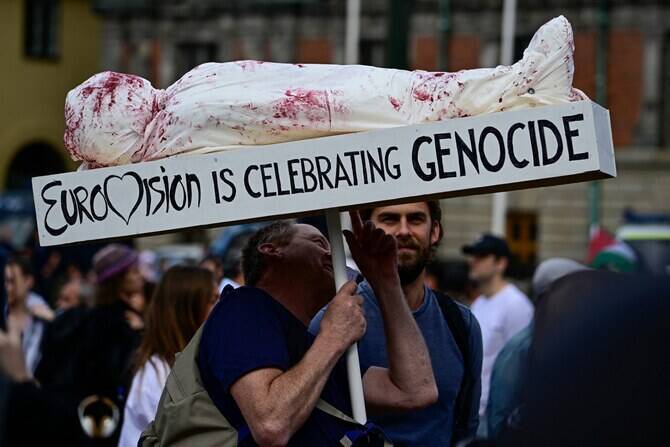
Organizers of the Eurovision Song Contest announced plans to change the voting system of the popular musical extravaganza to ensure fairness, a move that follows allegations of “interference” by Israel’s government. (AFP/File)
Short Url
Updated 21 November 2025
Follow

Eurovision plans changes to voting, security after allegations of Israeli government ‘interference’

  • Calls for Israel to be kicked out swelled over the conduct of Netanyahu’s government in the war in Gaza
  • The allegations of Israeli government interference have added a new twist to the debate

GENEVA: Organizers of the Eurovision Song Contest announced plans to change the voting system of the popular musical extravaganza to ensure fairness, a move that follows allegations of “interference” by Israel’s government.
The European Broadcasting Union, a Geneva-based union of public broadcasters that runs the event, said Friday that the changes were “designed to strengthen trust, transparency and audience engagement.”
Israel has competed in Eurovision for more than 50 years and won four times. But calls for Israel to be kicked out swelled over the conduct of Prime Minister Benjamin Netanyahu’s government in the Hamas-Israel war in Gaza.
The allegations of Israeli government interference have added a new twist to the debate.
In September, Dutch public broadcaster AVROTROS — citing human suffering in the Gaza war — said that it could no longer justify Israel’s participation in the contest. Several other countries took a similar stance.
The Dutch broadcaster went on to say there had been “proven interference by the Israeli government during the last edition of the Song Contest, with the event being used as a political instrument.” The statement didn’t elaborate.
That same month, the CEO of Israeli public broadcaster Kan, Golan Yochpaz, said that there was “no reason why we should not continue to be a significant part of this cultural event, which must not become political.”
Kan also said then that it was “convinced” that the EBU “will continue to maintain the apolitical, professional and cultural character of the competition, especially on the eve of the 70th anniversary of Eurovision” next year.
As part of the new Eurovision measures, in next year’s contest — scheduled to take place in May in Vienna — the number of votes per payment method will be reduced by half to 10, the EBU said.
In addition, “professional juries” will return to the semifinals for the first time since 2022 — a move that will give roughly 50-50 percentage weight between audience and jury votes, it said.
Organizers will also enhance safeguards to thwart “suspicious or coordinated voting activity” and strengthen security systems that “monitor, detect and prevent fraudulent patterns,” EBU said.
Contest director Martin Green said that the neutrality and integrity of the competition is of “paramount importance” to the EBU, its members, and audiences, adding that the event “should remain a neutral space and must not be instrumentalized.”
The EBU’s general assembly on Dec. 4-5 is poised to consider whether Israel can participate next year. A vote on that participation will only take place if member broadcasters decide the new steps are “not sufficient,” Green said.


US hotels seek World Cup boost after tourism dip under Trump

Updated 07 March 2026
Follow

US hotels seek World Cup boost after tourism dip under Trump

  • At the US hotels that Meade Atkeson manages, a drop in tourism weighs heavily on business — but hoteliers like him hope that World Cup enthusiasm will soon eclipse wariness over President

WASHINGTON: At the US hotels that Meade Atkeson manages, a drop in tourism weighs heavily on business — but hoteliers like him hope that World Cup enthusiasm will soon eclipse wariness over President Donald Trump’s policies.
The US hospitality sector has been reeling from a tourism slump in the world’s biggest economy, which became the only major destination to see a drop in foreign visitors last year.
“Just financially, it’s difficult when international travel is down,” Atkeson told AFP, noting that such visitors tend to stay longer and spend more.
Foreign travelers account for nearly a quarter of business at the three hotels under Sonesta group that he manages — two in Washington and a third in Miami Beach.
Yet, in the first eleven months of 2025, US official data showed that inbound travel dropped by 5.4 percent.
Canadians were noticeably absent, with travel plunging by 21.7 percent from 2024, translating to about four million fewer people. The decline was nearly seven percent for French visitors.
Industry professionals see this as a consequence of Trump’s policies, even if they may not openly say so.
Visitors have chafed at the Republican president’s sweeping tariffs on foreign goods, broadsides against other countries, tightening immigration rules and portrayal of certain Democrat-led cities as ridden with crime.
Canadians “were asked to be the 51st state, right?” Atkeson said.
“If you talk to Canadians, many of them have chosen not to travel out of conscience” or on principle, he added.
Brazilian tourists meanwhile “can go anywhere they want,” he said. “And so they may have gone to Europe, they may have gone to the islands.”
‘Fear’
Thousands of kilometers away, the major resort city of Las Vegas in Nevada — boasting 150,000 hotel rooms — has also had a bad year.
Elsa Rodan, a chambermaid at the Bellagio resort and casino, says her establishment is “blessed” compared with others.
But even so, it has had to lower prices to attract guests, added Rodan, a representative of the Unite Here union who spoke at a Washington press conference.
Unite Here President Gwen Mills urges for a renewed effort to lobby the Trump administration over policies and rhetoric that she believes are jeopardizing the sector employing more than two million people.
According to her, hoteliers are not pushing the government enough.
Employers express “fear, the fear of picking your head up,” she said.
Hopefully ‘better’
Fewer visitors and overnight stays, alongside a drop in revenue, have triggered a $6.7 billion shortfall for Nevada hotels in 2025, according to the American Hotel and Lodging Association (AHLA).
But the organization hopes that 2026 will be a turning point — it is counting on the World Cup, from June 11 to July 19, to attract visitors.
Eleven US cities will be hosting matches.
“It’s being equated to having nearly 80 Super Bowls in just over a month,” AHLA spokesman Ralph Posner told AFP.
“The economic lift won’t be limited to host cities,” he added. “Destinations across the country are hoping to benefit as international visitors extend their trips and travel between markets.”
Las Vegas, for example, hopes to draw fans who might stop there before or after a game in Los Angeles or Kansas City.
Organizers say that besides the seven million spectators in stadiums, the World Cup is set to attract 20-30 million tourists.
The whole event, they believe, can generate $30 billion for the US economy.
“I hope that things will look better,” Atkeson said.
His Miami hotel is under renovations and cannot host much World Cup-related activity.
But his Washington establishments are highlighting their proximity to Philadelphia, where several matches will be held.
Another complication is war in the Middle East following US-Israeli strikes on Iran, which could snarl travel.
“It’s a little too soon to tell how we’re going to do with that, but we’ll see,” he said.