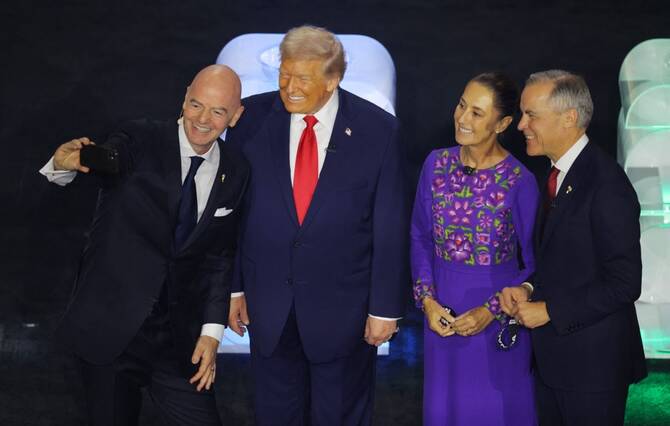
WASHINGTON: US President Donald Trump met Friday with Canadian Prime Minister Mark Carney and Mexican President Claudia Sheinbaum, with the talks partly focused on the future of a North American free trade deal.
The leaders met in Washington on the sidelines of the draw for the 2026 World Cup, co-hosted by Canada, Mexico and the United States.
“The three leaders met for approximately 45 minutes,” Carney spokesperson Audrey Champoux said in an email.
“They’ve agreed to keep working together on CUSMA,” she added, using the Canadian acronym for the existing free trade deal between the three countries, which Americans call the United States-Mexico-Canada Agreement .
The USMCA deal was struck during Trump’s first term.
Trump has slapped steep tariffs on exports from Canada and Mexico that do not fall under the USMCA, which Washington is seeking to renegotiate next year.
Friday’s talks were the first between Trump and Sheinbaum.
Carney has visited the White House twice since Trump’s return to power, but it will be his first encounter with Trump — except for a brief meeting at a summit in South Korea — since the US leader suspended trade talks in a bizarre row over an anti-tariff ad.
Trump has also threatened further punishment if they fail to curb cross-border migration and drug trafficking — and irked Sheinbaum by saying he would be “OK” with air strikes on Mexico to tackle traffickers.
She has vowed the strikes will never happen.
Canada also was outraged by Trump’s calls earlier this year for it to become the 51st US state.
Carney drew criticism at recent G20 meetings in South Africa when, asked by a reporter when he last spoke to Trump, answered, “Who cares?“
The three countries launched their joint World Cup bid in 2017 during Trump’s first term in the White House.
Trump said Friday that the United States had worked closely with Mexico and Canada over the tournament, adding “the coordination and friendship and relationship has been outstanding.”


Trump talks trade with Canada, Mexico leaders at World Cup draw
https://arab.news/cypf8
Trump talks trade with Canada, Mexico leaders at World Cup draw

- Friday’s talks were the first between Trump and Sheinbaum

South Korea calls for resuming dialogue with North
- President Lee Jae Myung has sought to mend ties with the nuclear-armed North since taking office in June
- North Korean leader Kim Jong Un last week dashed hopes of a diplomatic thaw with Seoul
SEOUL: South Korean President Lee Jae Myung called on Sunday for dialogue with North Korea to resume, after Pyongyang last week shunned the prospect of diplomacy with its neighbor.
Since taking office in June, a dovish Lee has sought to mend ties with the nuclear-armed North, which reaffirmed its anti-Seoul approach during a party meeting last week.
“As my administration has repeatedly made clear, we respect the North’s system and will neither engage in any type of hostile acts, nor pursue any form of unification by absorption,” Lee said in a speech marking the anniversary of a historical campaign against Japan’s colonial rule.
“We will also continue our efforts to resume dialogue with the North,” he said.
North Korean leader Kim Jong Un last week dashed hopes of a diplomatic thaw with Seoul, describing its overtures as “clumsy, deceptive farce and a poor work.”
Speaking at the party congress in Pyongyang, Kim said North Korea has “absolutely no business dealing with South Korea, its most hostile entity, and will permanently exclude South Korea from the category of compatriots.”
But he also said the North could “get along well” with the United States if Washington acknowledges its nuclear status.
Speculation has mounted over whether US President Donald Trump will seek a meeting with Kim during planned travels to China.
Last year, Trump said he was “100 percent” open to a meeting.
Previous Trump-Kim summits during the US president’s first term fell apart after the pair failed to agree over sanctions relief — and what nuclear concessions North Korea might make in return.


