US gave Venezuela’s Maduro chance to leave country: senator

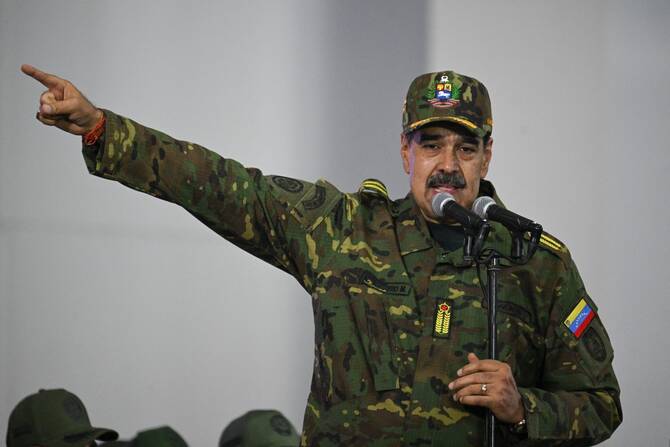
Venezuela’s President Nicolas Maduro delivers a speech during a military ceremony in Fuerte Tiuna, Caracas, Nov. 25, 2025. (AFP)
Short Url
Updated 30 November 2025
Follow

US gave Venezuela’s Maduro chance to leave country: senator

  • Maduro was offered the chance to leave Venezuela for Russia or elsewhere amid heightened tensions with US
  • Venezuelan president said he views the US military presence in the Caribbean as a precursor to regime change

WASHINGTON: The United States has offered Venezuelan President Nicolas Maduro the chance to leave his country for Russia or elsewhere, a Republican senator said Sunday, amid heightened fears of imminent US military action.
President Donald Trump sharply escalated his threats against Venezuela by warning Saturday that the country’s airspace should be considered “closed,” while the US military maintains a significant presence in the region.
Though Trump has not publicly threatened to use force against Maduro, he said in recent days that efforts to halt Venezuelan drug trafficking “by land” would begin “very soon.”
Maduro has said he views the US military presence in the Caribbean as a precursor to regime change.
“By the way, we gave Maduro an opportunity to leave. We said he could leave and go to Russia or he could go to another country,” Markwayne Mullin, a member of the Senate Armed Services Committee, told CNN’s “State of the Union” talk show.
When asked whether Trump was planning to attack Venezuela, the senator from Oklahoma said: “No, he’s made it very clear we’re not going to put troops into Venezuela. What we’re trying to do is protect our own shores.”
Since September, US air strikes have targeted alleged drug-trafficking boats in the Caribbean Sea and the eastern Pacific Ocean, killing at least 83 people.
Washington claims the leftist Maduro heads an alleged drug cartel.
Maduro “is an illegitimate leader who has been indicted for drug trafficking in US courts and maintains control of Venezuela by a reign of terror,” Republican Senator Lindsey Graham, a staunch Trump supporter, said Saturday on X.
“President Trump’s strong commitment to end this madness in Venezuela will save countless American lives and will give the beautiful people of Venezuela a new lease on life. I hear Turkiye and Iran are lovely this time of year...”
The steady US military buildup has seen the world’s largest aircraft carrier deployed to Caribbean waters, while American fighter jets and bombers have repeatedly flown off the Venezuelan coast in recent days.
The New York Times reported Friday that Trump and Maduro had discussed a possible meeting, while The Wall Street Journal said Saturday that the conversation also included conditions of amnesty if Maduro were to step down.


Only 4% women on ballot as Bangladesh prepares for post-Hasina vote

Updated 22 min 5 sec ago
Follow

Only 4% women on ballot as Bangladesh prepares for post-Hasina vote

  • Women PMs have ruled Bangladesh for over half of its independent history
  • For 2026 vote, only 20 out of 51 political parties nominated female candidates

DHAKA: As Bangladesh prepares for the first election since the ouster of its long-serving ex-prime minister Sheikh Hasina, only 4 percent of the registered candidates are women, as more than half of the political parties did not field female candidates.

The vote on Feb. 12 will bring in new leadership after an 18-month rule of the caretaker administration that took control following the student-led uprising that ended 15 years in power of Hasina’s Awami League party.

Nearly 128 million Bangladeshis will head to the polls, but while more than 62 million of them are women, the percentage of female candidates in the race is incomparably lower, despite last year’s consensus reached by political parties to have at least 5 percent women on their lists.

According to the Election Commission, among 1,981 candidates only 81 are women, in a country that in its 54 years of independence had for 32 years been led by women prime ministers — Hasina and her late rival Khaleda Zia.

According to Dr. Rasheda Rawnak Khan from the Department of Anthropology at Dhaka University, women’s political participation was neither reflected by the rule of Hasina nor Zia.

“Bangladesh has had women rulers, not women’s rule,” Khan told Arab News. “The structure of party politics in Bangladesh is deeply patriarchal.”

Only 20 out of 51 political parties nominated female candidates for the 2026 vote. Percentage-wise, the Bangladesh Socialist Party was leading with nine women, or 34 percent of its candidates.

The election’s main contender, the Bangladesh Nationalist Party, whose former leader Zia in 1991 became the second woman prime minister of a predominantly Muslim nation — after Pakistan’s Benazir Bhutto — was the party that last year put forward the 5 percent quota for women.

For the upcoming vote, however, it ended up nominating only 10 women, or 3.5 percent of its 288 candidates.

The second-largest party, Jamaat-e-Islami, has not nominated a single woman.

The 4 percent participation is lower than in the previous election in 2024, when it was slightly above 5 percent, but there was no decreasing trend. In 2019, the rate was 5.9 percent, and 4 percent in 2014.

“We have not seen any independent women’s political movement or institutional activities earlier, from where women could now participate in the election independently,” Khan said.

“Real political participation is different and difficult as well in this patriarchal society, where we need to establish internal party democracy, protection from political violence, ensure direct election, and cultural shifts around female leadership.”

While the 2024 student-led uprising featured a prominent presence of women activists, Election Commission data shows that this has not translated into their political participation, with very few women contesting the upcoming polls.

“In the student movement, women were recruited because they were useful, presentable for rallies and protests both on campus and in the field of political legitimacy. Women were kept at the forefront for exhibiting some sort of ‘inclusive’ images to the media and the people,” Khan said.

“To become a candidate in the general election, one needs to have a powerful mentor, money, muscle power, control over party people, activists, and locals. Within the male-dominated networks, it’s very difficult for women to get all these things.”