

Trump says airspace above and around Venezuela should be considered closed

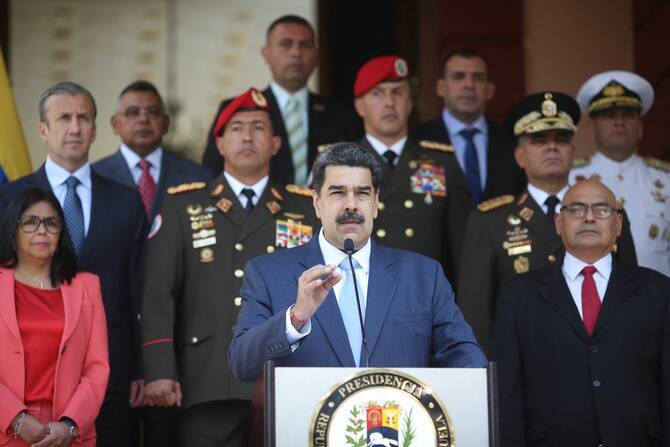
The New York Times reported on Friday that Trump and Maduro had spoken by phone last week and discussed a possible meeting in the United States. (AFP/File)
Short Url
Updated 29 November 2025
Follow

Trump says airspace above and around Venezuela should be considered closed

  • Venezuela’s government condemned Trump’s comments, describing them as a “colonialist threat” against the country’s sovereignty
  • The Trump administration has been weighing Venezuela-related options to combat what it has portrayed as Maduro’s role in supplying illegal drugs

WASHINGTON: US President Donald Trump said on Saturday the airspace above and surrounding Venezuela should be considered “closed in its entirety,” but gave no further details, stirring anxiety and confusion in Caracas as Washington ramps up pressure on President Nicolas Maduro’s government.
“To all Airlines, Pilots, Drug Dealers, and Human Traffickers, please consider THE AIRSPACE ABOVE AND SURROUNDING VENEZUELA TO BE CLOSED IN ITS ENTIRETY,” Trump said in a Truth Social post.
US officials contacted by Reuters were surprised by Trump’s announcement and unaware of any ongoing US military operations to enforce a closure of Venezuelan airspace. The Pentagon did not respond to requests for comment and the White House did not provide any further explanation.
In a statement Saturday afternoon, Venezuela’s government condemned Trump’s comments, describing them as a “colonialist threat” against the country’s sovereignty and incompatible with international law.

MASSIVE MILITARY BUILDUP IN CARIBBEAN
David Deptula, a retired lieutenant general who commanded a no-fly zone over northern Iraq in 1998 and 1999, said Trump’s announcement raises more questions than it answers. Imposing a no-fly zone over Venezuela could require significant resources and planning, depending on the goals of the airspace closure, he said.
“The devil’s in the details,” Deptula said.
The Trump administration has been weighing Venezuela-related options to combat what it has portrayed as Maduro’s role in supplying illegal drugs that have killed Americans. The socialist Venezuelan president has denied having any links to the illegal drug trade. Reuters has reported that options under US consideration included attempting to overthrow Maduro, and that the US military is poised for a new phase of operations after a massive military buildup in the Caribbean and nearly three months of strikes on suspected drug boats off Venezuela’s coast. Trump has also authorized covert CIA operations in the South American country.
Maduro, in power since 2013, has contended that Trump is seeking to oust him and that Venezuelan citizens and the military will resist any such attempt. Trump told military service members earlier this week that the US would “very soon” begin land operations to stop suspected Venezuelan drug traffickers.
Caracas residents who spoke to Reuters criticized Trump’s announcement.
“I think it’s unfair because people need to travel to work, to do business, to see their family, and us Venezuelans aren’t at fault for these situations,” said Manuel Romero, who works as a cooking assistant.
Carmen Castillo, a lawyer, said she worried that many people who would have traveled to visit their families outside Venezuela for the holidays now won’t be able to do so.
“We’re confined, here in Caracas, in Venezuela, of course it affects us,” she said.
Maduro and high-ranking officials in his government, some combination of whom appear almost daily on state television, have decried US imperialism in their recent comments, but do not single out Trump by name, as the Venezuelan government may be trying to de-escalate tensions, according to security and diplomatic sources. US Secretary of State Marco Rubio had previously been the focus of Venezuelan government ire, but even references to him have decreased in recent weeks.
The US boat bombings have led to stepped-up surveillance by authorities in the remote northeastern state of Sucre, with increased patrols by security agencies and ruling-party supporters stoking fear among locals, four residents and one recent visitor said.
GPS signals in Venezuela have also been affected in recent weeks amid the US buildup.
Trump’s announcement on Venezuela’s airspace followed a warning last week from the US Federal Aviation Administration that major airlines faced a “potentially hazardous situation” when flying over Venezuela due to a “worsening security situation and heightened military activity in or around” the country. Venezuela revoked operating rights for six major international airlines that had suspended flights to the country after the FAA warning.


In India’s mining belt, women spark hope with solar lamps

Updated 5 sec ago
Follow

In India’s mining belt, women spark hope with solar lamps

BEAWAR: Santosh Devi is proud to have brought light — and hope — to her hamlet in western India, taking up solar engineering through a program for women like her whose husbands suffer chronic disease from mining work.
Her husband is bedridden with silicosis, a respiratory illness caused by inhaling fine silica dust which is common across some 33,000 mines in Rajasthan state, where the couple and their four children live.
Santosh, 36, has joined seven other women for a three-month course at Barefoot College in Tilonia, a two-hour drive from her village in the desert state’s Beawar district.
There, the group learned the basics of solar engineering — installing panels, wiring them, and assembling and repairing lamps — to help light up homes and provide electricity for anything from charging phones to powering fans.
With their sick husbands out of work, the training has allowed these women to make a living and support their families.
Barefoot College has trained more than 3,000 women from 96 countries since it was set up in 1972, according to Kamlesh Bisht, the technical manager of the institute.
The college offers rural women new skills with the aim of making them independent in an environment where jobs are scarce and health care generally inaccessible.
Santosh, who is illiterate, said she wants to “offer a good education and a better future” to her children, aged five to 20.
She now earns a small income by installing solar panels, and hopes to eventually make the equivalent of $170 a month.
The time away from her family was tough, but Santosh said it was worth it.
“At first, I was very scared,” she recalled. “But this training gave me confidence and courage.”
She showed with enthusiasm the three houses where she had installed a photovoltaic panel powering lamps, fans and chargers.

- Slow killer -

Her husband used to cut sandstone for pavers exported around the world.
But now he can barely walk, needs costly medication and relies on a meagre state allowance of $16 a month.
Wiping away tears with the edge of her bright red scarf, Santosh said she has had to borrow money from relatives, sell her jewelry and mortgage her precious mangalsutra, the traditional Hindu wedding necklace, to make ends meet.
The family share a similar fate with many others in Rajasthan state’s mining belt, where tens of thousands of people suffer from silicosis.
According to pulmonologist Lokesh Kumar Gupta, there are between 5,000 and 6,000 cases in just a single district, Ajmer.
In Santosh’s village of 400 households, 70 people have been diagnosed with silicosis, a condition that kills slowly and, in many cases, has no cure.
An estimated 2.5 million people work in mines across Rajasthan, extracting sandstone, marble or granite for less than $6 a day.
Those using jackhammers earn double but face even higher exposure to toxic dust.
Vinod Ram, whose wife has also graduated from the Barefoot College course, has been suffering from silicosis for six years and struggles to breathe.
“The medication only calms my cough for a few minutes,” said Vinod, 34, who now weighs just 45 kilos (99 pounds).
He started mining at age 15, working for years without a mask or any other protective gear.

- No choice but to work -

His wife Champa Devi, 30, did not even know how to write her name when she arrived at Barefoot College in June.
Now back home, at a village not far from Santosh’s, she is proud of her newfound expertise.
But her life remains overshadowed by illness and poverty.
Champa, who has dark circles under her eyes, has installed solar panels in four nearby homes but has not yet been paid.
For now, she earns about 300 rupees ($3.35) a day working at construction sites — hardly enough to cover her husband’s medical bills, which come up to some $80 a month.
The couple live in a single dark room with thin blankets covering the floor, and the near-contact sound of detonations from nearby mines.
“There is no treatment for silicosis,” said pulmonologist Gupta.
Early treatment can help, but most patients come only after five to seven years, he said.
Under state aid schemes, patients receive $2,310 upon diagnosis, and their families get another $3,465 in the case of death.
Ill miners, who are physically capable, sometimes continue to cut sandstone for a pittance to support their families, despite the dire health risks.
Sohan Lal, a 55-year-old mine worker who suffers from shortness of breath and severe cough, sees no other option but to keep working.
“If I were diagnosed, what difference would it make?” he said.