

National Guard shooting suspect radicalized in US, homeland secretary says

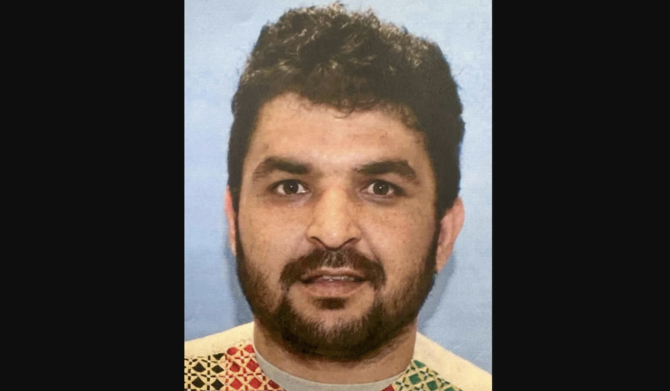
Rahmanullah Lakanwal, 29, an Afghan national who is the suspect in the shooting of two National Guard members in Washington, DC. (AFP)
Short Url
Updated 30 November 2025
Follow

National Guard shooting suspect radicalized in US, homeland secretary says

  • Noem’s comments suggest that Lakanwal, who was part of a CIA-backed unit in Afghanistan, may have embraced extremism after arriving in the US

WASHINGTON: US authorities believe the Afghan immigrant accused of ambushing National Guard members in Washington, D.C., was not radicalized until after he came to the United States, Homeland Security Secretary Kristi Noem said on Sunday.
Speaking on NBC’s “Meet the Press” and ABC’s “This Week,” Noem said authorities think that alleged shooter Rahmanullah Lakanwal was already living in Washington state when he became radicalized.

Investigators are seeking more information from family members and others, Noem said.

Authorities identified Lakanwal, 29, as the suspect in a Wednesday shooting that took place just blocks away from the White House and which killed one National Guard member and critically wounded another.

After the shooting, US President Donald Trump’s administration pointed to a lack of vetting of Afghans and other foreign nationals during the term of former President Joe Biden, although Lakanwal was granted asylum under Trump.

Lakanwal entered the US in 2021 as part of the Biden administration’s mass evacuation of Afghans who aided US forces during the two-decade war in Afghanistan as the Taliban took power.

He was granted asylum in April by Trump’s administration, a government file reviewed by Reuters showed.

Noem’s comments suggest that Lakanwal, who was part of a CIA-backed unit in Afghanistan, may have embraced extremism after arriving in the US.
“We believe he was radicalized since he’s been here in this country,” Noem told NBC News.

“We do believe it was through connections in his home community and state, and we’re going to continue to talk to those who interacted with him, who were his family members.” Noem said.

US officials have received “some participation” so far from people who knew Lakanwal and warned that the US would pursue anyone connected to the shooting.
“Anyone who has the information on this needs to know that we will be coming after you, and we will bring you to justice,” Noem said.

After Wednesday’s attack, the Trump administration took steps to clamp down on some legal immigration, including a freeze on processing of all asylum applications.
Noem said on Sunday that immigration officials would consider deporting people with active asylum cases if it was warranted.
“We are going to go through every single person that has a pending asylum claim,” she said.

Immigration judge rejects Trump effort to deport pro-Palestinian Tufts student

Updated 5 sec ago
Follow

Immigration judge rejects Trump effort to deport pro-Palestinian Tufts student

  • Her immigration lawyer, Mahsa Khanbabai, said the decision was issued by Immigration Judge Roopal Patel in Boston
  • The arrest of Ozturk, a child development researcher, in the Boston suburb of Somerville, was captured in a viral video that shocked many and drew criticism from civil rights groups

BOSTON: An immigration judge has rejected the Trump administration’s efforts to deport Tufts University PhD student Rumeysa Ozturk, who was arrested last year as part of its targeting ​of pro-Palestinian campus activists, her lawyers said on Monday.
Lawyers for the Turkish student detailed the immigration judge’s decision in a filing with the New York-based 2nd US Circuit Court of Appeals, which had been reviewing a ruling that led to her release from immigration custody in May.
An immigration judge on January 29 concluded the US Department of Homeland Security ‌had not met ‌its burden of proving she was ‌removable ⁠and ​terminated the ‌proceedings against her, her lawyers at the American Civil Liberties Union wrote.
Her immigration lawyer, Mahsa Khanbabai, said the decision was issued by Immigration Judge Roopal Patel in Boston.
That ended, for now, proceedings that began with Ozturk’s arrest by immigration authorities in March on a street in Massachusetts after the US Department of State ⁠revoked her student visa.
The sole basis authorities provided for revoking her visa was an ‌editorial she co-authored in Tufts’ student ‍newspaper a year earlier criticizing ‍her school’s response to Israel’s war in Gaza.
“Today, I breathe ‍a sigh of relief knowing that despite the justice system’s flaws, my case may give hope to those who have also been wronged by the US government,” Ozturk said in a statement.
The immigration judge’s ​decision is not itself public, and the administration could challenge it before the Board of Immigration Appeals, which is ⁠part of the US Department of Justice.
DHS, which oversees US Immigration and Customs Enforcement, did not respond to a request for comment.
The arrest of Ozturk, a child development researcher, in the Boston suburb of Somerville, was captured in a viral video that shocked many and drew criticism from civil rights groups.
The former Fulbright scholar was held for 45 days in a detention facility in Louisiana until a federal judge in Vermont, where she had briefly been held, ordered her immediately released after finding she ‌raised a substantial claim that her detention constituted unlawful retaliation in violation of her free speech rights.