

US judge questions Trump administration’s continued targeting of pro-Palestinian Tufts student

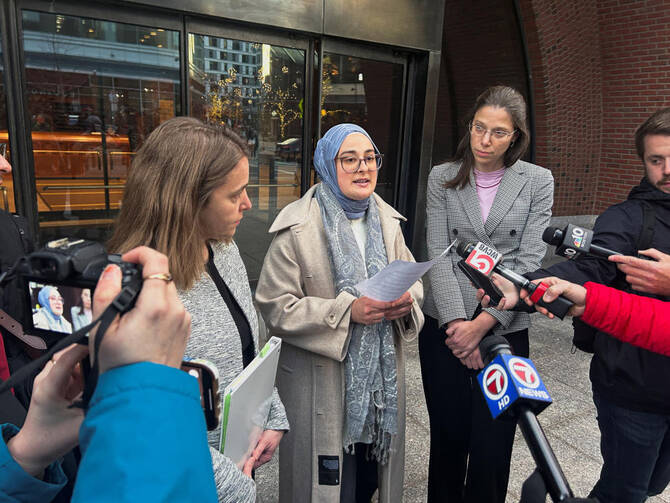
Rumeysa Ozturk, a Tufts University student from Turkiye, speaks to reporters after urging a federal judge to order the Trump administration to restore her student visa record, outside the federal court in Boston, Massachusetts, on December 4, 2025. (REUTERS)
Short Url
Updated 05 December 2025
Follow

US judge questions Trump administration’s continued targeting of pro-Palestinian Tufts student

  • Judge questions termination of Ozturk’s student status after op-ed
  • Ozturk’s visa revoked due to pro-Palestinian activism

BOSTON: A federal judge on Thursday said she was “struggling” to understand why President Donald Trump’s administration is preventing a Tufts University PhD student who had engaged in pro-Palestinian activism from working on campus nearly seven months after the Turkish citizen was released from an immigration detention center.

Chief US District Judge Denise Casper during a hearing in Boston questioned whether US Immigration and Customs Enforcement acted arbitrarily when it terminated Rumeysa Ozturk’s status in a key database used to track foreign students after she co-wrote an opinion piece in the Tufts student newspaper criticizing her school’s response to Israel’s war in Gaza.
“What’s the rationale for allowing the agency to have the discretion to terminate the record?” Casper asked.
Ozturk’s record in the ICE-maintained Student and Exchange Visitor Information System database was terminated on March 25, the same day that she was arrested by masked, plainclothes agents on a street in the Boston suburb of Somerville, Massachusetts, near her home, after the US Department of State revoked her student visa.
The sole basis authorities provided for revoking her visa was the opinion piece, which criticized Tufts’ response to calls by students to divest from companies with ties to Israel and to “acknowledge the Palestinian genocide.”

The former Fulbright scholar was held for 45 days in a detention facility in Louisiana until a federal judge in Vermont, where she had briefly been held, ordered her immediately released after finding she raised a substantial claim that her detention constituted unlawful retaliation for views she shared in the op-ed in violation of her free speech rights under the US Constitution’s First Amendment.

Following her release, Ozturk resumed her studies at Tufts. But the administration’s refusal to restore her SEVIS record has prevented her from teaching or working as research assistant, jeopardizing her academic and career development in the final months before her graduation, said Adriana Lafaille, an attorney for Ozturk at the American Civil Liberties Union of Massachusetts.
She urged the judge to order ICE to reinstate Ozturk’s SEVIS record. While the child development researcher’s visa remains revoked, Lafaille said that simply governed her entry into the United States and that its termination did not render her student status unlawful.
Assistant US Attorney Mark Sauter argued that ICE has the discretion to update the SEVIS database to reflect if a student’s visa is terminated and the person is facing removal proceedings as Ozturk has been.

But Lafaille said the administration had put forward shifting rationales for its actions, which stood in contrast to how it rescinded its decision to terminate SEVIS records for thousands of other foreign students in April.
“This was one of several retaliatory actions the government took against Ms. Ozturk for her protected speech,” Lafaille said.


Chile police arrest suspect over deadly wildfires

Updated 7 sec ago
Follow

Chile police arrest suspect over deadly wildfires

  • Suspect used a liquid accelerant to start fires in a wheat field, with authorities seizing five liters of fuel from him
LIRQUEN, Chile: Police in south-central Chile have arrested a man on suspicion of starting one of the recent wildfires that killed 21 people and razed entire neighborhoods, the government said Wednesday.
Security Minister Luis Cordero said the suspect used a liquid accelerant to start fires in a wheat field, with authorities seizing five liters (more than a gallon) of fuel from him.
He was arrested at dawn in the town of Perquenco in Araucania region, south of Biobio.
The fires began simultaneously on Saturday in various parts of Biobio and Nuble regions, about 500 kilometers (310 miles) south of the capital Santiago.
Fanned by strong winds and high temperatures, the flames quickly ripped through the coastal towns of Penco, Lirquen and Punta de Parra, leaving a blackened landscape of smoldering ruins.
Interior Minister Alvaro Elizalde told a press conference on Wednesday that an estimated 20,000 people suffered property damage from the fires, including some 800 homes that were destroyed.
President Gabriel Boric visited Biobio on Wednesday, where he said: “We’re working with heavy machinery to clear streets and remove debris, and we continue fighting the fire.
“We’re still in a state of emergency,” he added.
Other fires were later reported further inland, in the Biobio town of Florida, about 40 kilometers (25 miles) east of the city of Concepcion and in Araucania.
Cordero said substances used to start fires, including plastic containers containing accelerant, were found in Concepcion.
Firefighters were still battling 35 blazes Wednesday — 22 in Biobio, five in Nuble and eight in Araucania, according to national forestry officials.
A drop in temperature in recent days has helped ease the situation.
“We managed to reduce the intensity of the fire,” Carlos Zulieta, a firefighter in Florida said, adding that it was now advancing “more slowly.”
The government said it would pay compensation of $700 to $1,500 to victims.
Aid began trickling into affected areas on Wednesday.
Municipal workers and private companies were delivering portable toilets and generators to Lirquen, where some families are camped out in the ruins of their homes.
In February 2024, wildfires broke out around the coastal resort of Vina del Mar, 110 kilometers from Santiago, leaving 138 dead.
Investigations revealed that firefighters and forestry brigade members started the fire, which spread rapidly due in part to high temperatures during the southern hemisphere’s summer.
