

Pakistan rejects UN rights chief’s ‘ungrounded’ concerns over constitutional amendments

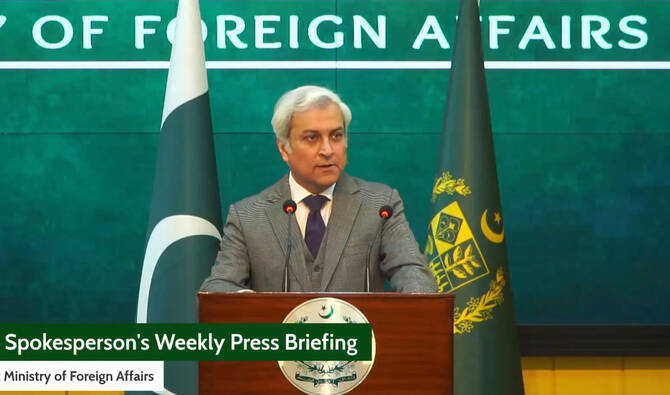
Screengrab showing Pakistan’s Foreign Office Spokesperson Tahir Andrabi speaks during a weekly press briefing in Islamabad, Pakistan, on November 14, 2025. (Screengrab/Foreign Office/File)
Short Url
Updated 30 November 2025
Follow

Pakistan rejects UN rights chief’s ‘ungrounded’ concerns over constitutional amendments

  • UN rights chief said this week Pakistan’s amendments undermine judicial independence, raise concerns over military accountability
  • Pakistan urges UN rights chief to respect the parliament’s decision, avoid commentary reflecting “political bias and misinformation”

ISLAMABAD: Pakistan’s foreign office spokesperson on Sunday rejected “ungrounded” concerns raised by the Office of the High Commissioner for Human Rights (OHCHR) recently over the contentious constitutional amendments that critics fear undermine judicial independence. 

OHCHR chief Volker Türk on Friday spoke about Pakistan’s recent constitutional amendments, which grant lifetime immunity from prosecution to the army chief and the president, and established a separate court separate from the Supreme Court of Pakistan to hear constitutional cases. 

Türk said the “hastily adopted” amendments undermine judicial independence, raise grave concerns about military accountability and respect for the rule of law. 

“Pakistan notes with deep concern the ungrounded and misplaced apprehensions aired on behalf of the United Nations High Commissioner for Human Rights regarding the 27th constitutional amendment adopted by the two-thirds majority of the parliament of Pakistan,” the foreign office said. 

The foreign office said constitutional amendments and legislation remain the “exclusive domain” of representatives elected by the people of Pakistan. 

It added that the amendments adopted by parliament followed the due procedures mentioned in the country’s constitution. 

The foreign office said that while Pakistan valued the work done by the OHCHR, it regretted that Islamabad’s views and ground realities were not reflected in its statement. 

“We urge the High Commissioner to respect the sovereign decisions of Pakistan’s parliament and avoid commentary that reflects political bias and misinformation,” the statement said. 

It said Pakistan remains fully committed to protecting, promoting and upholding human rights, human dignity, basic freedoms and rule of law. 


Pakistani, Libyan commanders discuss regional security, military cooperation

Updated 19 min 56 sec ago
Follow

Pakistani, Libyan commanders discuss regional security, military cooperation

  • The meeting follows reports that Pakistan struck a $4 billion defense deal to sell military equipment to Libyan National Army
  • Both sides exchanged views on matters of mutual interest, with particular focus on security dynamics in respective regions

ISLAMABAD: Libyan National Army Commander Field Marshal Khalifa Haftar met with Pakistan’s Chief of Defense Forces Field Marshal Asim Munir in Rawalpindi and discussed with him military cooperation and regional security, the Pakistani military said on Monday.

The meeting takes place after Munir’s visit to Libya in December that was followed by reports suggesting Pakistan had struck a $4 billion defense deal to sell military equipment, including JF-17 fighter jets and Super Mushak trainer aircraft, to the Libyan National Army that controls eastern Libya. There has been no official confirmation of the deal so far.

Haftar and Prime Minister Dr. Osama Saad Hammad, who governs eastern Libya, called on Field Marshal Munir at Pakistan Army’s General Headquarters in Rawalpindi, according to the Inter-Services Public Relations (ISPR), the Pakistani military’s media wing.

“During the meeting, both sides exchanged views on matters of mutual interest, with particular focus on security dynamics in respective regions and professional cooperation,” the ISPR said in a statement.

“The discussion underscored the importance of continued engagement and collaboration between the Armed Forces of Pakistan and Libya.”

Libya has been subject to a UN arms embargo since 2011, requiring approval from the UN for transfers of weapons and related material. It was not clear whether Pakistan or Libya had applied for ⁠any exemptions to the UN embargo.

During Monday’s meeting, Munir reaffirmed Pakistan’s commitment to strengthening bilateral relations with Libya, reiterating his country’s support for peace, stability and institutional development in Libya, according to the ISPR.

“The meeting was held in a cordial and constructive atmosphere, reflecting the longstanding friendly relations between Pakistan and Libya,” the Pakistani military said.