

UN rights chief says Pakistan constitutional amendments undermine judiciary, rule of law

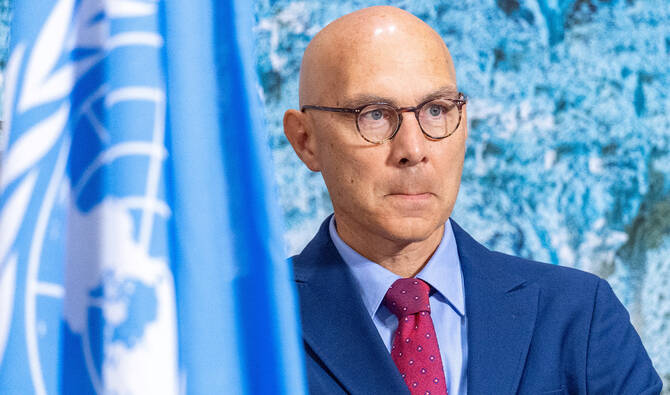
Volker Turk, United Nations High Commissioner for Human Rights, attends the Human Rights Council at the UN European headquarters in Geneva, Switzerland, on September 8, 2025. (REUTERS/File)
Short Url
Updated 29 November 2025
Follow

UN rights chief says Pakistan constitutional amendments undermine judiciary, rule of law

  • Amendments grant forms separate court to hear constitutional cases, grants lifetime immunity from prosecution to president, army chief
  • Pakistan’s government argues parliament reserves right to amend constitution, constitutional court will reduce burden of Pakistan’s top court

ISLAMABAD: UN High Commissioner for Human Rights Volker Türk this week raised alarm over Pakistan’s recent constitutional amendments, saying that they undermine judicial independence and raise “grave concerns” over military accountability and rule of law. 

Signed into law earlier this month, Pakistan’s 27th constitutional amendment empowers a new Federal Constitutional Court (FCC) to hear constitutional cases, replacing the previous authority of the Supreme Court. The government has been empowered to make decisions about the transfer of judges and appoint the FCC’s judges. 

The amendments also elevate Army Chief Field Marshal Syed Asim Munir to the new post of Chief of Defense Forces. They also grant lifetime immunity from criminal proceedings and arrest for the president, field marshal, marshal of the air force and admiral of the fleet.

Pakistan’s government has said the parliament reserves the right to amend the constitution as per law. It defended the changes to the constitution, saying the FCC will reduce the backlog of cases pending before the Supreme Court, ensuring speedy dispensation of justice to the masses. 

“UN High Commissioner for Human Rights Volker Türk said today that Pakistan’s hastily adopted constitutional amendments seriously undermine judicial independence, and raise grave concerns about military accountability and respect for the rule of law,” said the UN Human Rights Office of the High Commissioner on Friday.

Türk warned the amendments had been adopted “without broad consultation and debate” with the legal community and civil society. He warned the amendments run counter to the separation of powers that underpin the rule of law and safeguard the protection of human rights in Pakistan.

“Neither the executive nor legislative should be in a position to control or direct the judiciary, and the judiciary should be protected from any form of political influence in its decision-making,” the UN rights chief said. 

He criticized the lifetime immunities from criminal prosecution undermine accountability, which he noted remains a cornerstone of the human rights framework and “democratic control of the armed forces under the rule of law.”

“I am concerned that these amendments risk far-reaching consequences for the principles of democracy and rule of law which the Pakistani people hold dear,” Türk added.


Pakistan offers Kyrgyzstan Arabian Sea access as two states sign 15 cooperation accords

Updated 05 December 2025
Follow

Pakistan offers Kyrgyzstan Arabian Sea access as two states sign 15 cooperation accords

  • Pakistan and Kyrgyzstan sign MOUs spanning trade, energy, agriculture, ports, education, security cooperation
  • Kyrgyz president is on first visit to Pakistan in 20 years as both sides push connectivity and CASA-1000 power links

ISLAMABAD: Pakistan on Thursday offered Kyrgyzstan the shortest and most economical route to the Arabian Sea as the two countries signed 15 agreements and memoranda of understanding aimed at boosting cooperation across trade, energy, agriculture, education, customs data-sharing and port logistics.

The accords were signed during a visit to Islamabad by President Sadyr Zhaparov, the first by a Kyrgyz head of state to Pakistan in two decades, and part of Islamabad’s renewed push to link South Asia with landlocked Central Asian economies through ports, power corridors and transport routes.

For Pakistan, Kyrgyzstan offers access to hydropower through CASA-1000, a $1.2 billion regional electricity transmission project designed to carry surplus summer electricity from Kyrgyzstan and Tajikistan through Afghanistan into Pakistan. For Bishkek, Pakistan provides overland access to warm-water ports on the Arabian Sea, creating a shorter commercial route to global markets.

“President Asif Ali Zardari has reiterated Pakistan’s readiness to offer Kyrgyzstan the shortest and most economical route to the Arabian Sea,” Radio Pakistan reported after Zhaparov met the Pakistani president. 

The two leaders also discussed expanding direct flights to deepen business, tourism and people-to-people ties.

Zardari welcomed Kyrgyzstan’s completion of its segment of the CASA-1000 project and “reaffirmed Pakistan’s commitment to completing its part of the project, which is now at an advanced stage,” the state broadcaster said. 

Zhaparov thanked Islamabad for supporting Bishkek’s candidacy for a non-permanent UN Security Council seat and invited Zardari to visit Kyrgyzstan at a time of his convenience. Both sides expressed satisfaction with progress under the Quadrilateral Traffic in Transit Agreement, designed to facilitate road movement between Pakistan, Kyrgyzstan, Kazakhstan and China.

Earlier, both governments exchanged 15 sectoral cooperation documents covering commerce, mining, geosciences, power, agriculture, youth programs, the exchange of convicted persons, customs electronic data systems and a sister-city linkage between Islamabad and Bishkek.

According to APP, the MOUs were signed by ministers representing foreign affairs, commerce, economy, energy, power, railways, interior, culture, health and tourism. Agreements also covered cooperation between Pakistan’s Foreign Service Academy and the Diplomatic Academy of Kyrgyzstan, as well as collaboration between universities, youth ministries and cultural institutions.

“Our present mutual trade, comprising of about $15–16 million will be enhanced to $200 million in the next two years,” Prime Minister Shehbaz Sharif said after the agreements were signed, calling them “a framework for structured, result-oriented engagement and closer institutional linkages.”

Sharif said Pakistan was ready to serve as a maritime outlet for the landlocked Central Asian republic, offering access to Karachi, Port Qasim and Gwadar to help Kyrgyz goods reach regional and global markets.