
RIYADH: The Middle East’s startup ecosystem saw a steady flow of new funding and expansion activity this week, with investors backing companies across artificial intelligence, deep tech, fintech, and robotics.
Saudi Venture Capital Co. has announced joint investments worth $267 million across 17 venture capital, private equity, and private debt funds managed by 11 US-based fund managers.
The move is part of the Kingdom’s broader strategy to deepen economic ties with the US and boost investment in advanced-stage technology and innovation-driven firms.
According to the Saudi Press Agency, the initiative supports Vision 2030 goals by strengthening cross-border economic partnerships and fostering sustainable development through investment in strategic sectors such as AI, supply chains, and the digital economy.
Nabeel Koshak, CEO and board member of SVC, stated the investments reflect the private sector’s pivotal role in Saudi–US economic relations and represent a practical model for “advancing cross-border investment and knowledge transfer.”
He added that this approach supports high-quality job creation and strengthens Saudi Arabia’s role as a regional capital hub.
STAMP secures $2m in pre-seed round
Saudi Arabia-based regulatory technology firm STAMP has raised $2 million in pre-seed funding from undisclosed investors.
Founded in 2021 by Muyasser Al-Bar and Mohammed Zarei, the company streamlines licensing, registration, incorporation, and post-incorporation processes with Saudi authorities into a unified platform.
The funding will be used to advance STAMP’s AI capabilities as it works toward building a comprehensive regulatory tech solution tailored to the Saudi market.
Strataphy raises $6m seed round
Saudi-based deep tech startup Strataphy has secured $6 million in seed funding to scale its proprietary geothermal cooling systems. The round was led by Outliers VC and joined by Shorooq Partners and PlusVC.
Founded in 2025 by Ammar Al-Ali and Ahmed Al-Hani, Strataphy designs and operates energy-efficient cooling systems for data centres, giga-projects, and urban infrastructure.
The funding will support the expansion of engineering and operations teams and the deployment of systems across Saudi Arabia and the UAE.
Humanoid and QSS open first humanoid robotics showroom in Riyadh
UK-based robotics firm Humanoid has launched the Middle East’s first dedicated humanoid robotics showroom in Riyadh through a partnership with Saudi Arabia’s QSS AI & Robotics.
The showroom, named Humanoid Lounge, offers live demonstrations, interactive exhibits, and workshops.

UK-based robotics firm Humanoid has launched the Middle East’s first dedicated humanoid robotics showroom in Riyadh. (Supplied)
The centrepiece, HMND 01 Alpha Wheeled — developed in seven months — demonstrated industrial tasks at the launch.
The partnership includes a pre-order agreement for up to 10,000 humanoid robots over five years, with local assembly handled by QSS at the Riyadh Robotics Factory.
The deployment will target sectors including logistics, energy, retail, and public infrastructure.
Mnzil lands $11.7m series A
Property tech startup Mnzil has closed an $11.7 million series A round led by the Founders Fund, marking the US-based fund’s first investment in Saudi Arabia. COTU Ventures also participated in the round.
Established in 2024 by Abdulmajeed Al-Babtain and Abdulrahman Al-Shaya, Mnzil delivers end-to-end worker housing solutions.
The company will use the new capital to scale operations, including the development of a 22,000 sq. meter site for six new buildings, in collaboration with local landowners.
Erad secures $125m facility
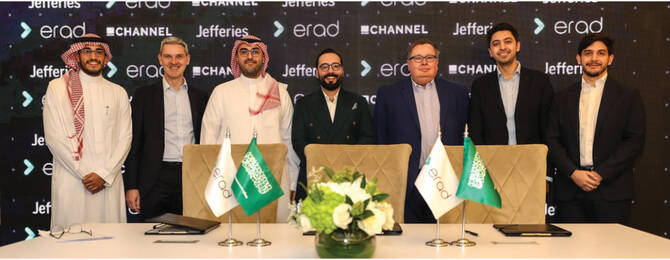
Riyadh-based embedded finance platform erad has secured a $125 million scalable facility led by Jefferies, alongside co-investment from Channel Capital. The deal marks Jefferies’ first major asset-backed SME financing transaction in the GCC.
Founded in 2022 by Salem Abu-Hammour, Faris Yaghmour, Abdulmalik Al-Meheini, and Youssef Said, erad provides Sharia-compliant working capital solutions to small and medium-sized enterprises.
The funding will enable the company to deepen its reach across the GCC and expand into new verticals including logistics, real estate, and distribution. This follows erad’s $16 million pre-series A round in April 2024.
Propeller launches $50m Fund III
Jordan-born, AI-focused venture capital firm Propeller has launched its third fund with a target size of $50 million, focused on early-stage investments in horizontal AI infrastructure and AI-native software companies in the US and MENA.
Founded in 2017 by Zaid Farekh and Tambi Jalouqa, Propeller has already made five Fund III investments in 2025, including Codemod, Netpreme, and Stealthium, as well as Pebble and Ciphero AI.
With this fund, the firm plans to bridge MENA-based founders with global capital and markets.

Caption
Revibe raises $17m
Refurbished electronics marketplace Revibe has raised $17 million in a new funding round led by Partech, with participation from e& Capital, Burda Principal Investments, and EQNX, as well as existing investors.
Founded in 2022 by Abdessamad Benzakour and Hamza Iraqui, the UAE-based platform operates in Saudi Arabia, the UAE, Kuwait, and South Africa.
The capital will support platform enhancements, product quality upgrades, and international expansion. In 2024, Revibe raised $7 million in a series A round.
FAST Ventures launches $3m venture studio
UAE-based FAST Ventures has launched FAST Foundry, a $3 million venture studio to support startups in advertising tech, retail, the creator economy, AI, and marketing.
The studio will provide capital, office space in Dubai or Riyadh, and access to a support ecosystem including Platformance, Lion, and Calibrate.
Founded in 2023 by Waseem Afzal, FAST Ventures aims to accelerate early-stage innovation across the region with integrated funding and operational support.
Buildroid AI raises $2m
US-based robotics startup Buildroid AI has raised $2 million in pre-seed funding in a round led by Tim Draper.
The company, founded in 2025 by Slava Solonitsyn and Anton Glance, is emerging from stealth with a focus on integrating AI-enabled robots into contractor workflows.
Buildroid plans to use the funding to scale pilot programs and expand into the UAE’s $42.75 billion construction market.
Bluworks closes $1m seed round
Cairo-based human resources tech startup bluworks has raised $1 million in seed funding led by A15, Enza Capital, Beltone Venture Capital, and Acasia Ventures, with participation from strategic angel investors.
Founded in 2022 by Hussein Wahdan and Farah Osman, bluworks provides workforce management tools tailored to blue-collar employees in Egypt.
The platform offers solutions for attendance, payroll, compliance, and real-time salary disbursement.
The company aims to deepen its presence in the Egyptian SME market and expand regionally.
Mastiska raises $10m seed round
UAE-based fabless semiconductor startup Mastiska has secured $10 million in seed funding, backed primarily by sovereign wealth funds from the GCC.
The company, founded in 2024 by Suresh Sugumar, is developing data-centre-class inference accelerators as part of its focus on sovereign AI hardware.
Mastiska operates model-creation teams in Abu Dhabi and VLSI engineering teams in India, offering customers full audit access for cybersecurity assurance.
With the new capital, the company plans to build UAE-based sovereign silicon using open-source technologies, launch commercial FPGA cards, and expand into sovereign markets across the GCC, South Asia, BRICS, and the Global South.