

Bangladesh, Pakistan explore avenues for cooperation in railways sector

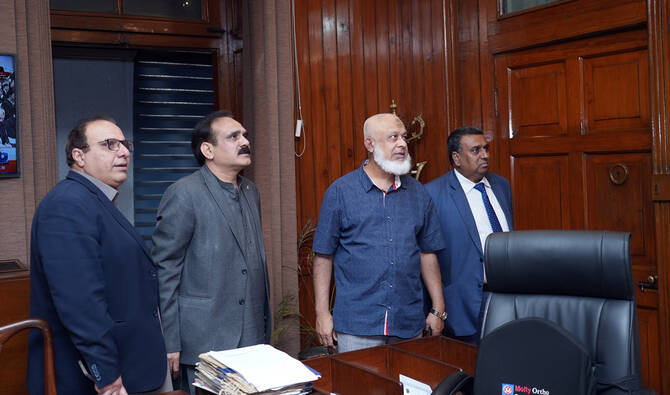
The handout photograph shows Bangladesh’s Secretary for International Organizations Farhad Islam (second right), High Commissioner to Pakistan Mohammad Iqbal Hussain Khan (right) visiting the Pakistan Railways Workshop Division in Lahore on February 7, 2026. (Pakistan Railways)
Short Url
Updated 07 February 2026
Follow

Bangladesh, Pakistan explore avenues for cooperation in railways sector

  • Islamabad, Dhaka have lately been looking to strengthen institutional linkages to broaden cooperation amid thaw in ties
  • Pakistan offers expertise in railway development, rolling stock and manufacturing to visiting Bangladeshi officials

KARACHI: Pakistani and Bangladeshi officials have discussed ways to strengthen cooperation in the railways sector, including technical collaboration and capacity-building, the Pakistani railways ministry said on Saturday, as the two sides explore avenues to expand bilateral ties.

The statement came after a visit of Bangladesh’s Secretary for International Organizations Farhad Islam and High Commissioner to Pakistan Mohammad Iqbal Hussain Khan to the Pakistan Railways Workshop Division in Lahore.

It comes amid Islamabad’s efforts to rebuild relations with Bangladesh since the ouster of former prime minister Sheikh Hasina, with both countries looking to strengthen institutional linkages to broaden their cooperation.

The visiting Bangladeshi officials were welcomed at the Pakistan Railways headquarters and briefed on the overall functioning, technical capabilities and projects, according to the Pakistani railways ministry.

“The delegation was subsequently given a detailed tour of the Mughalpura Locomotive Workshop, where they were briefed on various stages of locomotive maintenance, rehabilitation, and manufacturing processes,” the ministry said.

“The distinguished guests termed their visit as highly informative, productive, and encouraging, and appreciated the technical expertise and professional competence of Pakistan Railways.”

Pakistan and Bangladesh were part of the same country until Bangladesh’s secession following a bloody civil war in 1971, an event that long cast a shadow over bilateral ties.

Both countries have moved closer since August 2024, following the ouster of Hasina who was considered an India ally. While Pakistan-Bangladesh ties warm up, relations between Dhaka and New Delhi remain strained over India’s decision to grant asylum to Hasina.

A short documentary highlighting the working and operational strength of Pakistan Railways workshops was also presented to the Bangladeshi officials during their visit.

“Federal Minister for Railways, Mr. Muhammad Hanif Abbasi, remains fully committed to further strengthening bilateral relations with brotherly country Bangladesh, particularly in the areas of railway development, exchange of expertise, rolling stock, and cooperation in manufacturing sectors,” the railways ministry said.

“Minister has expressed his resolve to take forward railway-to-railway cooperation between the two countries, emphasizing that mutual collaboration in the railway sector can yield substantial benefits for both nations.”


Pakistan reviews austerity measures amid Middle East crisis, urges strict nationwide implementation

Updated 11 March 2026
Follow

Pakistan reviews austerity measures amid Middle East crisis, urges strict nationwide implementation

  • Deputy Prime Minister Ishaq Dar chairs review meeting of austerity steps
  • Officials briefed on salary cuts, school closures, four‑day week, petrol conservation

ISLAMABAD: Pakistan’s government on Wednesday assessed progress on a sweeping set of austerity measures introduced to mitigate the country’s economic strain from sharply rising global oil prices and supply disruptions linked to the ongoing war in the Middle East.

Prime Minister Shehbaz Sharif this week announced a series of austerity steps, including a four‑day work week for government offices, requiring 50  percent of staff to work from home, cutting fuel allowances for official vehicles by half, grounding up to 60  percent of the government fleet and closing all schools for two weeks to conserve fuel amid the global oil crisis.

The measures were unveiled in response to global oil market volatility triggered by the conflict involving the United States, Israel and Iran, which has disrupted supply routes such as the Strait of Hormuz and pushed crude prices sharply higher, straining Pakistan’s heavily import‑dependent energy sector.

“The meeting stressed the importance of strict and transparent adherence to the austerity measures, promoting fiscal responsibility and prudent use of public resources,” Deputy Prime Minister and Foreign Minister Senator Mohammad Ishaq Dar said in a statement.

He was chairing a meeting of the Committee for Monitoring and Implementation of Conservation and Additional Austerity Measures, constituted under the directions of the PM, bringing together federal and provincial officials to review execution of the broad cost‑cutting plan. 

Dar emphasized the government’s commitment to enforcing the PM’s austerity steps nationwide. The committee’s review also covered reductions in departmental expenditure, deductions from salaries of senior officials earning over Rs. 300,000 ($1,120), and coordination with provincial administrations to ensure uniform implementation of the plan.

Participants at the meeting reiterated that all ministries and divisions must continue strict monitoring and reporting, with transparent oversight mechanisms, as Pakistan navigates the economic pressures from the prolonged Middle East crisis and its fallout on global energy and trade markets.