

US gave Ukraine and Russia a June deadline to reach agreement to end war, Zelensky says

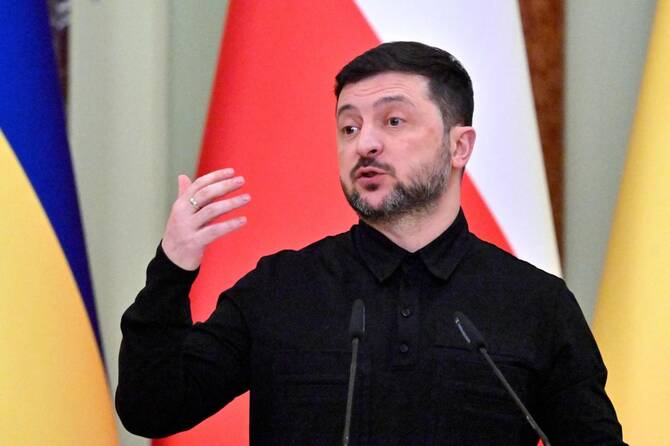
President Volodymyr Zelensky says will not accept the US making deals with Russia about Ukrainian sovereignty unless Kyiv is also involved. (AFP)
Short Url
Updated 07 February 2026
Follow

US gave Ukraine and Russia a June deadline to reach agreement to end war, Zelensky says

  • If the June deadline is not met, the Trump administration will likely put pressure on both sides to meet it, Zelensky added
  • “And they say that they want to do everything by June”

KYIV: The US has given Ukraine and Russia a June deadline to reach a deal to end the nearly four‑year war, President Volodymyr Zelensky told reporters, as Russian strikes on energy infrastructure forced nuclear power plants to cut output on Saturday.
If the June deadline is not met, the Trump administration will likely put pressure on both sides to meet it, he added.
“The Americans are proposing the parties end the war by the beginning of this summer and will probably put pressure on the parties precisely according to this schedule,” Zelensky said, speaking to reporters on Friday. Zelensky’s comments were embargoed until Saturday morning.
“And they say that they want to do everything by June. And they will do everything to end the war. And they want a clear schedule of all events,” he said.

He said the US proposed holding the next round of trilateral talks next week in their country for the first time, likely in Miami, Zelensky said. “We confirmed our participation,” he added.
Zelensky said Russia presented the US with a $12 trillion economic proposal — which he dubbed the “Dmitriev package” after Russian envoy Kirill Dmitriev. Bilateral economic deals with the US form part of the broader negotiating process.
Russian strikes on Ukrainian energy infrastructure continued with over 400 drones and about 40 missiles launched overnight Saturday, Zelensky said in a post on X. Targets included the energy grid, generation facilities and distribution networks.
Ukrenergo, the state energy transmission operator, said the attack was the second mass strike on energy infrastructure since the start of the year, forcing nuclear power plants to reduce output. Eight facilities in eight regions came under attack, it said in a statement.
“As a result of missile strikes on key high-voltage substations that ensured the output of nuclear power units, all nuclear power plants in the territories under control were forced to reduce their load,” the statement said.
It said the power deficit in the country has increased “significantly” as a result of the attacks forcing an extension of hourly power outages in all regions of Ukraine.
The latest deadline follows US-brokered trilateral talks in Abu Dhabi that produced no breakthrough as the warring parties cling to mutually exclusive demands. Russia is pressing Ukraine to withdraw from the Donbas, where fighting remains intense — a condition Kyiv says it will never accept.
“Difficult issues remained difficult. Ukraine once again confirmed its positions on the Donbas issue. ‘We stand where we stand’ is the fairest and most reliable model for a ceasefire today, in our opinion,” Zelensky said. He reiterated that the most challenging topics would be reserved for a trilateral meeting between leaders.
Zelensky said no common ground was reached on managing the Russian‑held Zaporizhzhia nuclear plant and expressed skepticism about a US proposal to turn the Donbas region, coveted by Russia, into a free economic zone as a compromise.
“I do not know whether this can be implemented, because when we talked about a free economic zone, we had different views on it,” he said.
He said in the last round of talks the negotiators discussed how a ceasefire would be technically monitored. He added that the US has reaffirmed it would play a role in that process.
Repeated Russian aerial assaults have in recent months focused on Ukraine’s power grid, causing blackouts and disrupting the heating and water supply for families during a bitterly cold winter, putting more pressure on Kyiv.
Zelensky said the US again proposed a ceasefire banning strikes on energy infrastructure. Ukraine is ready to observe such a pause if Russia commits; but he added that when Moscow previously agreed to a one-week pause suggested by the US, it was violated after just four days.


New US military-led group aided Mexico’s hunt for ‘El Mencho’ cartel boss

Updated 3 sec ago
Follow

New US military-led group aided Mexico’s hunt for ‘El Mencho’ cartel boss

  • Ex-official ‌says US gave Mexico detailed target package
  • Mexico planned, executed raid, Mexican official says
WASHINGTON: A new US-military-led task force specializing in intelligence collection on drug cartels played a role in the Mexican military raid on Sunday that killed the Mexican drug lord known as ‘El Mencho,’ ​a US defense official told Reuters. The Joint Interagency Task Force-Counter Cartel, which involves multiple US government agencies, was formally launched last month with the goal of mapping out networks of drug cartel members on both sides of the US-Mexico border, US officials said.
The US official, who spoke to Reuters on condition of anonymity, did not offer further details on any information that the US-military-led task force may have offered Mexican authorities. The official stressed the raid itself was a Mexican military operation.
A former US official, speaking on condition of anonymity without referring specifically to the task force, said the US compiled a detailed target package for El Mencho and provided it to the Mexican government for its operation.
This detailed dossier included information provided by US law enforcement, US intelligence, the former ‌official said.
The former official ‌added El Mencho was very high, if not at the top, of a ​list ‌of US ⁠targets in ​Mexico.
Mexican ⁠authorities killed drug lord Nemesio Oseguera, commonly known as ‘El Mencho,’ during an operation designed to capture him in the western state of Jalisco. The operation set off a wave of violence, with torched cars and gunmen blocking highways in more than half a dozen states.
Mexico’s defense ministry said US authorities had provided “complementary information,” but offered no details. A Mexican government source familiar with the operation said the Mexican government designed and executed it, and that no US military personnel were physically involved.
An ex-police officer, Oseguera, 60, was the shadowy leader of the powerful Jalisco New Generation Cartel (CJNG), an international criminal enterprise widely viewed as one of Mexico’s most powerful. He managed to evade arrest for ⁠years despite a $15 million bounty from the US for information leading to his arrest or capture.
The kingpin’s ‌killing notches a major victory for Mexico’s war on drug cartels that are ‌responsible for smuggling billions of dollars in cocaine and fentanyl into the US
President ​Donald Trump’s administration has waged a pressure campaign on Mexican President ‌Claudia Sheinbaum’s government to ramp up its crackdown on drug trafficking, including US threats to intervene directly in Mexico.

US MAPPING OUT ‌CARTELS
There is little information publicly available about the US Joint Interagency Task Force-Counter Cartel, or JITF-CC. Its website says its goal is to “identify, disrupt, and dismantle cartel operations posing a threat to the United States along the US-Mexico border.”
US Brig. Gen. Maurizio Calabrese, who leads the task force, spoke to Reuters this month about how the US military is channeling its experience battling groups like Al-Qaeda and Islamic State to map out cartel ‌networks.
“The cartels operate differently than Al-Qaeda or Daesh, different motivations, which makes it even more important for us to identify entire networks so that we can disrupt and dismantle (them),” ⁠Calabrese told Reuters, using an ⁠acronym for Islamic State.
Calabrese noted that estimates vary widely but said there were possibly a few hundred core cartel members “at the top.”
“But then you have anywhere from 200,000 to 250,000 independent contractors that will help you move these drugs,” Calabrese said.
Jack Riley, a former senior official at the Drug Enforcement Administration, said Trump’s designation of Mexican cartels as terrorist organizations last year
unlocked new kinds of US military assistance.
He said that could be helpful when it comes to US military intelligence, surveillance and reconnaissance resources.
“Our surveillance capabilities are going to be probably unlimited, and that will really help with real-time stuff,” Riley told Reuters.
“But these guys are extremely astute at being able to cover their tracks, cover who’s in charge and where those people are.”
A second US defense official, speaking to Reuters ahead of the Mexican operation, said the new task force fit into a broader US strategy to combat drug trafficking that has seen the US military take increasing operational control of the border with Mexico.
It also includes now-regular US strikes on suspected drug boats in ​Caribbean and Pacific waters, the legality of which has been ​challenged by Democratic lawmakers and legal experts.
“The whole idea of creating an interagency effort is to not have stray voltage, is to bring it all together, synchronize it,” the second official said of the task force.
