

Hong Kong mourns victims of apartment blaze that killed 128 and counting

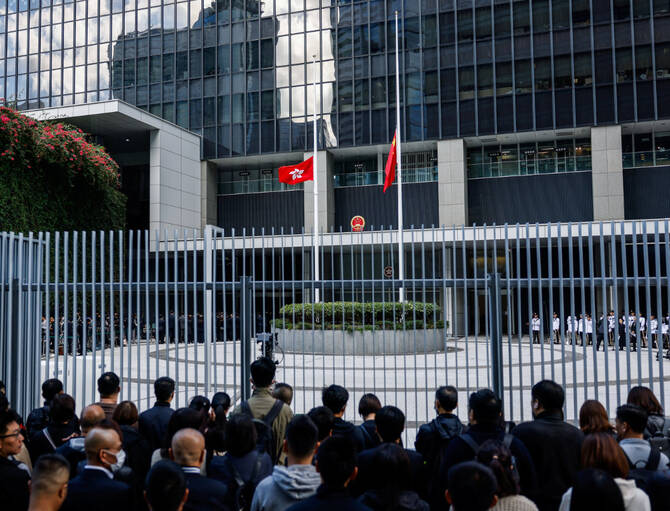
Flags of Hong Kong and China fly at half-mast next to Central Government Offices of Hong Kong as people gather after a ceremony to mourn victims killed in the deadly fire at the Wang Fuk Court housing complex in Tai Po, in Hong Kong, on November 29, 2025. (REUTERS)
Short Url
Updated 29 November 2025
Follow

Hong Kong mourns victims of apartment blaze that killed 128 and counting

  • 200 others still missing, search and rescue ended
  • 11 arrested in connection with city’s worst fire in decades

HONG KONG: Hong Kong’s leaders oversaw a ceremony on Saturday to mourn the at least 128 people killed in a high-rise apartment complex fire, a toll that is likely to rise further with 200 others still unaccounted for days after the tragedy.

Authorities have arrested 11 people in connection with the city’s worst blaze in nearly 80 years as they investigate possible corruption and the use of unsafe materials during renovations at the Wang Fuk Court complex.

Rescue operations at the site in the district of Tai Po, near the border with mainland China, concluded on Friday, though police say they may find more bodies as they search the burnt-out buildings as part of ongoing investigations.
The fire started on Wednesday afternoon and rapidly engulfed seven of the eight 32-story blocks at the complex, which were wrapped in bamboo scaffolding and green mesh and layered with foam insulation for the renovations.
Authorities have said the fire alarms at the estate, home to more than 4600 people, had not been working properly.

Search for bodies continues
Hong Kong leader John Lee, other officials and civil servants, all dressed in black, stood in silence for three minutes early on Saturday outside the central government offices, where flags were lowered to half-mast.
The officials then signed a condolence book for the dead.
At Wang Fuk Court, police officers from the disaster victim identification unit, wearing oxygen masks and helmets, prepared to enter the charred building to continue their search for remains.
Families there had the grim task of looking at photographs of the dead taken by rescue workers. Security Chief Tang said on Friday that only 39 of the 128 dead had been identified. Hong Kong’s Lee has said the government would set up a HK$300 million ($39 million) fund to help residents while some of China’s biggest listed companies have pledged donations.
Hundreds of volunteers have also mobilized to help the victims, sorting and distributing items from diapers to hot food.
They formed teams to collect, transport and distribute goods in round-the-clock shifts and have set up a sprawling support camp for displaced residents beside a shopping mall across from the complex.
At least two of the dead were domestic workers from Indonesia, the country’s consulate said. Dozens of domestic workers from the Philippines were also caught up in the disaster and 19 were still missing, said Edwina Antonio, executive director at migrant women refuge association Bethune House.
Hong Kong has around 368,000 domestic workers, mostly women from low-income Asian countries who live with their employers, often in cramped spaces.

Deadliest blaze since 1948
The fire is Hong Kong’s deadliest since 1948, when 176 people died in a warehouse blaze, and has prompted comparisons to London’s Grenfell Tower inferno, which killed 72 people in 2017. Residents of the housing complex were told by authorities last year that they faced “relatively low fire risks” after complaining repeatedly about fire hazards posed by ongoing renovation works, the city’s Labour Department told Reuters. The residents had raised concerns in September 2024, including about the potential flammability of the protective green mesh contractors had used to cover the bamboo scaffolding, a department spokesperson said.
Hong Kong’s anti-graft body said it had arrested eight individuals on Friday including an engineering consultant, a scaffolding subcontractor, and an intermediary.
Earlier, police arrested two directors and an engineering consultant of Prestige Construction, a firm identified by the government as doing maintenance on Wang Fuk Court for more than a year on suspicion of manslaughter for using unsafe materials, including flammable foam boards blocking windows.
Prestige did not answer repeated calls for comment.


House votes to slap back Trump’s tariffs on Canada in rare bipartisan rebuke

Updated 6 sec ago
Follow

House votes to slap back Trump’s tariffs on Canada in rare bipartisan rebuke

WASHINGTON: The House voted Wednesday to slap back President Donald Trump’s tariffs on Canada, a rare if largely symbolic rebuke of the White House agenda as Republicans joined Democrats over the objections of GOP leadership.
The tally, 219-211, was among the first times the House, controlled by Republicans, has confronted the president over a signature policy, and drew instant recrimination from Trump himself. The resolution seeks to end the national emergency Trump declared to impose the tariffs, though actually undoing the policy would require support from the president, which is highly unlikely. It next goes to the Senate.
Trump believes in the power of tariffs to force US trade partners to the negotiating table. But lawmakers are facing unrest back home from businesses caught in the trade wars and constituents navigating pocketbook issues and high prices.
“Today’s vote is simple, very simple: Will you vote to lower the cost of living for the American family or will you keep prices high out of loyalty to one person — Donald J. Trump?” said Rep. Gregory Meeks of New York, the top Democrat on the House Foreign Affairs Committee, who authored the resolution.
Within minutes, as the gavel struck, Trump fired off a stern warning to those in the Republican Party who would dare to cross him.
“Any Republican, in the House or the Senate, that votes against TARIFFS will seriously suffer the consequences come Election time, and that includes Primaries!” the president posted on social media.
The high-stakes moment provides a snapshot of the House’s unease with the president’s direction, especially ahead of the midterm elections as economic issues resonate among voters. The Senate has already voted to reject Trump’s tariffs on Canada and other countries in a show of displeasure. But both chambers would have to approve the tariff rollbacks, and send the resolution to Trump for the president’s signature — or veto.
Six House Republicans voted for the resolution, and one Democrat voted against it.
From Canada, Ontario, Premier Doug Ford on social media called the vote “an important victory with more work ahead.” He thanked lawmakers from both parties “who stood up in support of free trade and economic growth between our two great countries. Let’s end the tariffs and together build a more prosperous and secure future.”
Trump recently threatened to impose a 100 percent tariff on goods imported from Canada over that country’s proposed China trade deal, intensifying a feud with the longtime US ally and Prime Minister Mark Carney.
GOP defections forced the vote
House Speaker Mike Johnson tried to prevent this showdown.
Johnson insisted lawmakers wait for a pending Supreme Court ruling in a lawsuit about the tariffs. He engineered a complicated rules change to prevent floor action. But Johnson’s strategy collapsed late Tuesday, as Republicans peeled off during a procedural vote to ensure the Democratic measure was able to advance.
“The president’s trade policies have been of great benefit,” Johnson, R-Louisiana, had said. “And I think the sentiment is that we allow a little more runway for this to be worked out between the executive branch and the judicial branch.”
Late Tuesday evening, Johnson could be seen speaking to holdout Republican lawmakers as the GOP leadership team struggled to shore up support during a lengthy procedural vote, but the numbers lined up against him.
“We’re disappointed,” Kevin Hassett, the director of the White House’s National Economic Council, told reporters at the White House on Wednesday morning. “The president will make sure they don’t repeal his tariffs.”
Terminating Trump’s emergency
The resolution put forward by Meeks would terminate the national emergency that Trump declared a year ago as one of his executive orders.
The administration claimed illicit drug flow from Canada constitutes an unusual and extraordinary threat that allows the president to slap tariffs on imported goods outside the terms of the US-Mexico-Canada trade agreement.
The Republican chairman of the House Foreign Affairs Committee, Rep. Brian Mast of Florida, said the flow of fentanyl into the US is a dire national emergency and the policy must be left in place.
“Let’s be clear again about what this resolution is and what it’s not. It’s not a debate about tariffs. You can talk about those, but that’s not really what it is,” Mast said. “This is Democrats trying to ignore that there is a fentanyl crisis.”
Experts say fentanyl produced by cartels in Mexico is largely smuggled into the US from land crossings in California and Arizona. Fentanyl is also made in Canada and smuggled into the US, but to a much lesser extent.
Torn between Trump and tariffs
Ahead of voting, some rank-and-file Republican lawmakers expressed unease over the choices ahead as Democrats — and a few renegade Republicans — impressed on their colleagues the need to flex their power as the legislative branch rather than ceding so much power to the president to take authority over trade and tariff policy.
Rep. Don Bacon, R-Nebraska, said he was unpersuaded by Johnson’s call to wait until the Supreme Court makes its decision about the legality of Trump’s tariffs. He voted for passage.
“Why doesn’t the Congress stand on its own two feet and say that we’re an independent branch?” Bacon said. “We should defend our authorities. I hope the Supreme Court does, but if we don’t do it, shame on us.”
Bacon, who is retiring rather than facing reelection, also argued that tariffs are bad economic policy.
Other Republicans had to swiftly make up their minds after Johnson’s gambit — which would have paused the calendar days to prevent the measure from coming forward — was turned back.
“At the end of the day, we’re going to have to support our president,” said Rep. Keith Self, R-Texas.
Rep. Darrell Issa, R-Calif., said he doesn’t want to tie the president’s hands on trade and would support the tariffs on Canada “at this time.”