


ISLAMABAD: Pakistan’s foreign office on Friday said that Islamabad remains open to any mediation from Saudi Arabia to defuse tensions with Afghanistan, declaring that its truce with Kabul had collapsed because of continuing attacks by Afghanistan-based militant groups.
Tensions between Pakistan and Afghanistan escalate further this week after Afghanistan accused Islamabad of carrying out overnight strikes on Afghan territory that killed 10 civilians. Pakistan’s military denied the allegations as Kabul warned of retaliation.
Pakistan has accused Kabul of harboring militant groups, including the Tehreek-e-Taliban Pakistan (TTP), which carry out attacks inside Pakistan, seeking decisive action against them. The Afghan government denies the allegation and says Pakistan’s security challenges are its internal matter.
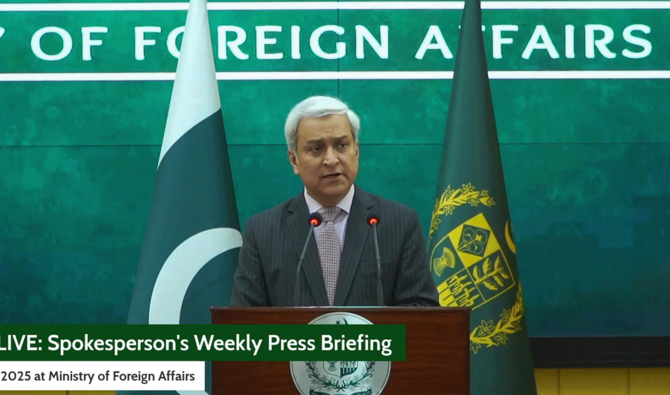
Responding to international media reports about a possible Saudi mediation between Islamabad and Kabul, Pakistani foreign office spokesperson Tahir Andrabi said they had not yet received any formal proposal in this regard.
“I am not aware of any such concrete offer made by our Saudi friends,” Andrabi told reporters at a weekly press briefing in Islamabad on Friday.
“Pakistan would not resent mediation in principle. If a country has a strong legal position on any issue, it welcomes mediation.”
Pakistan and Saudi Arabia share strong fraternal, economic, defense and cultural ties. The two nations have sought to broaden their cooperation in recent years and signed a Strategic Mutual Defense Agreement (SMDA) in Sept.
Pakistan would respond to any proposal that addresses the issue of the use of Afghan soil by militants, according to Andrabi.
“We would respond to any offer based on a concrete proposal, particularly with respect to terrorists using Afghan soil to attack Pakistan,” he said.
Last month, Pakistan and Afghanistan engaged in fierce clashes along their 2,600-kilometer border after Pakistan hit what it said were TTP-linked targets inside Afghanistan.
The two countries agreed to a ceasefire in Doha on Oct. 19, though two subsequent rounds of talks, facilitated by Turkiye and Qatar in Istanbul, failed to firm up the truce.
Andrabi said Pakistan’s ceasefire with Afghanistan was no longer holding after suicide attacks in Islamabad and Peshawar killed more than a dozen people this month.
“The ceasefire in this case implied that there would be no terrorist attack by Afghan-sponsored proxies into Pakistan. There have been major terrorist attacks after this ceasefire. So in that sense, the ceasefire is not holding,” he said.
“If Afghan nationals are attacking as they did in Islamabad and elsewhere, we cannot be very optimistic about the ceasefire.”
Pakistan remains fully alert to any possible escalation, according to the foreign office spokesman.
“Our military preparedness is robust. The security challenges that we face will be addressed with the seriousness they merit,” he said.
Andrabi rejected Kabul’s allegation of Islamabad harboring Daesh members, saying that such statements were aimed at “deflecting responsibility from the Afghan side.”
“Any extremist or terrorist element in Pakistan is dealt with strictly under our laws,” he said.
UAE VISA BAN
Asked about a recent disclosure in a Pakistani parliamentary committee about a visa ban on Pakistanis by the United Arab Emirates, the foreign office spokesman said this was not a new development and the statement made before the National Assembly committee was “based on prior record.”
“This news came in yesterday’s papers and I immediately checked with my predecessor and your well-known ambassador [to the UAE] Shafqat Ali Khan,” he said. “We follow of course these developments very closely. There’s no such new provision from UAE.”
Local media reports this year suggested a decline in visa approvals for Pakistani nationals by the UAE and a decrease in overall employment opportunities for Pakistanis in the Gulf country allegedly due to their lack of respect for local laws and customs.
In Feb., Pakistan’s then ambassador to the UAE, Faisal Niaz Tirmizi, had described the refusal of visas to Pakistani nationals as a “serious and significant” issue, saying that both countries were working to resolve the issue.


