ISTANBUL: Pope Leo XIV encouraged Turkiye’s tiny Catholic community to find strength in its small size as he embarked on the key day of his first trip that is meant to bolster Christians and pursue their centuries-old quest for unity.
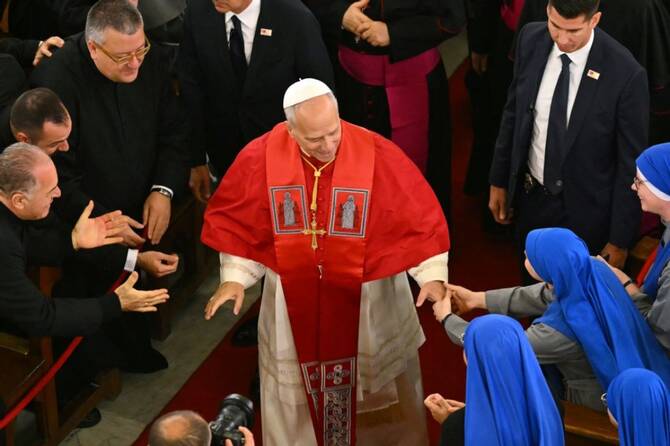
Shouts of “Papa Leo” and “Viva il Papa” (Long Live the pope) erupted along with cheering and clapping inside and outside Istanbul’s Cathedral of the Holy Spirit as Leo arrived to begin his first full day in Turkiye.
Leo presided over a prayer with Turkiye’s Catholic clergy and nuns before taking part in the key reason for his visit, the first of his pontificate. He will commemorate the 1,700th anniversary of one of the most important moments in Christianity: the 325 AD gathering of bishops that produced the Nicaean Creed, a statement of faith that millions of Christians still recite today.
The gathering happened at a time when the Eastern and Western churches were still united. They split in the Great Schism of 1054, a divide precipitated largely by disagreements over the primacy of the pope. But even today, Catholic, Orthodox and most historic Protestant groups accept the Nicaean Creed, making it a point of agreement and the most widely accepted creed in Christendom.
As a result, celebrating its foundations is an important marker in the centuries-old quest to re-unite all Christians.
Speaking at the cathedral, Leo said the creed wasn’t merely a doctrinal formula, but the “essential core of the Christian faith.”
“Therefore, its development is organic, akin to that of a living reality, gradually bringing to light and expressing more fully the essential heart of the faith,” he said.
The anniversary commemoration will take place in Iznik, site of the Council of Nicaea gathering, about 150 kilometers (93 miles) from Istanbul. Presiding with Leo will be Ecumenical Patriarch Bartholomew, the spiritual leader of the world’s Orthodox Christians.
Leo arrived in Turkiye on Thursday, emphasizing a message of peace as he met with Turkish President Recep Tayyip Erdogan. It’s a message he’ll bring to Lebanon on Sunday, the second and final leg of the trip for history’s first American pope.
At the cathedral on Tuesday, Leo sought to encourage Turkiye’s tiny Catholic community, which numbers around 33,000 in a nation of 85 million, most of whom are Sunni Muslims. He praised especially the church’s work with migrants and newcomers to Turkiye.
“The logic of littleness is the church’s true strength,” Leo told them in English.”The significant presence of migrants and refugees in this country presents the Church with the challenge of welcoming and serving some of the most vulnerable.”
It was a message that resonated with the crowd outside, which reflected the multinational face of the Catholic Church in Turkiye.
“With all my heart I am so happy,” said Debora Martina Da Silva, a political science student from Guinea Bissau.
Mateusz Zajdecki, a 21-year-old from Szczecin, Poland, recognized the ecumenical significance of Leo’s visit.
“I think it is important for Turkiye to (be) united at one table, eucharistic table, and to pray together to one father who is in heaven,” Zajdecki said.


![]()

Pope Leo XIV receives enthusiastic welcome from Turkiye’s Catholics as he opens key day in first trip
Short Url
https://arab.news/nbeby
Pope Leo XIV receives enthusiastic welcome from Turkiye’s Catholics as he opens key day in first trip
- Leo presided over a prayer with Turkiye’s Catholic clergy and nuns before taking part in the key reason for his visit, the first of his pontificate


Latest updates


© 2026 SAUDI RESEARCH & PUBLISHING COMPANY, All Rights Reserved And subject to Terms of Use Agreement.