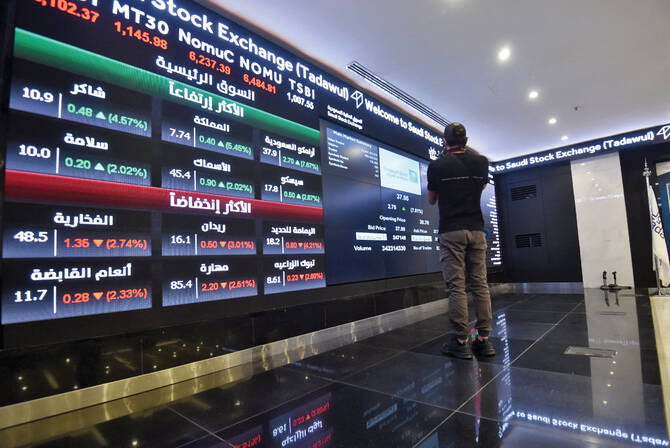

RIYADH: Saudi Arabia’s parallel equity market Nomu is emerging as a central channel for financing the Kingdom’s non-oil economy, widening access to public markets for small and medium enterprises while supporting the government’s diversification push.
More than 60 percent of Nomu-listed firms operate in sectors such as technology, healthcare and logistics — industries aligned with Vision 2030 priorities — highlighting the platform’s shift away from hydrocarbons, experts told Arab News.
Speaking to Arab News, Vijay Valecha, chief investment officer at Century Financial, said the market has fundamentally changed who can access Saudi Arabia’s equity ecosystem.
“Nomu plays a foundational role in Saudi Arabia’s capital market by opening the equity market to smaller, fast-growing companies that are not yet ready for the main exchange. Before Nomu was launched in 2017, access to public equity markets was largely limited to large, established firms. Nomu changed that structure,” said Valecha.
He added: “Nomu also plays an important role in diversification. More than 60 percent of listed companies come from non-oil sectors such as technology, healthcare, consumer services, logistics, and education. These are priority sectors under Vision 2030. By helping these firms raise growth capital, Nomu supports job creation, innovation, and private-sector expansion.”
Since launching with just seven companies in 2017, Nomu has expanded to host more than 126 listed firms by late 2025, reflecting rising SME demand for public funding.
According to Valecha, the market functions as a “training ground” where companies strengthen governance, adapt to public-market discipline and build investor credibility before transitioning to the main market.
Programs such as Monshaat’s “Tomoh” initiative have helped prepare high-growth companies for listing, feeding a pipeline of firms ready to tap equity markets.
Nomu has also lowered entry barriers by setting a minimum market capitalization requirement of SR10 million ($2.67 million), compared with the Tadawul main market’s SR300 million threshold — a gap that significantly widens access for SMEs.
Mohammad Nikkar, principal in financial services at Arthur D. Little Middle East, said the platform mirrors the function of London’s AIM market as an alternative route to public funding.

Nomu helps smaller companies to tap into public sources for funding.
Mohammad Nikkar, Principal in financial services at Arthur D. Little Middle East
“This market is a key pillar of Saudi Vision 2030 and the Financial Sector Development Program, which aim to diversify the economy away from oil by increasing the private sector’s role,” said Nikkar.
He added: “By providing an alternative to traditional bank loans, Nomu helps the smaller companies trading in the Kingdom to tap into the public sources for funding and allows the economy to move toward its goal of raising the SME contribution to GDP (gross domestic product) from 20 percent to 35 percent by 2030.”
Nikkar added that the parallel market serves as a “springboard” for companies to professionalize their management and corporate governance, allowing them to eventually transition to the main market after being publicly listed on Nomu for at least two years.
Hamza Dweik, head of trading at Saxo Bank for the Middle East and North Africa, said accessibility has improved through regulatory easing and issuer-friendly listing rules.
“The Capital Market Authority has eased investor eligibility by lowering transaction thresholds, removing quarterly trading requirements, and recognizing bachelor’s degree holders in finance-related fields as qualified investors, significantly widening participation,” said Dweik.
Ibrahim Masood, director and head of equities at Mashreq Capital, said Nomu is expanding the “funding stack” beyond bank loans and private capital, and is playing a critical role in the Kingdom’s economic diversification program.
Masood added: “Nomu is Saudi Arabia’s ‘on-ramp’ stock market; it gets smaller, faster-growing private companies funded earlier so the economy isn’t just big caps and hydrocarbons.”
In May 2025, Mohammed El-Kuwaiz, chairman of the Capital Market Authority, said the Nomu index had grown tenfold since inception, with market capitalization increasing 26 times to nearly SR60 billion ($16 billion) by the end of 2024.
Liquidity has also surged, with trading values reaching approximately SR14 billion this year — an eightfold increase.
Powering SMEs
Tony Hallside, CEO of STP Partners, said Nomu is helping create a more inclusive capital landscape by giving SMEs access to equity financing.
“Nomu’s impact is multi-dimensional. By end-2025, over 125 companies were listed on the parallel market, reflecting a growing pipeline of domestic enterprises seeking scalable financing options through public markets,” said Hallside.
Strengthening the SME ecosystem remains central to Vision 2030 as Saudi Arabia works to reduce reliance on oil revenues.
Valecha said listed firms are typically founder-led or family-run businesses with clear expansion ambitions.
“These are real businesses serving the local economy, not speculative or concept-driven listings. Typically, Nomu companies raise between SR10 million and SR100 million at the time of listing. For a large corporation, this may look small. For an SME, it can change everything,” added Valecha.
Dweik said Nomu functions as a scalable launchpad for SMEs entering public markets.

Nomu functions as a scalable launchpad for SMEs entering public markets.
Hamza Dweik, head of trading at Saxo Bank for the Middle East and North Africa
According to the Saxo Bank executive, improved visibility, easier access to capital and stronger financial discipline are among the main advantages of listing.
“Nomu’s flexible listing framework, including direct listings and semi-annual rather than quarterly reporting, also helps SMEs manage compliance costs while still meeting transparency standards,” added Dweik.
Masood said the platform is turning IPOs into a viable financing route for mid-sized firms. “For companies, the benefits are straightforward: capital raising, valuation discovery, reputational lift with customers, banks and suppliers, and an institutionalized shareholder base. For the market, it increases breadth — more issuers, more sectors, more deal flow, more advisory activity,” added Masood.
Valecha said public listing reshapes how smaller companies operate by enforcing institutional standards.
“Public market rules require regular disclosures, audited accounts, and stronger governance. For many firms, this is their first exposure to institutional standards. The result is better financial discipline and greater transparency. Over time, this makes it easier to attract professional investors,” he said.
Challenges and reforms
Experts also outlined challenges facing the parallel market, with the main one being lower liquidity.
“While the market faces challenges such as lower liquidity due to the smaller investor pool and higher level of volatility, the Saudi Exchange is addressing these through “market maker” programs that ensure more continuous trading,” said Nikkar.
Masood cited volatility, limited analyst coverage and governance transitions as structural hurdles, but said regulators are positioning Nomu as a bridge to the main exchange.
Valecha said thinner trading depth continues to amplify price swings.
In November 2025, the Capital Market Authority amended Nomu listing rules to expand qualified investor categories and update eligibility criteria.
Qualified investors now include capital market institutions, investment funds, Gulf Cooperation Council companies, qualified foreign financial institutions and certain high-net-worth individuals.
“Overall, the reforms formed part of the Saudi Exchange’s broader strategy to diversify funding channels and increase private sector participation in equity markets,” said Valecha.
He added: “The changes were introduced as Saudi Arabia continued to see a steady flow of listings on both the main market and Nomu, supported by favorable macroeconomic conditions and ongoing efforts to deepen the capital market.”