

Israel’s Supreme Court suspends govt move to shut army radio

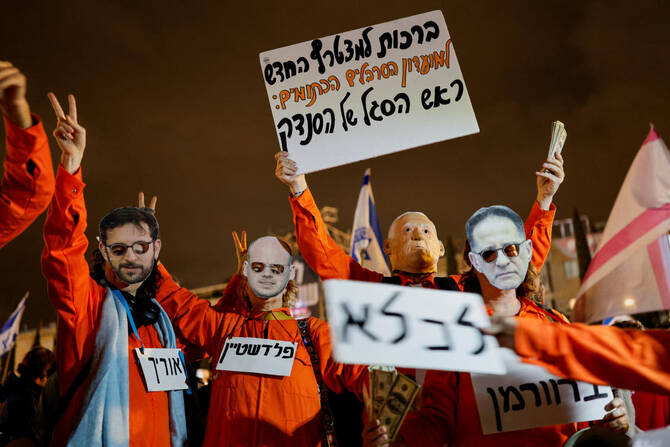
Protesters wearing orange jumpsuits and holding mock dollar bills take part in a demonstration against Israeli Prime Minister Benjamin Netanyahu and his government, in Tel Aviv, Israel, December 27, 2025. The sign at the top reads: "Congratulations to the winners of the fire sale: the corrupt movie producers". Another sign reads: "Palestine". REUTERS/Amir Cohen
Short Url
Updated 29 December 2025
Follow

Israel’s Supreme Court suspends govt move to shut army radio

  • Israel’s Supreme Court has issued an interim order suspending a government decision to shut down Galei Tsahal, the country’s decades-old and widely listened-to military radio station

JERUSALEM: Israel’s Supreme Court has issued an interim order suspending a government decision to shut down Galei Tsahal, the country’s decades-old and widely listened-to military radio station.
In a ruling issued late Sunday, Supreme Court President Isaac Amit said the suspension was partly because the government “did not provide a clear commitment not to take irreversible steps before the court reaches a final decision.”
He added that Attorney General Gali Baharav-Miara supported the suspension.
The cabinet last week approved the closure of Galei Tsahal, with the shutdown scheduled to take effect before March 1, 2026.
Founded in 1950, Galei Tsahal is widely known for its flagship news programs and has long been followed by both domestic and foreign correspondents.
A government audience survey ranks it as Israel’s third most listened-to radio station, with a market share of 17.7 percent.
Prime Minister Benjamin Netanyahu had urged ministers to back the closure, saying there had been repeated proposals over the years to remove the station from the military, abolish it or privatise it.
But Baharav-Miara, who also serves as the government’s legal adviser and is facing dismissal proceedings initiated by the premier, has warned that closing the station raised “concerns about possible political interference in public broadcasting.”
She added that it “poses questions regarding an infringement on freedom of expression and of the press.”
Defense Minister Israel Katz said last week that Galei Tsahal broadcasts “political and divisive content” that does not align with military values.
He said soldiers, civilians and bereaved families had complained that the station did not represent them and undermined morale and the war effort.
Katz also argued that a military-run radio station serving the general public is an anomaly in democratic countries.
Opposition leader Yair Lapid had condemned the closure decision, calling it part of the government’s effort to suppress freedom of expression ahead of elections.
Israel is due to hold parliamentary elections in 2026, and Netanyahu has said he will seek another term as prime minister.

Grendizer at 50
The anime that conquered Arab hearts and minds

Enter


keywords

First responders enter devastated Aleppo neighborhood after days of deadly fighting

Updated 12 January 2026
Follow

First responders enter devastated Aleppo neighborhood after days of deadly fighting

  • The US-backed SDF, which have played a key role in combating the Daesh group in large swaths of eastern Syria, are the largest force yet to be absorbed into Syria’s national army

ALEPPO, Syria: First responders on Sunday entered a contested neighborhood in Syria’ s northern city of Aleppo after days of deadly clashes between government forces and Kurdish-led forces. Syrian state media said the military was deployed in large numbers.
The clashes broke out Tuesday in the predominantly Kurdish neighborhoods of Sheikh Maqsoud, Achrafieh and Bani Zaid after the government and the Syrian Democratic Forces, the main Kurdish-led force in the country, failed to make progress on how to merge the SDF into the national army. Security forces captured Achrafieh and Bani Zaid.
The fighting between the two sides was the most intense since the fall of then-President Bashar Assad to insurgents in December 2024. At least 23 people were killed in five days of clashes and more than 140,000 were displaced amid shelling and drone strikes.
The US-backed SDF, which have played a key role in combating the Daesh group in large swaths of eastern Syria, are the largest force yet to be absorbed into Syria’s national army. Some of the factions that make up the army, however, were previously Turkish-backed insurgent groups that have a long history of clashing with Kurdish forces.
The Kurdish fighters have now evacuated from the Sheikh Maqsoud neighborhood to northeastern Syria, which is under the control of the SDF. However, they said in a statement they will continue to fight now that the wounded and civilians have been evacuated, in what they called a “partial ceasefire.”
The neighborhood appeared calm Sunday. The United Nations said it was trying to dispatch more convoys to the neighborhoods with food, fuel, blankets and other urgent supplies.
Government security forces brought journalists to tour the devastated area, showing them the damaged Khalid Al-Fajer Hospital and a military position belonging to the SDF’s security forces that government forces had targeted.
The SDF statement accused the government of targeting the hospital “dozens of times” before patients were evacuated. Damascus accused the Kurdish-led group of using the hospital and other civilian facilities as military positions.
On one street, Syrian Red Crescent first responders spoke to a resident surrounded by charred cars and badly damaged residential buildings.
Some residents told The Associated Press that SDF forces did not allow their cars through checkpoints to leave.
“We lived a night of horror. I still cannot believe that I am right here standing on my own two feet,” said Ahmad Shaikho. “So far the situation has been calm. There hasn’t been any gunfire.”
Syrian Civil Defense first responders have been disarming improvised mines that they say were left by the Kurdish forces as booby traps.
Residents who fled are not being allowed back into the neighborhood until all the mines are cleared. Some were reminded of the displacement during Syria’s long civil war.
“I want to go back to my home, I beg you,” said Hoda Alnasiri.