

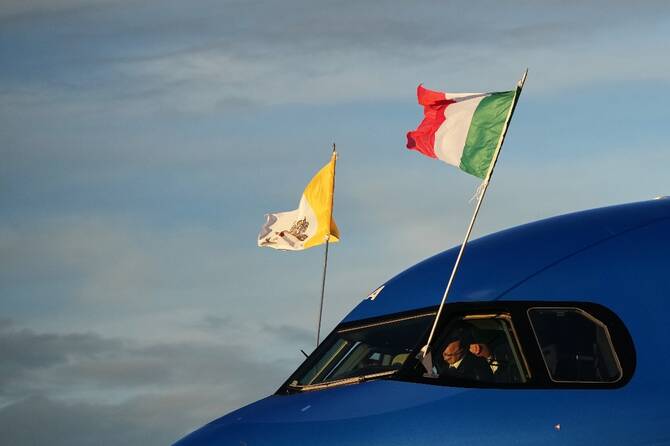

ANKARA: Pope Leo XIV arrived in Turkiye on Thursday for a four-day visit where he will hold talks with President Recep Tayyip Erdogan and meet Christian leaders on the first overseas trip of his papacy.
The trip, which includes a second leg to Lebanon, begins in the Turkish capital Ankara, where the first American pope landed shortly after midday.
“I have very much been looking forward to this trip because of what it means for Christians, but it is also a great message to the whole world,” he told reporters traveling with him on his plane, describing it as a “historic moment.”
After paying his respects at the mausoleum dedicated to Mustafa Kemal Ataturk, the founder of modern Turkiye, Leo will head into talks with Erdogan, who is seen as a key player for peace efforts in a region fraught with conflict.
Then he will address authorities, civil society and the diplomatic corps before heading to Istanbul in the early evening.
Leo’s first steps abroad will be scrutinized by the world’s media, with more than 80 journalists accompanying him on his papal plane.
Since his election in May as the leader of the world’s 1.4 billion Catholics, the pope has shown himself to be adept at handling the media, talking to reporters weekly.
In a sign of his desire to reach a wide audience, Leo will deliver all his speeches during the trip in English, his native language, rather than the Italian he usually uses.
His first address in Turkiye is expected to focus on dialogue with Islam in a country where Christians account for only 0.1 percent of the 86 million inhabitants — most of them Sunni Muslims.
On the doorstep of a conflict-ridden Middle East, the pope who upon his election called for “unarmed and disarming” peace, is expected to address the crises troubling the region.
But between the colonnades of Ankara’s monumental presidential palace, Leo will have to tread delicately if he plans to address the sensitive issue of human rights, the arrest of Erdogan’s opponents, or the status of Turkiye’s Christians, who are struggling against inequality and exclusion.
- ‘Promoting unity’ -
The Holy See also acknowledges Turkiye’s efforts in taking in more than 2.5 million mostly Syrian refugees, according to authorities.
On the subject of refugees and migrants, Leo has followed in the footsteps of his predecessor Francis, most recently criticizing the “extremely disrespectful” treatment of migrants by the government of US President Donald Trump.
Friday’s calendar will take on a more religious aspect with the celebration in Iznik of the 1,700th anniversary of the First Council of Nicaea, a gathering of bishops in the year 325 that resulted in a creed, or statement of faith, still central to Christianity.
Invited by the Patriarch of Constantinople, Bartholomew I, leader of the world’s Orthodox Christians, Leo will take part in a prayer on the shores of Lake Iznik that was initially to include former Pope Francis, who died in April.
“Bartholomew and I have already met several times, and I think this will be an exceptional opportunity to promote unity among all Christians,” Leo told journalists late Tuesday.
Catholics and Orthodox Christians have been divided since a schism in 1054.
Catholics recognize the universal authority of the pope as the head of the Church, while Orthodox Christians are organized into local Churches with their own leaders.
Leo’s trip comes as the Orthodox world appears even more fragmented than ever, with the war in Ukraine accelerating the split between the Moscow and Constantinople patriarchates.
The pope is the fifth pontiff to visit Turkiye, after Paul VI in 1967, John Paul II in 1979, Benedict XVI in 2006 and Francis in 2014.
On Sunday, Leo will head to religiously diverse Lebanon, a nation that has been crushed by a devastating economic and political crisis since 2019 and which has been the target of repeated bombings by Israel in recent days, despite a ceasefire.


