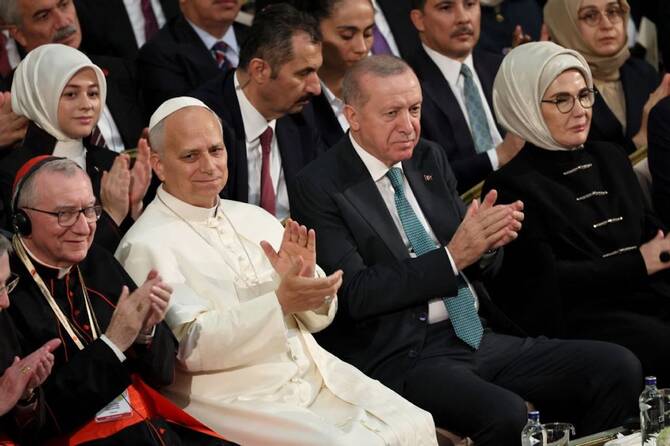
Erdogan praises Pope’s ‘astute stance’ on Palestinian issue

1 / 3
Pope Leo XIV, Turkey's President Recep Tayyip Erdogan and his wife Emine Erdogan attend a meeting with representatives of Turkey's authorities, civil society and diplomatic corps at the Turkish national Library in Ankara on Thursday. (AFP)
2 / 3
Turkish President Recep Tayyip Erdogan shakes hands with Pope Leo XIV during their meeting at the Presidential palace in Ankara on Thursday. (Via AP)
3 / 3
Pope Leo XIV and Turkey's President Recep Tayyip Erdogan review an honor guard during an official welcome ceremony at the presidential palace, in Ankara. (AP)
Short Url
Updated 27 November 2025
Follow

Erdogan praises Pope’s ‘astute stance’ on Palestinian issue

  • President Tayyip Erdogan meets Pope Leo in ceremony in Ankara
  • Turkish president says he hopes Catholic leader's first overseas visit will benefit humanity at time of tension and uncertainty

ANKARA: Turkish President Tayyip Erdogan praised Pope Leo’s stance on the Palestinian issue after meeting him in Ankara on Thursday, and said he hoped his first overseas visit as Catholic leader will benefit humanity at a time of tension and uncertainty.
“We commend (Pope Leo’s) astute stance on the Palestinian issue,” Erdogan said in an address to the Pope and political and religious leaders at the presidential library in the Turkish capital Ankara.
“Our debt to the Palestinian people is justice, and the foundation of this is to immediately implement the vision of a two-state solution based on the 1967 borders. Similarly, preserving the historic status of Jerusalem is crucial,” Erdogan said.
Pope Leo’s calls for peace and diplomacy regarding the war in Ukraine are also very meaningful, Erdogan said.
In September, Leo met at the Vatican with Israeli President Isaac Herzog and raised the “tragic situation” in Gaza with him.
Turkiye has emerged as among the harshest critics of Israel’s bombardment of Gaza, in its conflict there with Palestinian militant group Hamas.


Could Lebanon’s bid for direct Israel talks reshape a decades-long conflict?

Updated 7 sec ago
Follow

Could Lebanon’s bid for direct Israel talks reshape a decades-long conflict?

  • Beirut proposes unprecedented ministerial-level negotiations with Israel as war devastates Lebanon and diplomacy struggles
  • Analysts say direct talks could redefine Lebanon’s sovereignty but risk deepening divisions and confrontation with Hezbollah

BEIRUT/LONDON: As a Lebanese delegation starts taking shape to hold direct talks with Israel, the people of Lebanon remain trapped in the crossfire between Israel and Hezbollah, victims of a conflict their country neither sought nor wanted.

This time, however, amid the renewed suffering, destruction and mass displacement of Lebanon’s citizens, a cautious hope is taking hold that a historic peace initiative proposed by the Lebanese government could pave the way to an end to the country’s decades of turmoil.

Lebanon has formally asked the US and other countries to broker direct talks with Israel, proposing Cyprus as a neutral venue for ministerial-level negotiations.

The move is being hailed as the most ambitious diplomatic overture Beirut has made toward Tel Aviv in a generation, and its potential historic significance is not lost on analysts.

As Israeli forces continue to bombard Lebanon, President Joseph Aoun, right, calls for direct negotiations with Israel to end the escalating conflict with Hezbollah. (AFP)

“Any talks between two countries that have been for so long in the state of war is important,” said Yossi Mekelberg, professor of international relations and associate fellow of the MENA Programme at Chatham House.

“If you look at the underlying differences between Israel and Lebanon, and you take Hezbollah and Iran out of the equation, they are minimal.”

Furthermore, he added, “the Lebanese army is doing better than they did in the past, I think it’s asserting itself.

“When Hezbollah is on the wrong foot, there is an opportunity … and Israel and Lebanon are not interested in fighting one another.”

But no one is under any illusion that the path forward will be easy.

The formal request for direct peace talks with Israel was conveyed to Tom Barrack, the US ambassador to Turkiye and special envoy to Syria, by Lebanon’s President Joseph Aoun and Prime Minister Nawaf Salam.

Cyprus has confirmed its willingness to host talks, but no date has been set as yet.

Israeli forces press deeper into southern Lebanon as airstrikes intensify across the country. (AFP)

The proposal has already hit its first wall. Beirut has insisted that any meeting must be preceded by a “full cessation” of hostilities — stopping short of formally calling it a ceasefire. Israel has rejected the condition outright, saying talks must proceed while fighting continues.

But President Aoun continues to work the phones. Minister of Information Paul Morcos told Arab News that Aoun has been reaching out to the French president, the US ambassador, and a number of European leaders.

Former Foreign Minister Nassif Hitti endorsed the approach. “The most important thing is to put such a proposal on the table, and this requires Arab and international contacts,” he told Arab News.

Political analyst Walid Choucair was blunter. Israel, he said, “no longer views (the Lebanese state) as a capable partner for commitment or implementation,” and it “has decided to move from the logic of containment to the logic of a decisive resolution.”

Beirut, he said, should move quickly and look to a recent regional precedent. “Syria resorted to direct negotiation. Why should Lebanon not do so?”

A constitutional judicial source, who requested anonymity, told Arab News that the question of direct negotiations “is highly sensitive — it cannot be discussed constitutionally in isolation from politics, which is linked to the Israeli-US war on Iran and its ramifications in Lebanon. The two issues cannot be separated.”

Residents and emergency personnel stand amid debris at the site of an overnight Israeli airstrike in the village of Younine, in Lebanon's Bekaa Valley, on March 12, 2026.(AFP)

At the political level, according to the judicial source, the president cannot be prevented from exercising his right to negotiate, but they warned that Lebanon’s deep parliamentary divisions made the path treacherous.

“What is required is a unified Lebanese position that does not result in divisions that are dangerous for Lebanon’s future,” the source told Arab News.

The fear runs deeper than political fracture. Moving against Hezbollah while Israeli bombardment continues risks a direct clash between the army and the group.

Any such confrontation could shatter both domestic stability and the unity of the military establishment at the worst possible moment.

Enforcement of any agreement would present its own dilemma. The UN Interim Force in Lebanon, UNIFIL, has documented thousands of Israeli violations since November 2024 without any mechanism to impose consequences.

The Lebanese Armed Forces has deployed south of the Litani River and claims to have dismantled Hezbollah’s visible military infrastructure, but so far Israel has dismissed those efforts as insufficient and has continued striking regardless.

The diplomatic initiative comes against the backdrop of rapidly escalating violence which began when Hezbollah launched a wave of missile and drone attacks against Israeli military installations in retaliation for the killing of Iran’s Supreme Leader Ali Khamenei.

Khamenei died in an Israeli airstrike on Feb. 28, in the first wave of Israel’s surprise attack on Iran.

Israel has responded to Hezbollah’s intervention with overwhelming force.

In addition to pounding Hezbollah positions across south Lebanon and Beirut’s southern suburbs, the Israeli military has been accused by Human Rights Watch of illegally using banned incendiary white phosphorus munitions over homes in the southern Lebanese town of Yohmor.

According to Lebanese authorities, so far nearly 600 people have been killed and more than 750,000 have been displaced in the current conflict.

One possible path forward proposed by Lebanese economist and political adviser Nadim Shehadi would be a new border agreement covering demarcation, security arrangements and the replacement of the 1949 armistice, without it constituting normalization or a formal peace treaty.

Such a deal would allow Lebanon to maintain its commitment to the Saudi-sponsored 2002 Arab Peace Initiative, under which normalization is conditional upon a comprehensive resolution of the Palestinian question, while still achieving a functional settlement on its own border.

“The talks with Israel are not peace talks, they are direct talks with an agenda to be determined and it is wrong to have preconditions,” said Shehadi. “It is important that the Lebanese state ensures Israeli withdrawal diplomatically and that Hezbollah does not claim that it has liberated them.

“Most importantly — and that’s the most difficult point — is to convince the international community and Israel that Hezbollah and Lebanon are not one and the same.”

Should direct talks eventually materialize, they would carry enormous historic weight.

The last time Lebanese and Israeli officials met publicly was on Dec. 3, 2025, when civilian envoys sat down at UNIFIL headquarters in Naqoura to discuss Hezbollah disarmament and economic cooperation.

This was the first direct contact between the two sides since 1983.

Any formal agreement would be only the second binding document between the two countries since the armistice of March 23, 1949, signed at Naqoura to end the first Arab-Israeli war.

But what is now being proposed is categorically different. These would be the first genuine ministerial-level negotiations in over 40 years and the first ever to take place outside Lebanese territory.

An official Lebanese government source told Arab News its initiative rests on four points: a complete ceasefire halting all Israeli ground, air, and naval operations; immediate deployment of the Lebanese Armed Forces to flashpoint areas with orders to confiscate Hezbollah’s weapons, depots, and warehouses; swift international logistical support for the army; and direct negotiations between Lebanon and Israel, under international auspices, to implement all of the above.

If talks did begin, the agenda would be both wide-ranging and challenging, embracing thorny issues including the disputed Blue Line, the status of Shebaa Farms, Israeli-occupied Lebanese territory, security buffer arrangements and, above all, Hezbollah’s weapons.

Lebanon would be negotiating from a position of acute weakness. The November 2024 Israel-Hezbollah ceasefire collapsed under the weight of its own contradictions. There were thousands of Israeli violations within weeks, Hezbollah’s disarmament stalled, and the Lebanese economy continued its freefall.

“In the November 27 agreement — violated by both parties — the Lebanese government was acting on behalf of Hezbollah for a war it did not fight and an agreement it did not negotiate, with conditions it has no control over,” said Shehadi.

Any durable agreement, he added, must be state-to-state, with Lebanon negotiating as a sovereign government rather than as a proxy manager for an armed group it cannot control. Hezbollah, in that framework, becomes an internal matter for Beirut — not a party at the table.

The question of who would lead any such talks remains unanswered. The US is the only realistic mediator — Ambassador Barrack has been the channel thus far — but Washington appears skeptical.

“So far, matters remain at the communication stage and have involved the US, France, the UN, Arab countries, and Gulf countries,” an official Lebanese source told Arab News. “However, no road map for the proposal has yet been established.”

Moreover, any formal US-led process would also likely signal the end of the Mechanism Committee, the five-member, US-chaired international body overseeing ceasefire monitoring since 2024.

The committee’s future is already a point of contention. In a meeting with former premiers on Tuesday, Lebanese Speaker Nabih Berri insisted it must remain the framework for implementing any ceasefire.

Whether it is formally dissolved or simply sidelined is unclear, but with UNIFIL’s mandate expiring at the end of the year, options are narrowing.

More contentious still is whether Hezbollah should have any seat at the table, even as an observer. The pragmatic case for inclusion is straightforward: no deal holds without the group’s endorsement. The case against is equally clear.

“Hamas, Hezbollah and the Islamic Revolutionary Guard Corps would gain power if they become the interlocutors at the expense of their internal or regional rivals,” said Shehadi.