

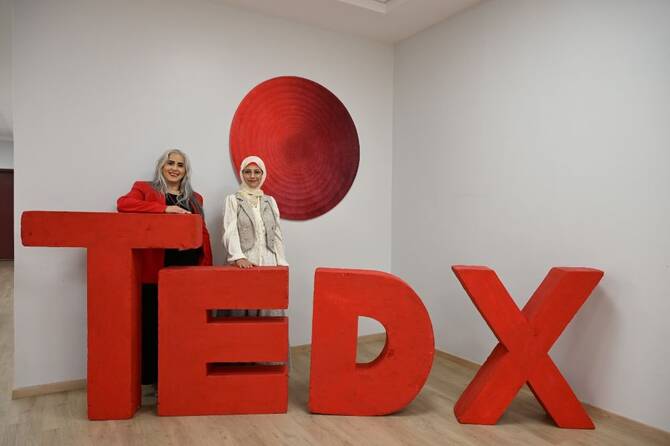
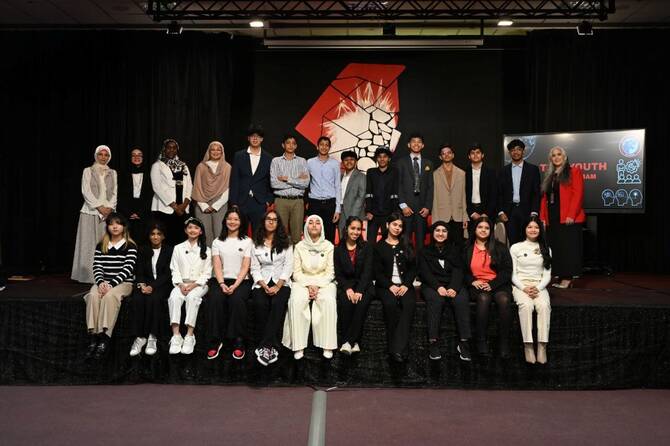

DAMMAM: The ISG Dammam hosted its second TEDxYouth event on Wednesday, featuring 17 young speakers who shared ideas that challenged assumptions, explored identity, and offered fresh perspectives on the world.
Held under the vibrant red banner of Technology, Entertainment, and Design — the popular YouTube TED talks — the “x” indicates the event is independently organized while following TED’s strict guidelines.
This year’s theme, “Beyond the Surface: seeing deeper, choosing better, dreaming together, living fully,” invited students to reflect on life and imagine new possibilities.
English teacher Nadia Iqbal, who organized the event, said: “Our students here represent different voices. Some have prior experience, while many — around 12 speakers — are new to this big TEDx stage.
“I wanted those ideas to come forth on the TEDx stage because I believe in them. Life is not full of victories and failures; there’s something in between — that’s beyond the surface,” Iqbal told Arab News.
Auditions began in late May, followed by summer coaching from Iqbal as students refined and rehearsed their talks. Many repeatedly rewrote drafts to make their speeches accurate, insightful, and engaging.
The event was hosted by students Menaal Shaikh, Bailey Balajadia, Aashna Rao, and Mohammed Hamza, who paired up to provide context and humor between talks.
Students explored topics of growth, resilience, and how young people interpret the world. Each brought a distinct outlook, blending personal reflections, facts, and data, creating a program that moved swiftly while leaving room for reflection.
Omar Hamdan opened the talks, examining the idea of “falling forward” and how setbacks can propel progress.
Raima Abu Bakar addressed the harm of stereotypes, or as she put it, “mental shortcuts” or cognitive heuristics, aiming to foster open-mindedness.
Senior Ayan Khan described attention as a new kind of currency. “You are not using the app, the app is using you,” he said. “Attention is how you choose what matters. Your mind is your most valuable real estate.
“I believe we’re in a different world; we’re not paying with dollars anymore. We are paying with clicks, likes, and screen time,” he told Arab News.
“This has been a really interesting journey for me — from never being on stage to giving a TED talk in front of many people and adults. It’s been tough, it’s been fun.”
He credited Iqbal, his sixth-grade teacher, for encouraging him to join, and watching the inaugural TEDx Dammam talk on YouTube, when his friend Ahmed Faraz — then a senior and now an engineering freshman — took the stage.
“Ahmed first introduced me to TED Talks in our school. I thought, this is such a cool idea. I also thought, when else will I get to give a TEDx talk? I was really glad I could take part in this,” Khan told Arab News.
Planning to be a mechanical engineer, Khan also aspires to continue as a motivational speaker. “I really want to continue my life like this — I love talking to people; I believe it’s the best way a human can connect to another human. I want to keep inspiring, sharing my perspective, and helping others.”
Bayan Omran offered a powerful reflection on existence and visibility.
“Hi, my name is Bayan, and I’m in 9th grade,” she said.
“Today, I want to talk about existence — not in an abstract way, but in a real, tangible experience of being black in a world that doesn’t always see us as whole,” she told the audience to loud applause.
Several speakers addressed youth challenges and strong emotions.
Eleven-year-old Sofia Aniversario reflected on feeling “stuck in the middle,” literally and metaphorically, during her transition from elementary to middle school.
“I feel a bit overwhelmed being the youngest speaker, but I’m proud of myself,” she told Arab News. “I joined TEDx because I was inspired by my sister’s talk last year. She’s my role model and will speak in a few minutes.”
Her older sister, Izabela Aquino Aniversario — who spoke at last year’s inaugural TEDx — compared life to a marathon, not a sprint. Sofia captured her sister’s talk on her phone.
The sessions were live-streamed on YouTube via the TEDx channel.
Farida Ghadiry highlighted the impact of small “micro-moments,” like a smile, a hug, or the feeling of the sun on your skin.
Mohid Alam discussed how disrupting the body’s natural circadian rhythm affects overall well-being. “We eat, work, eat, work, eat, relax, eat, eat,” the screen beside him emphasized.
Hayeon Jang examined how, even in a diverse international school, longstanding racist attitudes were shaped more by environment than by individual children.
Dhruva Prasanth returned to the TEDx stage, questioning traditional definitions of success. “Failure isn’t the end — it’s the plot twist,” he said.
After a lunch and prayer break, the program shifted to topics on innovation and modern challenges.
Ali Baseer Awan presented research on harvesting water from air — a potential solution for water-scarce regions. Ann Thomas highlighted the dangers of staying silent in the face of harm, while Hala Khaled Aboueita explored “deepfakes” and their impact on digital trust and safety.
Other talks reflected on perseverance and purpose. Ahmad Hamdan, a swimmer and Omar’s twin brother, delivered “The Empty Lane,” a metaphor for self-driven endurance.
“Even if you never swam a lap in your life,” his talk resonated with anyone who works long hours or hones a skill when no one is watching.
Usayd Shahid explored ikigai, inspired by the 2017 bestseller “IKIGAI: The Japanese Secret to a Long and Happy Life” by Hector Garcia and Francesc Miralles, highlighting the concept of finding purpose at the intersection of passion, skill, need, and reward.
Ayesha Asher, a host last year, explained the neuroscience behind overthinking, while Gen Grason Kitaoka, also a previous host, closed the day with a humorous take on coping with anxiety and embarrassment.
The event concluded with remarks from Muna Brookshire, Iqbal’s co-captain on the project. “Most of all, I want to thank the parents. Thank you for being your kids’ supporters, the biggest encouragers behind them, allowing them time, patience, and just being there for them,” she said.


