

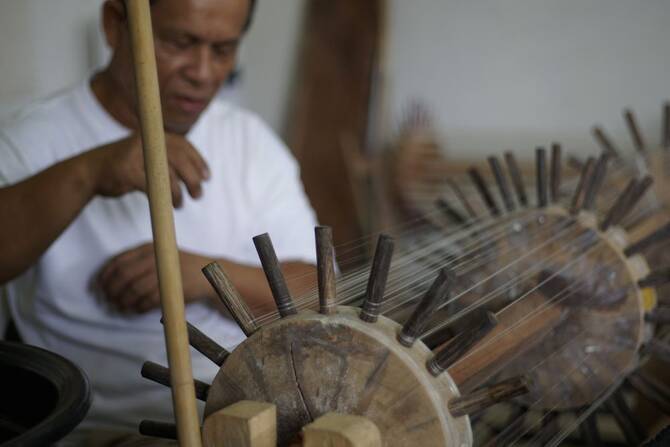

MANILA: Growing up in a family of pineapple farmers and weavers, Carlo Eliserio began his journey with pina when he was 6 years old, marking the beginning of a lifelong mission to preserve the Philippine heritage.
Pina, a lightweight, handwoven textile made from the fine fibers of pineapple leaves, was at the heart of the community of artisans, which included his mother, in the western town of Balete Aklan, where Eliserio first learned the intricacies of pina weaving and natural fiber processing.
“From a young age, I was deeply immersed in the delicate art of transforming pineapple fibers into exquisite textiles, absorbing the patience, skills, and passion that define our craft,” Eliserio said during a recent public lecture in Manila.
“Now at age 29, I have devoted nearly my entire life to preserving and advancing this precious heritage — one that remains at the very heart of our cultural identity.”
In Tagalog, pina refers to the traditional Philippine fiber made from the long leaves of pineapple plants.
Extracting the fabric involves hand scraping the pineapple leaves before they are washed, dried and spun into threads. It is a days-long, labor-intensive process that requires special skills that Eliserio said are passed down through generations.
“Pina fibers are known for their strength, liveness, and natural translucency, which contribute to the fabric’s distinctive texture and appearance,” Eliserio said.
“More than just a fabric, pina is a symbol of elegance, tradition, and social prestige. Worn during important ceremonies and formal occasions, pina garments represent centuries of craftsmanship, cultural identity in a clan. Each piece tells a story of dedication, patience, and artistry, making pina a treasured heirloom and a testament to Filipino heritage.”
The production of pina fabric began in the 16th century, but the light and airy textile that suited tropical climates enjoyed its golden age later, from the late 18th to the 19th century, a period when it was highly coveted in Europe and considered a worthy gift to give to royalty.
In the Philippines, pina became part and parcel of the national identity as it was made into traditional male garments called barong tagalog and women’s Maria Clara ensembles, but also table linens, handkerchiefs and shoulder scarfs.

Barong tagalog, the Philippine traditional formal wear for men, made from pina fabric as displayed during an exhibition in Paris, in 2024. (Facebook)
Today, pina is one of the most used fabrics in the Philippines. In 2023, the pina handweaving tradition from Aklan was recognized on the UNESCO Intangible Cultural Heritage List.
“A source of pride and a strong identity marker, the pina is the most highly regarded of the traditional textiles of the Philippines,” the UN body said.
Because different indigenous groups in the Philippines are each known for their distinct textile traditions that are used as a way to display ethnic identity, the origins of pina lend it a unique place in Philippine society, one that “ties Filipinos together” as formal wear, said Rambie Lim, a founding member of the HABI Philippine Textile Council.
“Textiles in general are really about identity, especially traditional textiles. So pina is, I think, they probably say it’s the ‘queen of Philippine textiles’ because it’s also the one that brings the Filipinos together,” she told Arab News.
“Because even if you’re from Maguindanao or if you’re from Ifugao or if you’re from Batangas, you can still wear pina.”
Through HABI’s programs, competitions, and collaborations, Lim and other Filipino textile advocates have helped bridge traditional weaving with contemporary design, ensuring that pina continues to inspire artisans and fashion innovators.
“Each strand of pina carries the touch of an artisan’s hand,” Lim said. “It’s delicate, but it endures — just like our culture.”


