LONDON: Israel is entering a “new and dangerous phase” to cement its hold over occupied East Jerusalem, using sweeping legal and bureaucratic measures to reshape the Sheikh Jarrah neighborhood and expand settlements, an Israeli nonprofit said in a new report.
The report, released in late October by human rights group Ir Amim, says the Israeli government is promoting two major housing projects under the guise of urban renewal.
Together, they would see about 2,000 Israeli families settled in Sheikh Jarrah, a neighborhood long emblematic of Palestinian identity.
According to the report, the plans would displace all Palestinians in the western section, a key Palestinian area known as the Western Neighborhood or Umm Haroun.
This push, Ir Amim notes, forms part of a wider set of state actions reshaping control over one of East Jerusalem’s most contested areas.

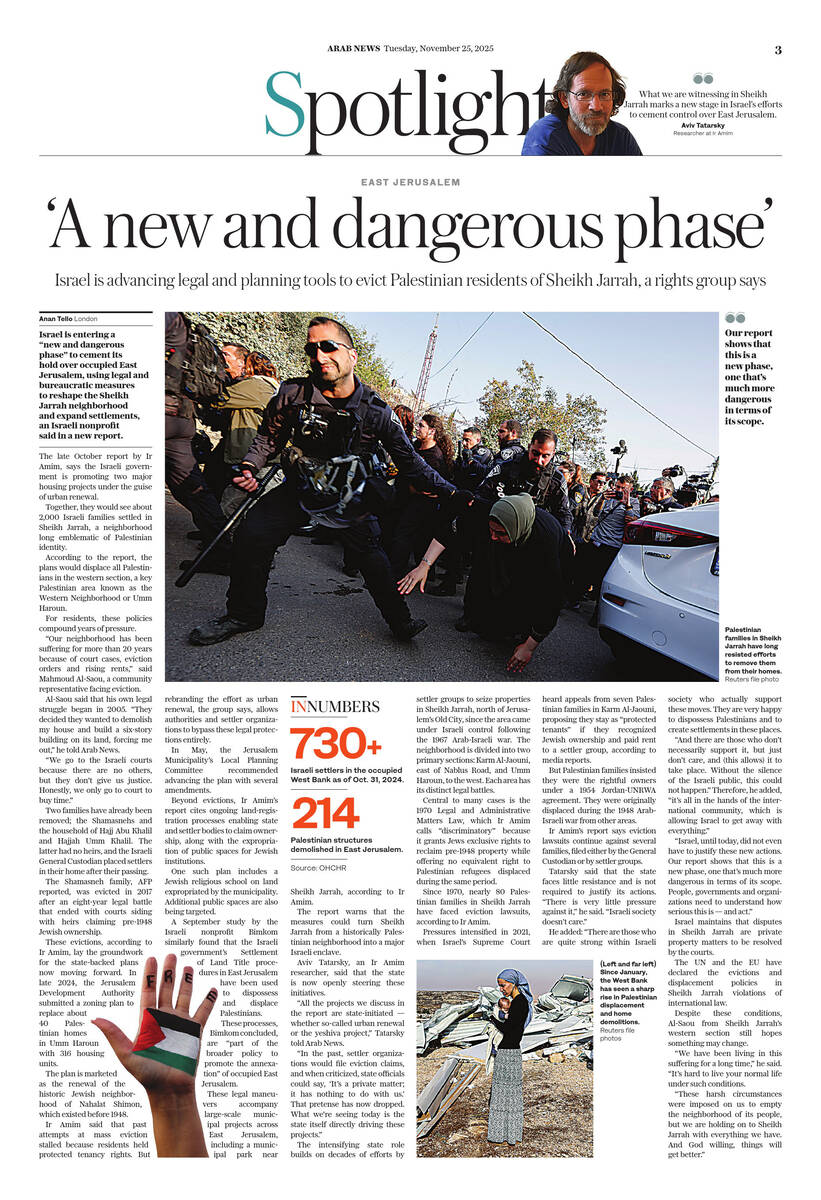
Israeli security forces clash with left-wing peace activists during a demonstration against the eviction of Palestinians from their homes in the Sheikh Jarrah neighbourhood of Israeli-annexed east Jerusalem, on September 8, 2023. (AFP)
For residents, these policies compound years of pressure.
“Our neighborhood has been suffering for more than 20 years because of court cases, eviction orders and rising rents,” said Mahmoud Al-Saou, a community representative facing eviction. “All of this is being done to force the residents out.”
Al-Saou said that his own legal struggle began in 2005. “They decided they wanted to demolish my house and build a six-story building on its land, forcing me out,” he told Arab News.
“We go to the Israeli courts because there are no others, but they don’t give us justice. Honestly, we only go to court to buy time.”
That uncertainty, he said, has become a constant burden. “Imagine living in your home and constantly being threatened that at any moment, you might be forced to leave, with nowhere to go.”
His family has lived in their Umm Haroun home since 1963. “I was born here, my children were born here, and all our memories are in Sheikh Jarrah,” he said. “We can’t imagine handing our homes over to settlers.”

Israel's parliament member Ofer Cassif lifts a Palestinian flag during a demonstration against the eviction of Palestinians from their homes in the Sheikh Jarrah neighbourhood of Israeli-annexed east Jerusalem, on September 8, 2023. (AFP)
According to Al-Saou, settler groups have already seized several plots, turning empty land into parking lots to strengthen future claims. “They want to build settlement units, shopping centers, malls and playgrounds — all through land seizure,” he said.
Two families have already been removed; the Shamasnehs and the household of Hajj Abu Khalil and Hajjah Umm Khalil. The latter had no heirs, and the Israeli General Custodian placed settlers in their home after their passing.
“We tried so hard to take over that house legally, but we couldn’t,” Al-Saou said. “The neighborhood desperately needs housing for its own families.”
The Shamasneh family, AFP reported, was evicted in 2017 after an eight-year legal battle that ended with courts siding with heirs claiming pre-1948 Jewish ownership. Ir Amim’s report confirms that the second household had no heirs and was seized by the state.
These evictions, the report shows, lay the groundwork for the state-backed plans now moving forward. In late 2024, the Jerusalem Development Authority submitted a zoning plan to replace about 40 Palestinian homes in Umm Haroun with 316 housing units.
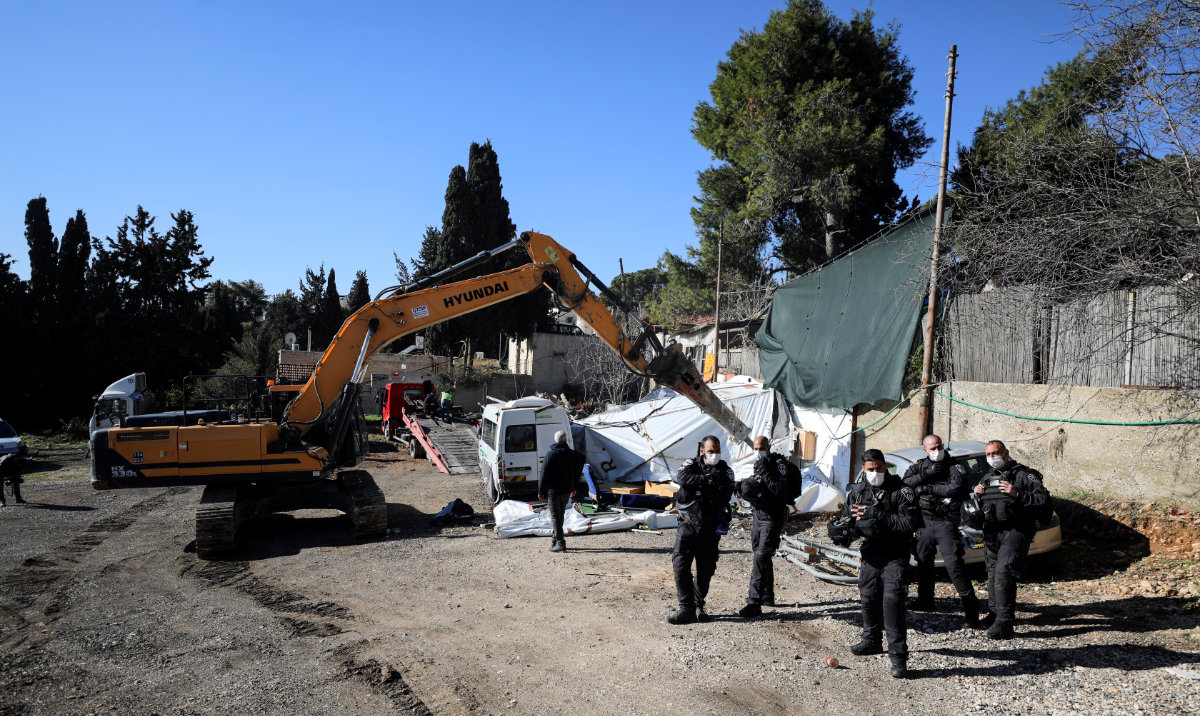
Israeli police stand guard during the demolition of structures outside the home of a Palestinian family facing eviction in East Jerusalem January 17, 2022. (Reuters)
The plan is marketed as the renewal of the historic Jewish neighborhood of Nahalat Shimon, which existed before 1948.
The authority, jointly owned by the Ministry of Jerusalem Affairs and the Jerusalem Municipality, is responsible for carrying out government development initiatives.
Ir Amim said that past attempts at mass eviction stalled because residents held protected tenancy rights. But rebranding the effort as urban renewal, the group says, allows authorities and settler organizations to bypass these legal protections entirely.
In May, the Jerusalem Municipality’s Local Planning Committee recommended advancing the plan with several amendments.
Pressure is also mounting in the Eastern Neighborhood, or Karm Al-Jaouni, where several families — including the Hanouns, Al-Kurds and Al-Ghaouis — have already been evicted.
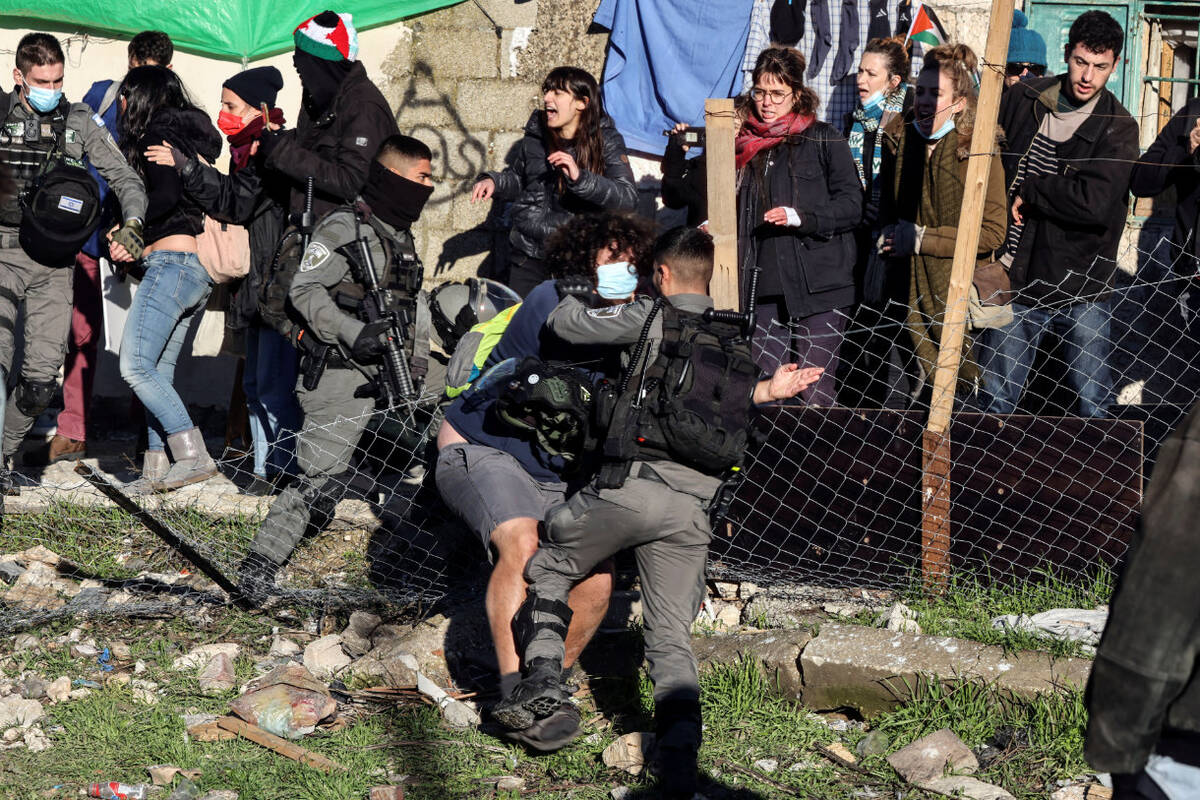
Pro-Palestinian protesters clash with Israeli police around the area of a house that was evacuated and destroyed by Israeli authorities earlier this week in Sheikh Jarrah, east Jerusalem January 21, 2022. (Reuters)
“They were evicted years ago,” Al-Saou said. “And the court cases continue in the eastern section.”
Beyond evictions, Ir Amim’s report cites ongoing land-registration processes enabling state and settler bodies to claim ownership, along with the expropriation of public spaces for Jewish institutions.
One such plan includes a yeshiva — a Jewish religious school and dormitory — on land expropriated by the municipality. Additional public spaces are also being targeted, further tightening Israel’s grip on the area.
A September study by the Israeli nonprofit Bimkom similarly found that the Israeli government’s Settlement of Land Title procedures in East Jerusalem have been used to dispossess and displace Palestinians.
The group argues that the legal framework structurally disadvantages Palestinian landowners seeking to prove and formalize ownership. These processes, Bimkom concluded, are “part of the broader policy to promote the annexation” of occupied East Jerusalem.

Palestinian and pro-Palestine activists take part in a protest at Jerusalem's Sheikh Jarrah neighbourhood January 13, 2023. (Reuters)
These legal maneuvers accompany large-scale municipal projects across East Jerusalem, including a business complex in Wadi Joz and a planned municipal park near Sheikh Jarrah, according to Ir Amim.
While city officials say the projects will improve services for Palestinian residents, Ir Amim argues they will instead entrench Israeli control over Sheikh Jarrah and the Old City Basin, accelerating Palestinian displacement.
Together, the report notes, these actions form a coordinated strategy of demographic transformation.
Titled “A Stranglehold on Sheikh Jarrah: New Tools for Israeli Takeover and Palestinian Displacement,” the report warns that the measures could turn Sheikh Jarrah from a historically Palestinian neighborhood into a major Israeli enclave, severing the heart of Palestinian Jerusalem from surrounding neighborhoods.
Aviv Tatarsky, an Ir Amim researcher, said that the state is now openly steering these initiatives.
INNUMBERS:
• 730k+ Israeli settlers in the occupied West Bank as of Oct. 31, 2024.
• 214 Palestinian structures demolished in East Jerusalem.
• 217 Palestinian households with eviction cases filed in Israeli courts.
(Source: OHCHR)
“All the projects we discuss in the report are state-initiated — whether so-called urban renewal or the yeshiva project,” Tatarsky told Arab News. “Even though the yeshiva is supposedly a religious organization’s initiative, the land was allocated by the Israel Land Authority and the municipality.
“In the past, settler organizations would file eviction claims, and when criticized, state officials could say, ‘It’s a private matter; it has nothing to do with us.’ That pretense has now dropped. What we’re seeing today is the state itself directly driving these projects.”
The intensifying state role builds on decades of efforts by settler groups to seize properties in Sheikh Jarrah, north of Jerusalem’s Old City, since the area came under Israeli control following the 1967 Arab-Israeli war.
The neighborhood is divided into two primary sections: Karm Al-Jaouni, east of Nablus Road, and Umm Haroun, to the west. Each area has its distinct legal battles, community composition and historical land claims.
Central to many cases is the 1970 Legal and Administrative Matters Law, which Ir Amim calls “discriminatory” because it grants Jews exclusive rights to reclaim pre-1948 property while offering no equivalent right to Palestinian refugees displaced during the same period.
Since 1970, nearly 80 Palestinian families in Sheikh Jarrah have faced eviction lawsuits, according to Ir Amim.

A burned Palestinian vehicle after Israeli settlers attacked olive pickers in the village of Beita, according to Palestinian media, in the Israeli-occupied West Bank, October 10, 2025. (Reuters)
Pressures intensified in 2021, when Israel’s Supreme Court considered appeals from seven Palestinian families in Karm Al-Jaouni. The court proposed allowing the families to remain as “protected tenants” if they acknowledged Jewish ownership and paid rent to a settler organization, according to media reports.
But Palestinian families insisted they were the rightful owners under a 1954 Jordan-UNRWA agreement. They were originally displaced during the 1948 Arab-Israeli war from areas including Haifa and Jaffa.
Amid protests in August 2021, the Israeli government declined to intervene in the cases. The Foreign Ministry insisted Sheikh Jarrah was a “private real estate dispute” that had been turned into an international anti-Israel issue, The Times of Israel reported then.
Jordanian civil law Article 395, along with the 1950s resettlement agreements with UNRWA, affirms Palestinian families’ claims, according to the Beirut-based Institute for Palestine Studies.
But Israel’s 1950 Absentee Property Law and 1972 Tenant Protection Law have enabled authorities to transfer refugee property to state or settler control.

An Israeli settler gestures as he argues with a Palestinian farmer (not pictured), during olive harvesting in Silwad, near Ramallah, in the Israeli-occupied West Bank, October 29, 2025. (Reuters)
Ir Amim’s report says eviction lawsuits continue against several families, filed either by the General Custodian — a department within the Israeli Justice Ministry — or by settler groups. The General Custodian oversees assets allegedly owned by Jews before 1948.
Tatarsky said that the state faces little resistance and is not required to justify its actions. “There is very little pressure against it,” he said. “Israeli society doesn’t care.”
He added: “There are those who are quite strong within Israeli society who actually support these moves. They are very happy to dispossess Palestinians and to create settlements in these places.
“And there are those who don’t necessarily support it, but just don’t care, and (this allows) it to take place. Without the silence of the Israeli public, this could not happen.”
Therefore, he added, “it’s all in the hands of the international community, which is allowing Israel to get away with everything,” including “the destruction of Gaza, the terrible nationalistic Jewish (radicalism) in the West Bank, and dispossessing Palestinians in East Jerusalem.
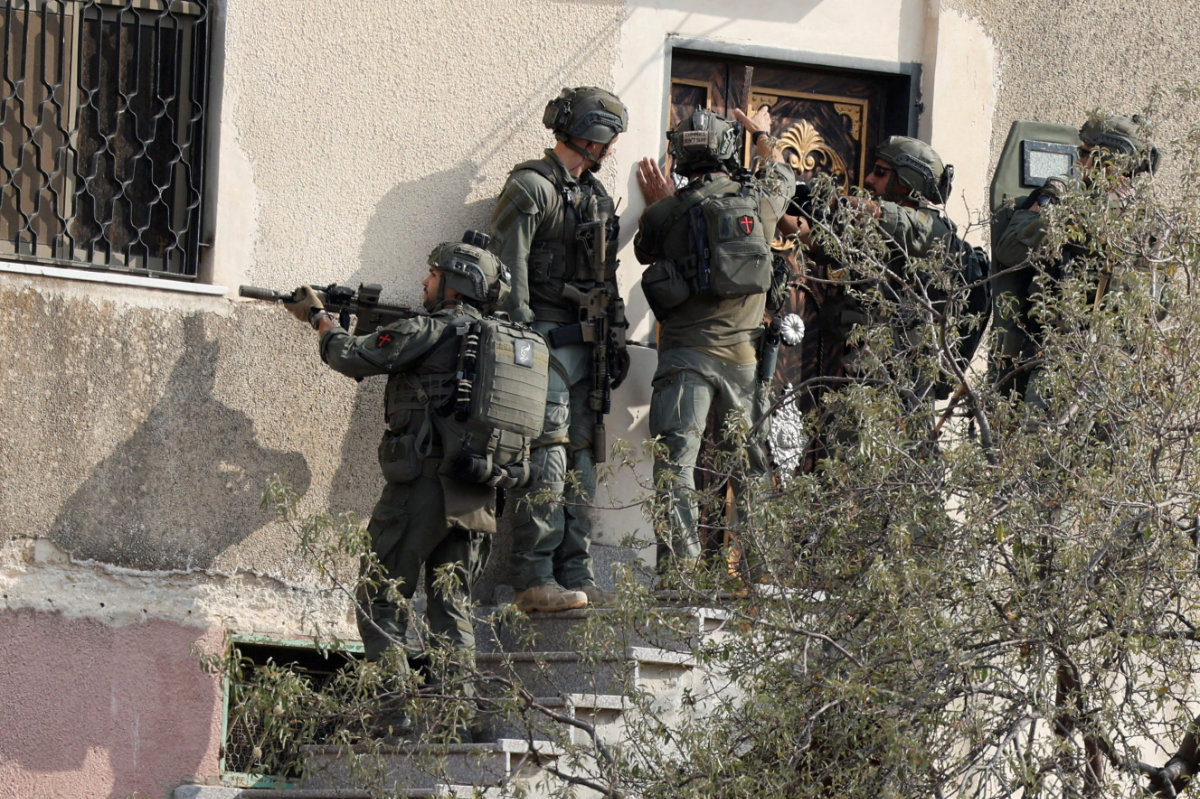
Soldiers operate during an Israeli raid in Tammun near Tubas in the Israeli-occupied West Bank, November 4, 2025. (Reuters)
“Israel, until today, did not even have to justify these new actions. Our report shows that this is a new phase, one that’s much more dangerous in terms of its scope. People, governments and organizations need to understand how serious this is — and act.”
Israel maintains that disputes in Sheikh Jarrah are private property matters to be resolved by the courts.
The UN and the EU have declared the evictions and displacement policies in Sheikh Jarrah violations of international law, including Article 49 of the Fourth Geneva Convention, which prohibits forcible transfers in occupied territory.
In July 2024, the International Court of Justice issued a landmark opinion declaring Israel’s occupation of Palestinian territory illegal and calling for the evacuation of all settlements in the West Bank and East Jerusalem.
Still, international action has largely been limited to calls for accountability, documentation of abuses, diplomatic condemnation and support for Palestinian legal challenges.

Reuters journalist Raneen Sawafta is moved by medics following an Israeli settlers attack, near Nablus, in the Israeli-occupied West Bank, November 8, 2025. (Reuters)
Meanwhile, since the Oct. 7, 2023, Hamas-led attack triggered Israel’s retaliatory war in Gaza, a parallel escalation has unfolded in the occupied West Bank, including East Jerusalem.
By October this year, more than 1,000 Palestinians had been killed by Israeli forces and settlers in the West Bank, one in five of them children, according to UN figures.
The number represents 43 percent of all Palestinians killed in the West Bank over the past two decades and excludes those who died in Israeli detention during the same period.
Since Oct. 7, 2023, 59 Israelis have been killed in Palestinian attacks or armed clashes in the West Bank and Israel, including 16 women and five children. Twenty-two were members of Israeli security forces.
The UN Human Rights Office in the Occupied Palestinian Territory attributes the high Palestinian death toll to what it describes as systematic, unlawful and disproportionate use of lethal force by Israeli security forces, including live fire, airstrikes and shoulder-fired missiles, “with evident disregard for Palestinians’ right to life, including children.”

Achinoam holds her baby after her house was destroyed as Tzur Misgavi, an unauthorized Israeli settler outpost, is dismantled by Israeli security forces, in the Israeli-occupied West Bank, November 17, 2025. (Reuters)
During the same period, more than 38,450 Palestinians across the West Bank have been displaced, according to UNRWA, with home demolitions a key driver. About 75 percent of them were forced to flee during large-scale Israeli military raids in the northern West Bank.
Despite these conditions, Al-Saou from Sheikh Jarrah’s western section still hopes something may change.
“We have been living in this suffering for a long time,” he said. “It’s hard to live your normal life under such conditions.
“These harsh circumstances were imposed on us to empty the neighborhood of its people, but we are holding on to Sheikh Jarrah with everything we have. And God willing, things will get better.”