


Saudi Arabia leads outcome-based education to prepare future-ready generations: Harvard Business Review

Saudi students sit for their final high school exams in the Red Sea port city of Jeddah. (File/AFP)
Short Url
Updated 11 February 2026
Follow

Saudi Arabia leads outcome-based education to prepare future-ready generations: Harvard Business Review

  • The transformation is being adopted and spearheaded by institutions such as Al-Nobala Private Schools

RIYADH: Saudi Arabia’s education system is undergoing a sweeping transformation aligned with Vision 2030, shifting from traditional, input-focused methods to outcome-based education designed to equip students with future-ready skills, Harvard Business Review Arabic reported.

The transformation is being adopted and spearheaded by institutions such as Al-Nobala Private Schools, which introduced the Kingdom’s first national “learning outcomes framework,” aimed at preparing a generation of leaders and innovators for an AI-driven future, the report said.

Al-Nobala Private Schools has leveraged international expertise to localize advanced learning methodologies.

The Riyadh-based school group developed a strategy that links every classroom activity to measurable student competencies, aiming to graduate learners equipped for the digital economy and real-world contexts. The school’s group approach combines traditional values with 21st-century skills such as critical thinking, communication, innovation and digital fluency.

According to the report, the shift addresses the growing gap between outdated models built for low-tech, resource-constrained environments and today’s dynamic world, where learners must navigate real-time information, virtual platforms, and smart technologies.

“This is not just about teaching content, it’s about creating impact,” the report noted, citing how Al-Nobala Private Schools’ model prepares students to thrive in an AI-driven world while aligning with national priorities.

The report noted that Saudi Arabia’s Ministry of Education has paved the way for this shift by transitioning from a centralized controller to a strategic enabler, allowing schools such as Al-Nobala Private Schools to tailor their curriculum to meet evolving market and societal needs. This is part of the long-term goal to place the Kingdom among the top 20 global education systems.

Al-Nobala Private Schools’ work, the report stated, has succeeded in serving the broader national effort to link education outcomes directly to labor market demands, helping to fulfill the Vision 2030 pillar of building a vibrant society with a thriving economy driven by knowledge and innovation.

Last February, Yousef bin Abdullah Al-Benyan, Saudi Arabia’s minister of education, said that the Kingdom was making “an unprecedented investment in education,” with spending aligned to the needs of growth and development. He said that in 2025, education received the second-largest share of the state budget, totaling $53.5 billion.
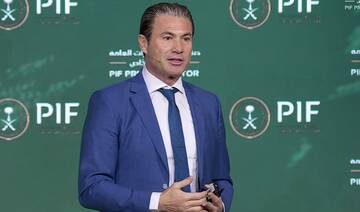

PIF’s Humain invests $3bn in Elon Musk’s xAI prior to SpaceX acquisition

Updated 18 February 2026
Follow

PIF’s Humain invests $3bn in Elon Musk’s xAI prior to SpaceX acquisition

JEDDAH: Humain, an artificial intelligence company owned by Saudi Arabia’s Public Investment Fund, invested $3 billion in Elon Musk’s xAI shortly before the startup was acquired by SpaceX.

As part of xAI’s Series E round, Humain acquired a significant minority stake in the company, which was subsequently converted into shares of SpaceX, according to a press release.

The transaction reflects PIF’s broader push to position Saudi Arabia as a central hub in the global AI ecosystem, as part of its Vision 2030 diversification strategy.

Through Humain, the fund is seeking to combine capital deployment with infrastructure buildout, partnerships with leading technology firms, and domestic capacity development to reduce reliance on oil revenues and expand into advanced industries.

The $3 billion commitment offers potential for long-term capital gains while reinforcing the company’s role as a strategic, scaled investor in transformative technologies.

CEO Tareq Amin said: “This investment reflects Humain’s conviction in transformational AI and our ability to deploy meaningful capital behind exceptional opportunities where long-term vision, technical excellence, and execution converge, xAI’s trajectory, further strengthened by its acquisition by SpaceX, one of the largest technology mergers on record, represents the kind of high-impact platform we seek to support with significant capital.” 

The deal builds on a large-scale collaboration announced in November at the US-Saudi Investment Forum, where Humain and xAI committed to developing over 500 megawatts of next-generation AI data center and computing infrastructure, alongside deploying xAI’s “Grok” models in the Kingdom.

In a post on his X handle, Amin said: “I’m proud to share that Humain has invested $3 billion into xAI’s Series E round, just prior to its historic acquisition by SpaceX. Through this transaction, Humain became a significant minority shareholder in xAI.”

He added: “The investment builds on our previously announced 500MW AI infrastructure partnership with xAI in Saudi Arabia, reinforcing Humain’s role as both a strategic development partner and a scaled global investor in frontier AI.”

He noted that xAI’s trajectory, further strengthened by SpaceX’s acquisition, exemplifies the high-impact platforms Humain aims to support through strategic investments.

Earlier in February, SpaceX completed the acquisition of xAI, reflecting Elon Musk’s strategy to integrate AI with space exploration.

The combined entity, valued at $1.25 trillion, aims to build a vertically integrated innovation ecosystem spanning AI, space launch technology, and satellite internet, as well as direct-to-device communications and real-time information platforms, according to Bloomberg.

Humain, founded in August, consolidates Saudi Arabia’s AI initiatives under a single entity. From the outset, its vision has extended beyond domestic markets, participating across the global AI value chain from infrastructure to applications.

The company represents a strategic initiative by PIF to diversify the Kingdom’s economy and reduce oil dependence by investing in knowledge-based and advanced technologies.