Gavi, UNICEF sign deal to cut malaria vaccine price  

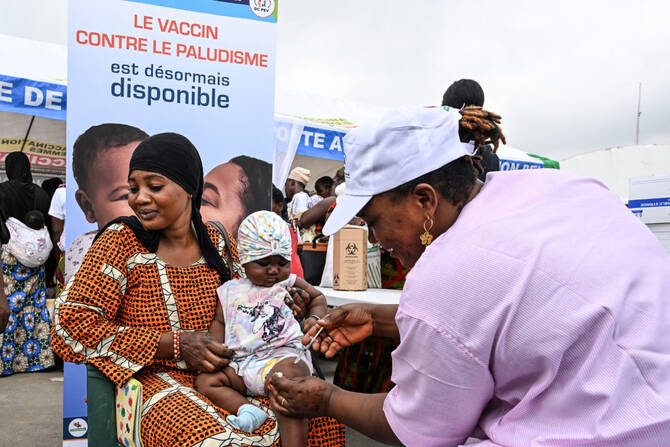
A health worker vaccinates a baby against malaria during the launch of the vaccination campaign for children from zero to 23 months at La Marie d'Abobo, a popular commune in Abidjan on July 15, 2024. (AFP)
Short Url
Updated 24 November 2025
Follow

Gavi, UNICEF sign deal to cut malaria vaccine price  

  • Deal to reduce the cost of the R21 vaccine, made by the Serum Institute of India, to $2.99 a dose from around $4
  • Babies require four doses of the vaccine to be fully protected against malaria. That means a full course of R21 will cost $11.96

LONDON: Global vaccine alliance Gavi and its partner UNICEF will pay 25 percent less for a new malaria vaccine made by the Serum Institute of India within roughly a year’s time, allowing them to reach more children despite cuts in international aid.
The deal will reduce the cost of the R21 vaccine to $2.99 a dose from around $4. Unicef buys the vaccines with funding from Gavi, a partnership that works with governments to immunize children in the world’s poorest countries.
Gavi estimates the price drop will save $90 million, which can fund 30 million more doses for up to 7 million more children over the next five years.
Gavi raised $3 billion less than its target at a fundraising event earlier this year as international donors, led by the United States, focused on other priorities.
“At this critical juncture of unprecedented decline in funding for international aid, Unicef is determined to continue our proactive work with partners,” said Leila Pakkala, director of UNICEF’s supply division, in a statement.
Babies require four doses of the vaccine to be fully protected against malaria, which still claims more than 500,000 lives annually, mainly children under 5 years old in sub-Saharan Africa. That means a full course of R21 will cost $11.96.
Treating a case of uncomplicated malaria in sub-Saharan Africa costs $4 to $7 per outpatient visit, while severe cases requiring hospital care can cost more than $70, according to World Health Organization figures quoted by Gavi.
The other malaria vaccine, made by GSK, is priced at around $10 a dose. Earlier this year, Bharat Biotech and GSK pledged to halve that price when Bharat takes over production in 2028.


Ice-cool Rybakina beats Sabalenka in tense Australian Open final

Updated 5 sec ago
Follow

Ice-cool Rybakina beats Sabalenka in tense Australian Open final

  • The big-serving Kazakh fifth seed held her nerve to pull through 6-4, 4-6, 6-4
  • Rybakina who was born in Moscow, adds her Melbourne triumph to her Wimbledon win in 2022
MELBOURNE: Elena Rybakina took revenge over world number one Aryna Sabalenka to win a nail-biting Australian Open final on Saturday and clinch her second Grand Slam title.
The big-serving Kazakh fifth seed held her nerve to pull through 6-4, 4-6, 6-4 at Rod Laver Arena in Melbourne in 2hrs 18mins.
It was payback after the Belarusian Sabalenka won the 2023 final between two of the hardest hitters in women’s tennis.
The ice-cool Rybakina, 26, who was born in Moscow, adds her Melbourne triumph to her Wimbledon win in 2022.
“Hard to find the words now,” said Rybakina, and then addressed her beaten opponent to add: “I know it is tough, but I hope we play many more finals together.”
Turning to some Kazakh fans in the crowd, she said: “Thank you so much to Kazakhstan. I felt the support from that corner a lot.”
It was more disappointment in a major final for Sabalenka, who won the US Open last year for the second time but lost the French Open and Melbourne title deciders.
She was into her fourth Australian Open final in a row and had been imperious until now, with tears in her eyes at the end.
“Let’s hope maybe next year will be a better year for me,” Sabalenka said ruefully.
Rybakina fights back
With the roof on because of drizzle in Melbourne, Rybakina immediately broke serve and then comfortably held for 2-0.
Rybakina faced two break points at 4-3, but found her range with her serve to send down an ace and dig herself out of trouble, leaving Sabalenka visibly frustrated.
Rybakina looked in the zone and wrapped up the set in 37 minutes on her first set point when Sabalenka fired long.
Incredibly, it was the first set Sabalenka had dropped in 2026.
The second game of the second set was tense, Rybakina saving three break points in a 10-minute arm-wrestle.
They went with serve and the seventh game was another tussle, Sabalenka holding for 4-3 after the best rally of a cagey affair.
The tension ratcheted up and the top seed quickly forged three set points at 5-4 on the Kazakh’s serve, ruthlessly levelling the match at the first chance to force a deciding set.
Sabalenka was now in the ascendancy and smacked a scorching backhand to break for a 2-0 lead, then holding for 3-0.
Rybakina, who also had not dropped a set in reaching the final, looked unusually rattled.
She reset to hold, then wrestled back the break, allowing herself the merest of smiles.
At 3-3 the title threatened to swing either way.
But a surging Rybakina won a fourth game in a row to break for 4-3, then held to put a thrilling victory within sight.
Rybakina sealed the championship with her sixth ace of the match.
The finalists were familiar foes having met 14 times previously, with Sabalenka winning eight of them.
Sabalenka came into the final as favorite but Rybakina has been one of the form players on the women’s tour in recent months.
She also defeated Sabalenka in the decider at the season-ending WTA Finals.
Rybakina beat second seed Iga Swiatek in the quarter-finals and sixth seed Jessica Pegula in the last four in Melbourne.
Rybakina switched to play under the Kazakh flag in 2018 when she was a little-known 19-year-old, citing financial reasons.