PARIS: The US military operation against Venezuelan alleged drug traffickers coupled with threats by Donald Trump for a ground assault against President Nicolas Maduro have troubled European powers who retain strategically located territories in the Caribbean, observers say.
The concern of France, the Netherlands and the UK is such that they have started limiting intelligence sharing with Washington about the Caribbean over worries it could be used for strikes that would be considered illegal in their countries, according to officials and sources who spoke to AFP.
The UK retains small overseas territories in the Caribbean from the colonial era, while the large islands of Martinique and Guadeloupe as well as French Guiana on the South American mainland are now officially part of France.
The Netherlands is the most geographically implicated, with three islands off the coast of Venezuela dubbed the ABC — Aruba, Bonaire and Curacao — all part of the kingdom.
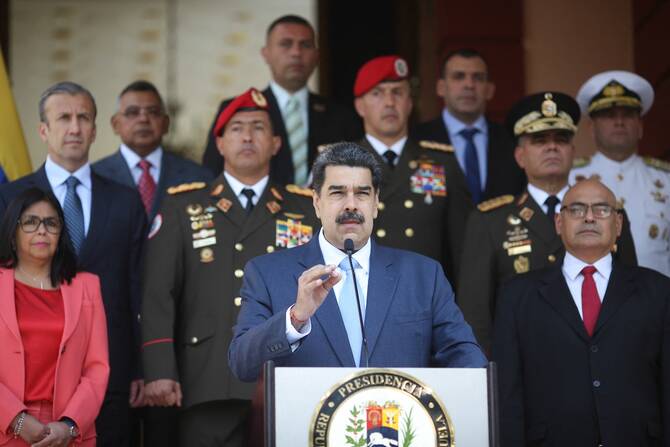
Venezuela has accused Washington of seeking regime change in Caracas with its military build-up, including an aircraft carrier group, warships and several stealth jets.
Washington accuses Maduro of leading a “terrorist” drug cartel, a charge he denies. Since September, US forces have killed at least 83 people via air strikes on boats accused of ferrying drugs in international waters, according to an AFP tally of publicly released figures.
The United States has released no details to back up its claims that the people targeted in both the Caribbean and eastern Pacific in the more than 20 strikes were traffickers.
Trump has said he believes Maduro’s days were numbered and on Monday refused to rule out boots on the ground while adding he was open to talks with the leftist leader.
“The Dutch are concerned about their ABC islands... located about 50 kilometers (31 miles) off the coast of Venezuela,” a French military official said, asking not to be named.
They “would find themselves on the front line” in the event of war, a European military source added, also asking not to be named as they were not authorized to speak on the record.
- ‘Not currently giving intelligence’ -
With few options in the face of Trump’s resolve, these three countries have decided to stop sharing certain intelligence with Washington, multiple sources said.
“We are particularly vigilant regarding the politicization of our services and human rights violations,” Erik Akerboom, director of the Dutch civilian intelligence and counterintelligence service, told the newspaper De Volkskrant.
“No European country, France included, will send operational intelligence to the Americans in the current situation if they could use it as a basis for a military strike on a ship,” a senior French police official, Dimitri Zoulas, head of the OFAST anti-drug service, told Radio Caraibes (RCI).
This position has not been publicly confirmed by French authorities. But a security source said: “It is 100 percent clear that Europeans are not currently giving any intelligence to the United States that could lead to a strike.”
In the UK, the Times reported that attorney general Richard Hermer, the government’s top legal adviser, told ministers to cut off intelligence sharing over fears Trump could “assassinate” drug dealers in the Caribbean.
US Secretary of State Marco Rubio earlier this month dismissed reports the UK had stopped sharing such intelligence as “fake news.”
- ‘Not a fundamental change’ -
Richard Dearlove, former head of the British MI6 foreign intelligence service, told AFP the situation was not unique and avoided Europeans being complicit in an action that was perhaps legal in an American jurisdiction but not in their countries.
“It doesn’t affect the overall intelligence exchange. It’s a local and a specific issue. And it’s occurred before in my experience,” he said.
Europeans are aware of the risk of antagonizing the Trump administration.
“Before saying no to the United States and making it known, we have to think twice, because they provide a lot” of information to their allies, said a source from a European intelligence service.
But the Europeans’ contribution to American intelligence work in the field is very limited, said a former US military officer who worked in counter-narcotics operations in the region.
The Europeans’ restraint has a “theoretical” effect because the United States doesn’t need the information, according to the French security source.
Dearlove insisted that as it is “strictly speaking a legal problem” this should not affect the wider picture of transatlantic intelligence sharing.
“The CIA understands this extremely well. It’s a well known area which is sometimes problematic but it does not indicate a fundamental change in the intelligence relationship,” he said.


![]()
Troubled by US Venezuela operation, Europeans limit intel sharing
Short Url
https://arab.news/4mjsk
Troubled by US Venezuela operation, Europeans limit intel sharing
- The US military operation against Venezuela coupled with threats by Trump have troubled European powers who retain strategically located territories in the Caribbean, observers say

Latest updates





© 2026 SAUDI RESEARCH & PUBLISHING COMPANY, All Rights Reserved And subject to Terms of Use Agreement.